Birds Guide
Goshawk
What Is a Goshawk? The goshawk, Accipiter gentilis, is a powerful, forest-dwelling bird of prey and the largest member of the true hawk genus Accipiter. Often called the northern goshawk, it is renowned among naturalists …
At a glance
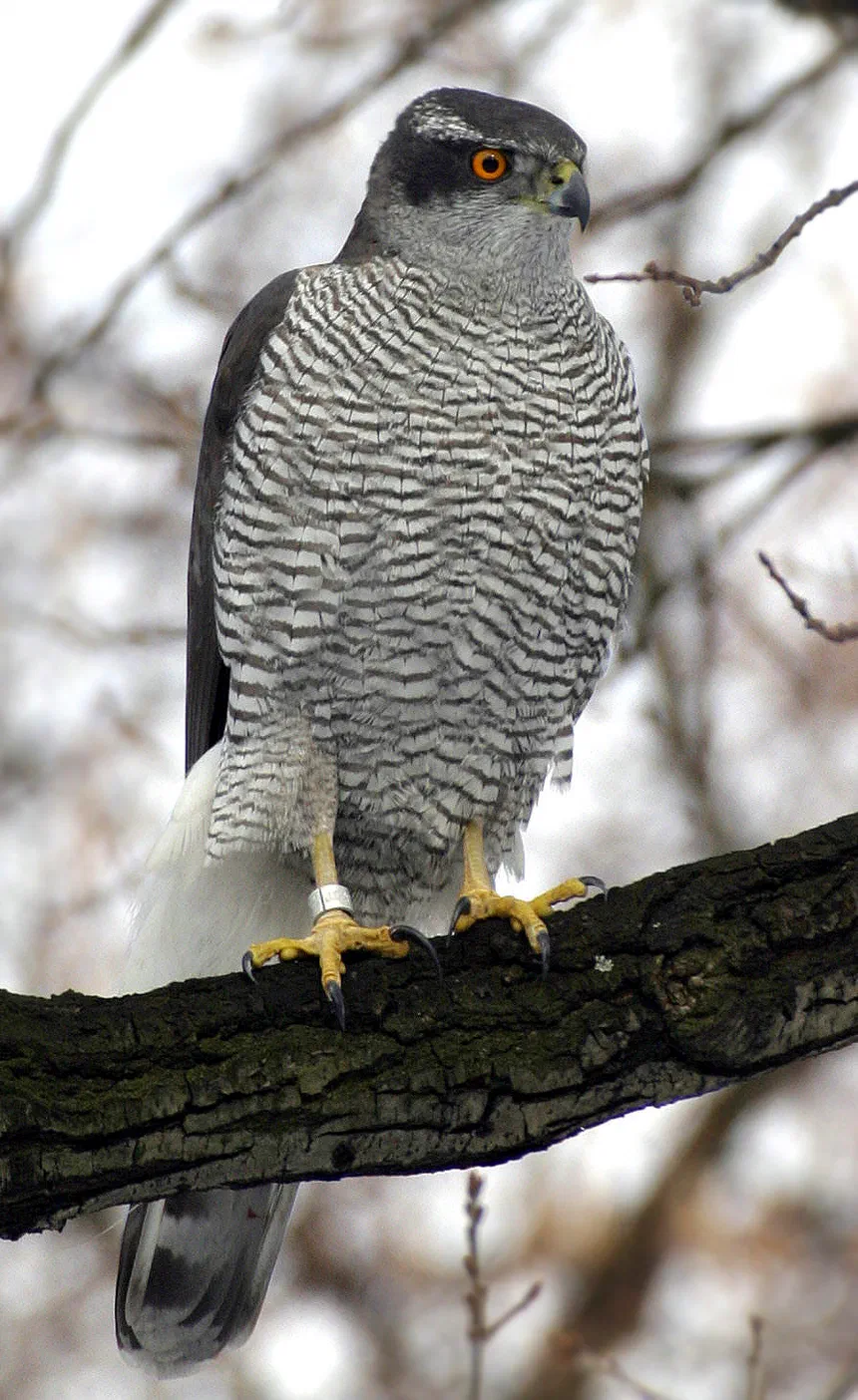
Image: Norbert Kenntner, Berlin — CC BY-SA 3.0 · source
What Is a Goshawk?
The goshawk, Accipiter gentilis, is a powerful, forest-dwelling bird of prey and the largest member of the true hawk genus Accipiter. Often called the northern goshawk, it is renowned among naturalists and falconers for its speed, agility, and fierce hunting drive. It ranges widely across the temperate and boreal forests of the Northern Hemisphere.
Appearance and Identification
Adult goshawks are handsome, robust hawks with broad, rounded wings and a long, banded tail that lends them exceptional maneuverability among trees. The upperparts are slate-gray to blue-gray, while the underparts are pale and finely barred with gray. A striking white eyebrow arches over piercing eyes that are orange to deep red in adults. Juveniles look quite different, showing brown upperparts and buffy, streaked underparts with yellow eyes. As with many raptors, females are noticeably larger and heavier than males, sometimes weighing nearly twice as much.
Habitat and Range
Goshawks favor large tracts of mature forest, including coniferous, deciduous, and mixed woodlands, often near clearings and edges where they can hunt. They occur across North America, Europe, and northern Asia, from lowland woods to mountain forests. Northern populations may move south in winter, especially when prey becomes scarce, while birds in milder regions tend to remain year-round on their territories.
Diet
An accomplished predator, the goshawk hunts a wide variety of birds and mammals. Typical prey includes grouse, pigeons, corvids, thrushes, and other medium-sized birds, along with squirrels, rabbits, hares, and other small mammals. Hunting is usually a matter of surprise: the hawk perches quietly or flies low through cover, then bursts out in a fast, direct chase, using its long tail and short wings to twist through dense branches. Strong feet and sharp talons dispatch prey quickly.
Behavior
Goshawks are secretive and territorial for much of the year, and they can be surprisingly difficult to observe despite their size. They are strong, agile fliers, alternating quick wingbeats with short glides. During the breeding season they become more conspicuous and are famously bold in defending their nests, sometimes diving at intruders, including humans, that stray too close. Their calls include a loud, repeated “kak-kak-kak” given in alarm.
Life Cycle and Reproduction
Pairs are typically monogamous and often reuse a nesting territory across many years. The nest is a large stick platform built high in a sturdy tree, and a pair may maintain several alternate nests within their territory. The female usually lays two to four eggs, which she incubates for roughly a month while the male brings food. After hatching, the young are brooded and fed in the nest for several weeks before fledging, then remain dependent on their parents for a further period as they learn to hunt. Goshawks generally begin breeding at one to two years of age.
Conservation Status
The northern goshawk is currently listed as Least Concern by the IUCN, reflecting its broad range and large overall population. Even so, it depends on extensive mature forest, and local declines have been linked to logging and habitat fragmentation. The species suffered historically from persecution and, in some regions, from pesticide contamination. Today, sustainable forestry that retains large nesting trees and undisturbed woodland is key to keeping populations healthy.
Frequently Asked Questions
How big is a goshawk? It is a large hawk, roughly 18 to 27 inches long with a wingspan of about 38 to 50 inches. Females are distinctly larger than males.
What does a goshawk eat? Goshawks are carnivores that hunt birds such as grouse and pigeons and mammals such as squirrels, rabbits, and hares.
Are goshawks endangered? No. The northern goshawk is listed as Least Concern, though it relies on large areas of mature forest and can decline locally where such habitat is lost.