Birds Guide
Golden Pheasant
What Is a Golden Pheasant? The golden pheasant (Chrysolophus pictus) is a strikingly colorful game bird in the pheasant family, Phasianidae. Native to the mountain forests of central and western China, the male is famous …
At a glance
What Is a Golden Pheasant?
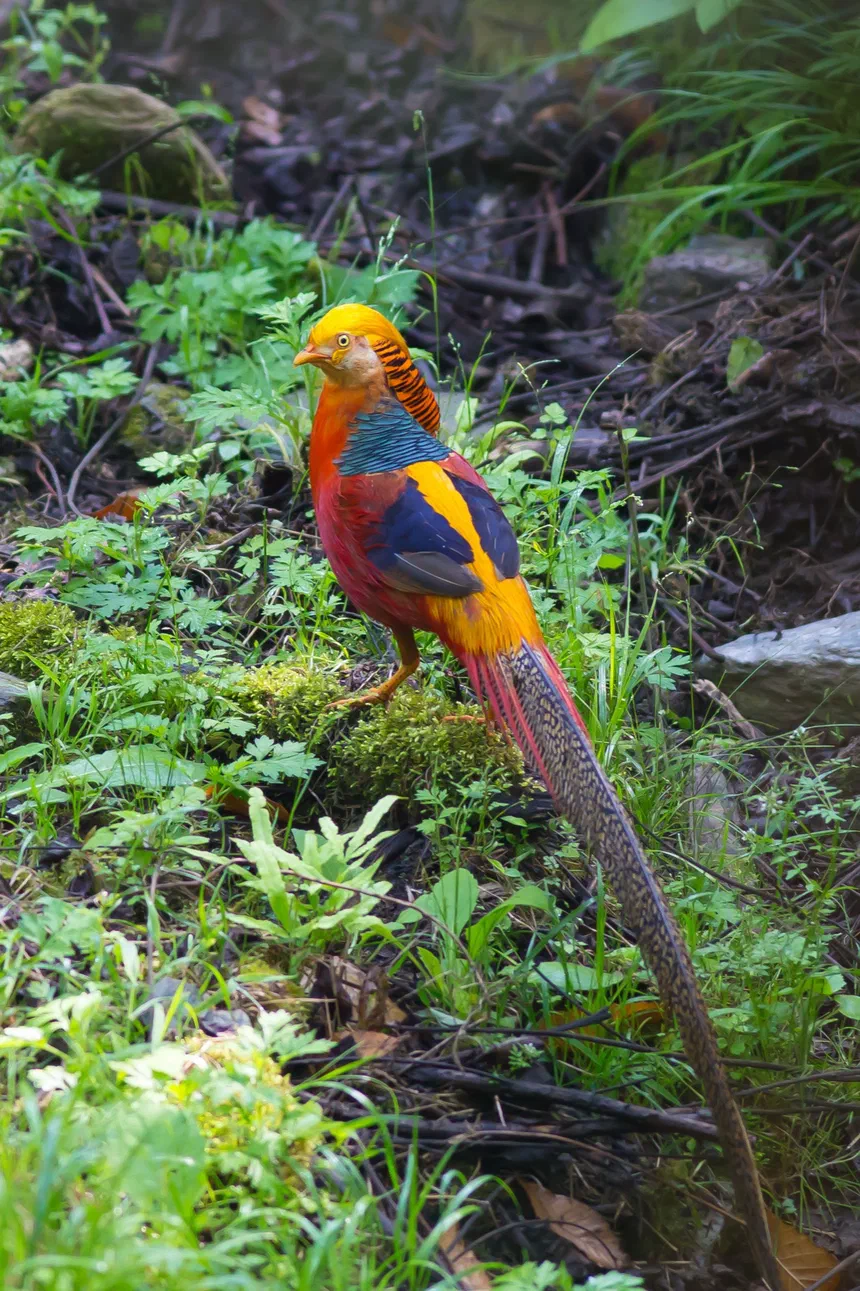
The golden pheasant (Chrysolophus pictus) is a strikingly colorful game bird in the pheasant family, Phasianidae. Native to the mountain forests of central and western China, the male is famous for its dazzling gold, scarlet, and orange plumage, making it one of the most recognizable pheasants in the world. It is sometimes called the “Chinese pheasant” or “rainbow pheasant.”
Appearance and Identification
The golden pheasant shows dramatic differences between the sexes. The adult male is unmistakable, with a silky golden-yellow crest, a bright red underside, and an orange “cape” of feathers across the neck that can be fanned during display. Its back blends golden yellow into deep green and blue, and it sports a very long, finely barred brown tail that makes up more than half of its total length. Males can measure roughly 90-105 cm from head to tail tip.
Females, by contrast, are far more subdued, cloaked in mottled brown and buff barring that provides excellent camouflage on the forest floor. Females are smaller, typically 60-70 cm long, with shorter tails. Both sexes have bright yellow legs and a pale bill. Juveniles resemble females until males begin developing their vivid colors in their first year.
Habitat and Range
Golden pheasants are native to the mountainous forests of central and western China, where they favor dense woodland, bamboo thickets, and scrubby, rocky hillsides. They tend to occupy steep terrain with plenty of ground cover, generally at moderate elevations. Beyond their native range, escaped and released birds have established small feral populations in parts of the United Kingdom and elsewhere, though these tend to be localized and often fluctuate in number.
Diet
The golden pheasant is an omnivore that forages mostly on the ground. Its diet consists largely of plant matter, including seeds, grains, berries, leaves, buds, and shoots. It also eats invertebrates such as insects, spiders, and grubs, which are especially important for growing chicks. Birds typically feed in the early morning and late afternoon, scratching through leaf litter, and roost in trees at night for safety.
Behavior
Despite the male’s brilliant coloring, golden pheasants are shy, secretive birds that are often difficult to observe in the wild. They spend most of their time on the ground and prefer to run into cover rather than fly when startled. Although they are somewhat clumsy fliers, they can produce short, explosive bursts of flight to escape danger or reach a roost. They are generally solitary or found in small groups outside the breeding season. During breeding, males perform an elaborate courtship display, spreading the orange cape sideways across the face and giving sharp calls to attract females.
Life Cycle and Reproduction
Breeding typically takes place in spring. Males are polygynous, often mating with several females within their territory. The female builds a shallow, well-hidden nest on the ground, usually lined with vegetation and concealed under dense cover. She lays a clutch of roughly 8-12 eggs and incubates them alone for about 22-23 days. The chicks are precocial, meaning they are covered in down and able to leave the nest and feed themselves shortly after hatching, though they remain under the female’s care for several weeks. Young males take a full year or more to acquire their full adult plumage. In the wild, golden pheasants generally live around 5-10 years, though individuals in captivity may live longer.
Conservation Status
The golden pheasant is listed as Least Concern by the IUCN, reflecting a wide native range and a stable overall population. It is not considered globally threatened, and it is also very common in captivity, where it is widely kept in aviaries and collections for its ornamental beauty. Localized pressures such as habitat loss and hunting can affect wild populations in parts of China, but these have not raised broad conservation concern.
Frequently Asked Questions
Why is the male golden pheasant so colorful? The male’s brilliant gold, red, and orange plumage evolved through sexual selection: bright, healthy-looking males are more attractive to females, so the vivid colors help them compete for mates.
Can golden pheasants fly? Yes, but only for short distances. They are ground-dwelling birds and prefer to run from danger, using brief bursts of flight mainly to escape predators or reach a nighttime roost.
Where do golden pheasants live in the wild? They are native to the forests and scrubby hillsides of central and western China. Small feral populations, descended from escaped captive birds, also exist in a few other countries.