Birds Guide
Golden Eagle
What Is a Golden Eagle? The golden eagle (Aquila chrysaetos) is a large, powerful bird of prey and one of the most widespread eagles in the Northern Hemisphere. Named for the golden sheen of feathers on its head and …
At a glance
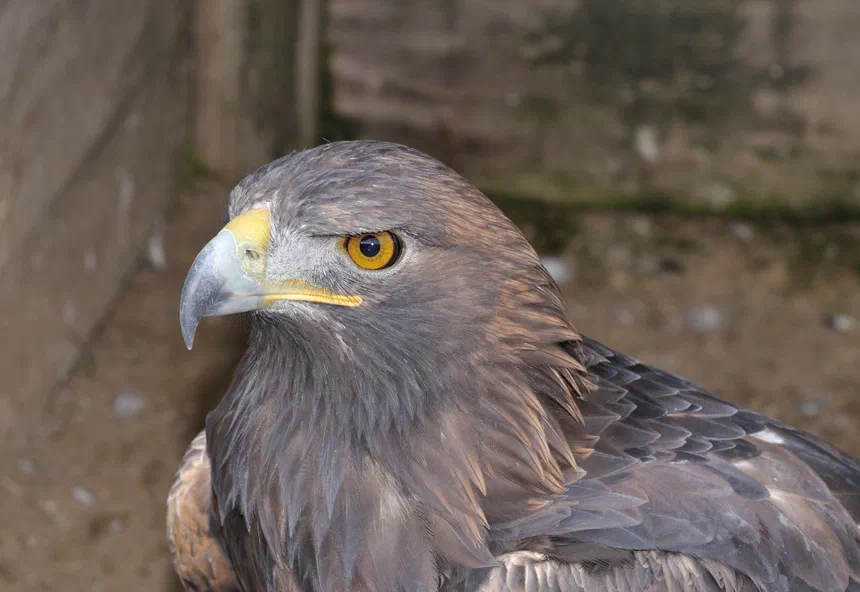
Image: Quartl — CC BY-SA 3.0 · source
What Is a Golden Eagle?
The golden eagle (Aquila chrysaetos) is a large, powerful bird of prey and one of the most widespread eagles in the Northern Hemisphere. Named for the golden sheen of feathers on its head and neck, it is a swift and agile hunter admired across many cultures as a symbol of strength.
Appearance and Identification
Golden eagles are large raptors with a mostly dark brown body. Their most distinctive feature is a wash of golden to tawny-buff feathers across the crown, nape, and back of the neck, which gives the species its name. The wings are long and broad, and in flight the bird holds them in a slight upward V, or dihedral. Adults are fairly uniform in color, while juveniles show bold white patches at the base of the flight feathers and a white band at the base of the tail that fade over several years. The legs are feathered all the way down to the toes, a trait that separates true, or “booted,” eagles from vultures and many other raptors. Females are noticeably larger than males, a common pattern among birds of prey.
Habitat and Range
The golden eagle has an enormous range spanning North America, Europe, Asia, and parts of North Africa. It favors open and semi-open landscapes where it can spot prey from a distance and soar on rising air currents. Typical habitats include mountains, foothills, high plateaus, canyons, tundra, grassland, and desert edges. The birds generally avoid dense forest and heavily developed areas. In North America they are most common in the West, while in Eurasia they occur from Scotland and Scandinavia across to the mountains of central Asia and beyond.
Diet
Golden eagles are carnivores and formidable hunters. Their diet is dominated by medium-sized mammals such as rabbits, hares, ground squirrels, marmots, and prairie dogs, but they are opportunistic and will also take birds, reptiles, and occasionally larger prey like young deer or foxes. They readily feed on carrion, especially in winter when live prey is scarce. Hunting usually involves a fast, powerful dive from a soar or a low, gliding approach that surprises prey on the ground. Their strong feet and long talons deliver a crushing grip.
Behavior
These eagles are strong, acrobatic fliers capable of steep dives at high speed when stooping on prey. They are largely solitary or found in pairs, and mated pairs often defend large territories year-round. Golden eagles are known for spectacular courtship and territorial flight displays, including deep undulating “sky-dances” in which a bird repeatedly dives and climbs. Depending on the region, populations may be resident or migratory, with northern breeders moving south for the winter while many temperate birds stay put.
Life Cycle and Reproduction
Golden eagles form long-lasting pair bonds and often reuse the same nesting sites for many years. Nests, called eyries, are large structures of sticks built on cliff ledges or in tall trees, and pairs may maintain more than one within their territory. The female usually lays one to three eggs, and incubation lasts roughly six weeks. Where more than one chick hatches, the older, larger sibling sometimes outcompetes the younger. Chicks fledge at around two to three months of age but may depend on their parents for further weeks. Young birds typically do not reach breeding age until they are four or five years old.
Conservation Status
Globally, the golden eagle is listed as Least Concern by the IUCN thanks to its very large range and sizable overall population. Even so, local populations face real pressures. Historically the species suffered from shooting, poisoning, and persecution, and today threats include collisions with wind turbines and vehicles, electrocution on power lines, lead poisoning from ingesting ammunition in carcasses, and loss of open habitat. In many countries the golden eagle is legally protected, and monitoring programs help track regional trends.
Frequently Asked Questions
How big is a golden eagle? Adults have a wingspan of roughly 6 to 7.5 feet and weigh about 6.5 to 15 pounds, with females larger than males.
What do golden eagles eat? They mainly hunt medium-sized mammals such as rabbits, hares, and ground squirrels, but they also take birds and reptiles and will feed on carrion.
Are golden eagles endangered? No. They are listed as Least Concern overall, though some local populations are declining and the species is legally protected in many countries.