Birds Guide
Goldcrest
What Is a Goldcrest? The goldcrest (Regulus regulus) is one of the smallest birds in Europe, a tiny, restless songbird of coniferous forests. It belongs to the kinglet family (Regulidae), a group named for the …
At a glance
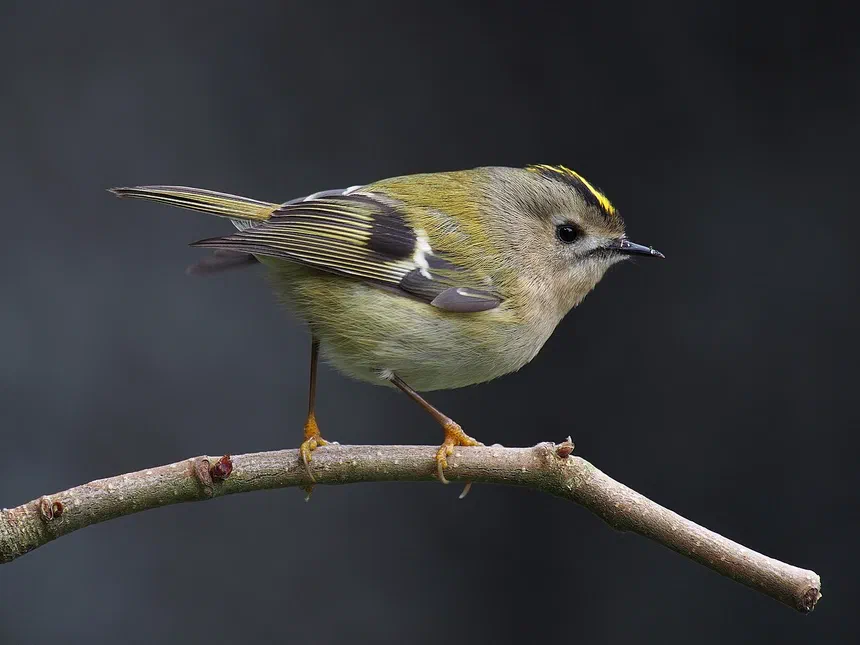
Image: Francis C. Franklin — CC BY-SA 3.0 · source
What Is a Goldcrest?
The goldcrest (Regulus regulus) is one of the smallest birds in Europe, a tiny, restless songbird of coniferous forests. It belongs to the kinglet family (Regulidae), a group named for the flame-colored crest that gives these birds a “crowned” appearance. Despite weighing only a few grams, the goldcrest is a hardy species found across a vast swath of the northern hemisphere.
Appearance and Identification
The goldcrest is a rounded, plump-looking bird with olive-green upperparts and paler, buff-white underparts. Its most distinctive feature is the bright crown stripe running along the top of the head, bordered by black. In males this stripe is orange in the center, while females show a purely yellow crown. Both sexes have a plain face with a large, dark eye set in a pale surround, giving them a somewhat wide-eyed expression. The wings are marked with a pale wing bar and dark flight feathers. The bill is thin, fine, and needle-like, well suited to picking small prey from foliage. At roughly 9 centimeters long and weighing only a few grams, it is easily confused with its close relative, the firecrest, which has a bolder facial pattern including a white eyebrow stripe.
Habitat and Range
Goldcrests are strongly associated with conifers, favoring spruce, fir, and pine woodlands, though they also use mixed forests, parks, and mature gardens containing evergreens. Their range spans much of Europe and extends across temperate Asia to the Pacific. In the northern and eastern parts of this range, populations may migrate south or to lower elevations in autumn to escape harsh winters, while birds in milder maritime climates tend to be resident year-round. During migration, goldcrests are capable of surprisingly long over-water flights despite their tiny size.
Diet
The goldcrest is almost entirely insectivorous. It feeds on small invertebrates such as springtails, aphids, spiders, and the eggs and larvae of various insects. Its light body allows it to forage at the very tips of conifer needles and in crevices that heavier birds cannot reach, often hovering briefly or hanging upside down to reach prey. Because of its small size and high metabolism, the goldcrest must feed almost constantly through the day, and in cold weather it can lose a large fraction of its body weight overnight, making steady food supply critical to survival.
Behavior
Goldcrests are highly active, flitting and hovering among branches in near-constant motion as they search for food. They are less shy than many woodland birds and will often forage close to observers. The species has a very high-pitched, thin call and song, so high that it lies near the upper limit of human hearing and is often missed by older listeners. Outside the breeding season, goldcrests frequently join mixed feeding flocks with tits and other small birds. To survive freezing winter nights, they may huddle together in sheltered spots, sharing body heat.
Life Cycle and Reproduction
Breeding usually takes place from spring into summer. The male sings and displays his crest to attract a mate and defend territory. The nest is a remarkable structure: a deep, cup-shaped hammock built largely of moss, lichen, and spider silk, suspended beneath a conifer branch and lined with feathers. The female typically lays a large clutch, often around 7 to 12 tiny eggs, which she incubates for roughly two weeks. Both parents feed the nestlings, which fledge after about three weeks. Goldcrests frequently raise two broods in a single season, a strategy that helps offset high mortality. Few individuals survive more than a couple of years in the wild.
Conservation Status
The goldcrest is listed as Least Concern by the IUCN, reflecting its very large range and abundant overall population. Numbers can fluctuate sharply from year to year, as severe winters may kill large proportions of a local population, but the species generally rebounds quickly thanks to its high reproductive rate. Long-term threats include the loss of mature conifer habitat, though widespread commercial and ornamental planting of conifers has in some areas expanded suitable nesting grounds.
Frequently Asked Questions
How small is a goldcrest? It is among the smallest birds in Europe, roughly 9 centimeters long and weighing only about 5 to 7 grams, comparable to a small coin.
How can you tell a goldcrest from a firecrest? The firecrest has a bold white eyebrow stripe and a black eye-line, giving it a striped face, while the goldcrest has a plainer face and a large dark eye in a pale surround.
Why do goldcrests need to eat so often? Their tiny bodies lose heat rapidly, so they must feed almost continuously to fuel a fast metabolism, especially in winter when a single cold night can be life-threatening without enough reserves.