Birds Guide
Gentoo Penguin
What Is a Gentoo Penguin? The gentoo penguin (Pygoscelis papua) is a mid-sized penguin of the Southern Ocean, easily recognized by the bright white patch that arcs across the top of its head. It belongs to the …
At a glance
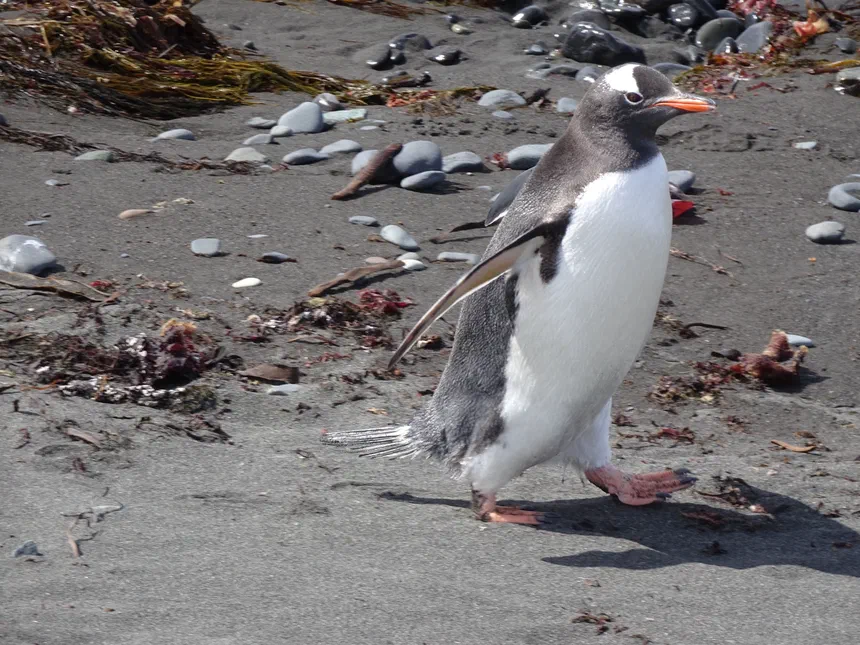
Image: Sastognuti — CC BY-SA 4.0 · source
What Is a Gentoo Penguin?
The gentoo penguin (Pygoscelis papua) is a mid-sized penguin of the Southern Ocean, easily recognized by the bright white patch that arcs across the top of its head. It belongs to the brush-tailed genus Pygoscelis, which also includes the Adelie and chinstrap penguins, and it is the fastest swimmer among all penguins.
Appearance and Identification
Gentoos are among the larger penguins, standing roughly 70 to 90 centimeters (28 to 35 inches) tall and weighing about 4.5 to 8.5 kilograms (10 to 19 pounds), with birds heaviest just before molting and lightest afterward. The back and head are black and the underside is white, but the two most distinctive features are the wide white “bonnet” that connects across the crown and the bright orange-red bill. The feet are also orange, and the tail is unusually long and stiff, sweeping from side to side as the bird walks. Males and females look alike, though males tend to be slightly larger. Chicks are covered in gray down before developing adult plumage.
Habitat and Range
Gentoo penguins breed on the Antarctic Peninsula and on many subantarctic islands, including the Falkland Islands, South Georgia, the South Shetland and South Orkney Islands, Kerguelen, and Macquarie Island. They favor ice-free ground near the coast, from low-lying beaches and tussock grass to gentle rocky slopes. Unlike some penguins that migrate long distances, gentoos generally stay close to their breeding colonies year-round, foraging in nearby coastal waters.
Diet
Gentoos are carnivores that hunt at sea. Their diet varies by location but commonly includes Antarctic krill and other crustaceans, small fish, and squid. The balance shifts with what is locally abundant; birds in the far south often rely heavily on krill, while those farther north take more fish. They pursue prey underwater in dives that usually last a minute or two, and they are capable of short bursts of remarkable speed, making them the swiftest of the penguins.
Behavior
On land, gentoos are relatively shy compared with some of their neighbors, but they are social and nest in colonies that can number from a few dozen to many thousands of pairs. They are strong, agile swimmers, using their flippers to “fly” through the water and their tail and feet to steer. Gentoos communicate with a range of trumpeting and braying calls, especially during the breeding season, and they are known for the loud, honking displays that pairs perform at the nest.
Life Cycle and Reproduction
Breeding usually begins in the southern spring. Pairs build nests from small stones, along with bits of grass and feathers, and stones are a prized commodity that birds may steal from neighbors. The female typically lays two eggs of similar size, and both parents share incubation over roughly five weeks. After hatching, the chicks are brooded and guarded before gathering into loose groups called creches while both parents forage. Youngsters fledge at around two to three months of age. Gentoos generally live about 15 to 20 years in the wild, though some individuals reach greater ages.
Conservation Status
The gentoo penguin is currently listed as Least Concern by the IUCN, reflecting a large overall population spread across many colonies. Even so, numbers vary considerably between sites, with some colonies growing while others decline. Ongoing concerns include shifts in prey availability tied to a warming ocean, disturbance at breeding sites, pollution, and interactions with fisheries. Long-term monitoring helps track how these locally variable populations respond to environmental change.
Frequently Asked Questions
How fast can a gentoo penguin swim? Gentoos are the fastest-swimming penguins, capable of short bursts estimated at up to roughly 35 kilometers per hour (about 22 miles per hour) when pursuing prey or escaping predators.
How do you tell a gentoo penguin apart from other penguins? Look for the broad white patch across the top of the head and the bright orange-red bill and feet. Together these markings make gentoos easy to distinguish from their close relatives, the Adelie and chinstrap penguins.
Where do gentoo penguins live? They breed on the Antarctic Peninsula and on subantarctic islands such as the Falklands, South Georgia, and Kerguelen, nesting on ice-free coastal ground and foraging in nearby waters.