Birds Guide
Northern Fulmar
What Is a Northern Fulmar? The Northern Fulmar (Fulmarus glacialis) is a stocky, gull-like seabird that belongs to the tube-nosed order Procellariiformes, the same group as albatrosses, petrels, and shearwaters. Despite …
At a glance
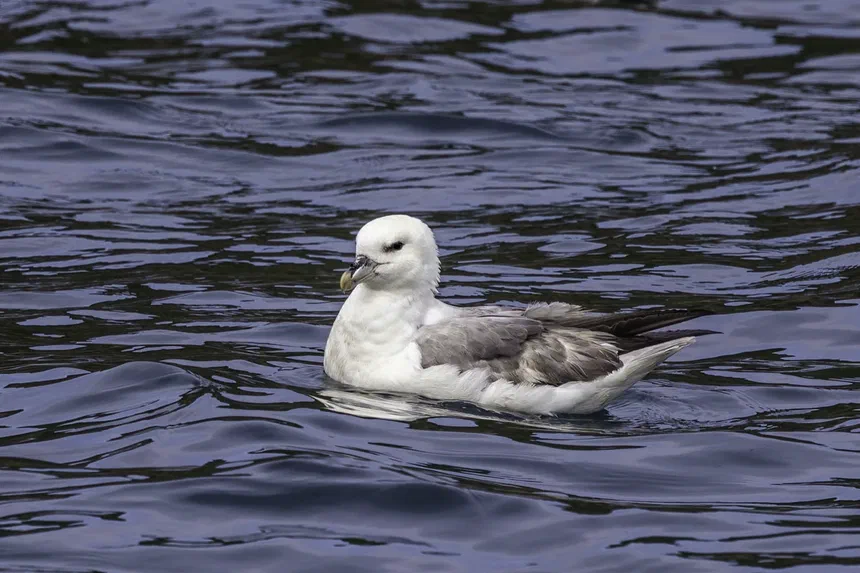
Image: Charles J. Sharp — CC BY-SA 4.0 · source
What Is a Northern Fulmar?
The Northern Fulmar (Fulmarus glacialis) is a stocky, gull-like seabird that belongs to the tube-nosed order Procellariiformes, the same group as albatrosses, petrels, and shearwaters. Despite its superficial resemblance to a gull, it is a true “tubenose,” with paired nostril tubes running along the top of its hooked bill. It spends most of its life far out at sea, coming ashore only to breed on cold northern coasts.
Appearance and Identification
Fulmars are compact and thick-necked, with a bull-headed profile and stiff, straight wings that they hold flat while gliding low over the waves. Most birds are “light morphs,” pale gray above and white below with a whitish head and a pale patch at the base of the primaries. In the far north, darker “blue” morphs are uniformly smoky gray. The bill is short, stout, and hooked, marked by the prominent tubular nostrils that distinguish tubenoses from gulls. In flight, their shallow, snappy wingbeats followed by long glides are a reliable way to tell them apart from the more buoyant, flexible-winged gulls.
Habitat and Range
The Northern Fulmar is a bird of cold and temperate oceans across the Northern Hemisphere. It breeds on sea cliffs and steep coastal slopes around the North Atlantic and North Pacific, extending north into the Arctic. Colonies are found from arctic Canada, Greenland, and Iceland through the British Isles and Scandinavia, and across the Pacific from Alaska and the Aleutians to the northeast coast of Asia. Outside the breeding season, birds range widely over the open ocean and are strongly pelagic, rarely coming near land except at colonies.
Diet
Fulmars are opportunistic carnivores that feed mainly at the sea surface. Their natural diet includes fish, squid, shrimp and other crustaceans, jellyfish, and floating carrion. They are also well known for following fishing vessels in large numbers, scavenging offal and discards. Feeding is done by seizing prey from the surface, making shallow dives, or plunging briefly beneath the water. Like other tubenoses, they have a keen sense of smell that helps them locate patchy food across vast expanses of ocean.
Behavior
On the wing, fulmars are masterful gliders, using wind deflected off waves and cliffs to travel long distances with little effort. They are highly social at colonies and often gather in rafts on the water. A notable defensive trait shared with other tubenoses is the ability to eject a foul-smelling, oily stomach fluid at intruders and predators; the name “fulmar” itself derives from Old Norse words meaning “foul gull.” This oil can mat the plumage of attacking birds and serves as an effective deterrent at the nest.
Life Cycle and Reproduction
Northern Fulmars are long-lived and slow to mature, typically not breeding until they are several years old. They form long-term pair bonds and return to the same cliff ledges year after year. The female lays a single white egg on a bare ledge or shallow scrape, with no substantial nest. Both parents share incubation over roughly seven to eight weeks, and both feed the chick, which remains at the nest for around seven weeks before fledging. Because they raise just one chick per year, breeding success depends heavily on adult survival, and individuals may live for several decades.
Conservation Status
The Northern Fulmar is listed as Least Concern by the IUCN, reflecting its large population and wide range. Numbers expanded considerably over the past century, aided in part by discards from commercial fisheries. However, fulmars face ongoing threats, including entanglement in fishing gear, oil pollution, and the ingestion of plastic debris at sea; because they scavenge floating material, they are frequently used as an indicator species for monitoring marine plastic pollution. Shifts in fish availability tied to changing ocean conditions may also affect future populations.
Frequently Asked Questions
Is a fulmar a type of gull? No. Although fulmars look gull-like, they are tubenosed seabirds (Procellariiformes) related to petrels and albatrosses, not to true gulls. The tubular nostrils on the bill and stiff-winged flight set them apart.
Why do fulmars spit oil? Fulmars, including chicks on the nest, can eject a foul, oily stomach fluid as a defense against predators and intruders. The oil can foul an attacker’s feathers and helps protect the single egg or chick.
How long do Northern Fulmars live? They are notably long-lived seabirds, commonly reaching 30 to 40 years, and some individuals are recorded living even longer.