Birds Guide
Magnificent Frigatebird
What Is a Magnificent Frigatebird? The magnificent frigatebird (Fregata magnificens) is a large seabird known for its enormous wingspan, deeply forked tail, and the male’s inflatable scarlet throat pouch. It is the …
At a glance
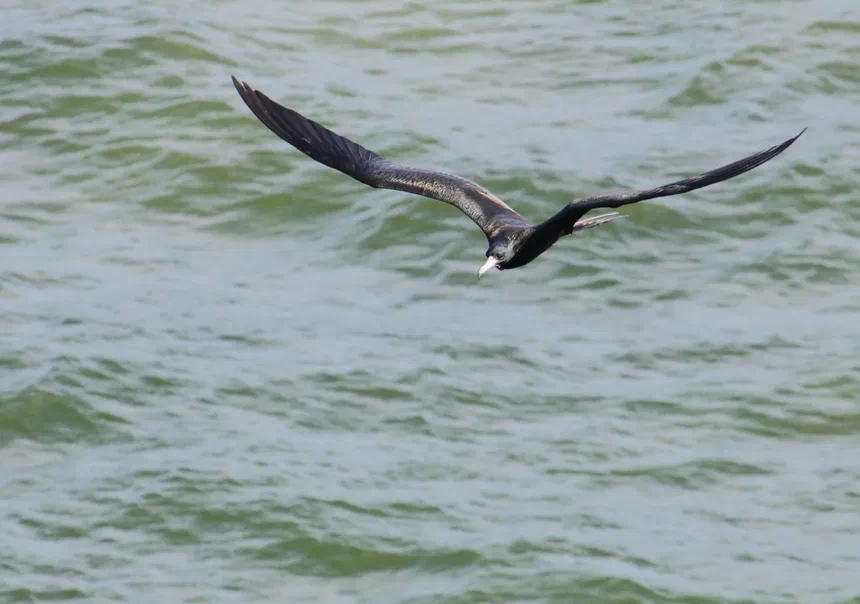
What Is a Magnificent Frigatebird?
The magnificent frigatebird (Fregata magnificens) is a large seabird known for its enormous wingspan, deeply forked tail, and the male’s inflatable scarlet throat pouch. It is the largest of the five frigatebird species and a familiar sight soaring over warm coastal waters of the Americas.
Appearance and Identification
Magnificent frigatebirds are unmistakable in flight. Adults have long, narrow, angular wings and a long forked tail that they open and close like scissors while gliding. Males are almost entirely glossy black with a striking red gular (throat) pouch that they inflate into a large balloon during courtship. Females are duller, with a white breast and a bluish eye-ring, while juveniles have a white head and underparts. Their hooked bills are long and gray, well suited to snatching prey from the water’s surface. Despite their great size, they are remarkably light, with hollow bones and a large wing area giving them among the lowest wing loading of any bird.
Habitat and Range
This species inhabits tropical and subtropical coastlines, favoring islands, cays, sandbars, and mangrove stands for nesting and roosting. Its range spans the coasts of the Americas, including the tropical Atlantic from Florida and the Gulf of Mexico south through the Caribbean to Brazil, and along the eastern Pacific from Mexico to Ecuador, including the Galapagos Islands. A small, isolated population also breeds on the Cape Verde Islands off West Africa. Frigatebirds generally remain over warm ocean waters and rarely stray far inland, though wanderers occasionally turn up well outside the usual range after storms.
Diet
Magnificent frigatebirds are carnivores that feed mainly on fish and squid taken from the ocean surface. Flying fish are a favorite, often caught in midair as they leap from the water. They also eat jellyfish, crustaceans, and the hatchlings of sea turtles and other seabirds. Because their feathers are not fully waterproof, frigatebirds cannot land on the sea or dive; they must pluck food while barely touching the surface. They are also notorious kleptoparasites, harassing boobies, gulls, and other seabirds in the air until the victim drops or regurgitates its catch, which the frigatebird then snatches.
Behavior
These birds are superb aerialists, capable of staying aloft for days or even weeks at a time by riding thermals and ocean winds with minimal wingbeats. Studies tracking individuals have shown they can sleep in brief bursts while gliding. They are highly social at breeding colonies, where hundreds may nest close together. Their piracy and effortless soaring have earned them nicknames such as “man-o’-war bird.” On land they are awkward, with short legs and small feet that make walking difficult, so they spend nearly all their time in the air or perched.
Life Cycle and Reproduction
Breeding is a slow, deliberate affair. During courtship, groups of males gather and inflate their brilliant red throat pouches, throwing back their heads and vibrating their bills to attract passing females. Once paired, the birds build a flimsy stick nest in a low shrub or tree. The female lays a single white egg, and both parents incubate it for around seven to eight weeks. The chick is fed for many months, and the extended dependency means females typically breed only every other year. Young frigatebirds may not reach full adult plumage or breed until they are several years old, one of the longest maturation periods among seabirds.
Conservation Status
The magnificent frigatebird is listed as Least Concern by the IUCN, reflecting a wide range and a large overall population. Nonetheless, it faces localized threats. Because it nests in dense colonies on a limited number of islands, it is vulnerable to habitat disturbance, introduced predators, entanglement in fishing gear, and human disturbance at breeding sites. Protecting key nesting islands remains important for the long-term health of regional populations.
Frequently Asked Questions
Why do male frigatebirds have a red pouch? The inflatable red throat pouch is a courtship display. Males puff it into a large balloon to attract females, and it deflates once breeding is underway.
Can frigatebirds land on water? No. Their plumage is not waterproof and their legs are tiny, so they cannot swim or take off from the sea. They feed by snatching prey from the surface in flight.
How long can a frigatebird stay in the air? Magnificent frigatebirds are extraordinary flyers and can remain airborne for many days at a time, gliding on ocean winds and thermals while feeding and even sleeping on the wing.