Birds Guide
Franklin's Gull
What Is a Franklin’s Gull? The Franklin’s Gull (Leucophaeus pipixcan) is a small, elegant gull of the North American interior, named for the Arctic explorer Sir John Franklin. Unlike many gulls that hug the coast …
At a glance
What Is a Franklin’s Gull?
The Franklin’s Gull (Leucophaeus pipixcan) is a small, elegant gull of the North American interior, named for the Arctic explorer Sir John Franklin. Unlike many gulls that hug the coast year-round, this species nests on inland prairie wetlands and undertakes one of the longest migrations of any gull, wintering along the Pacific coast of South America.
Appearance and Identification
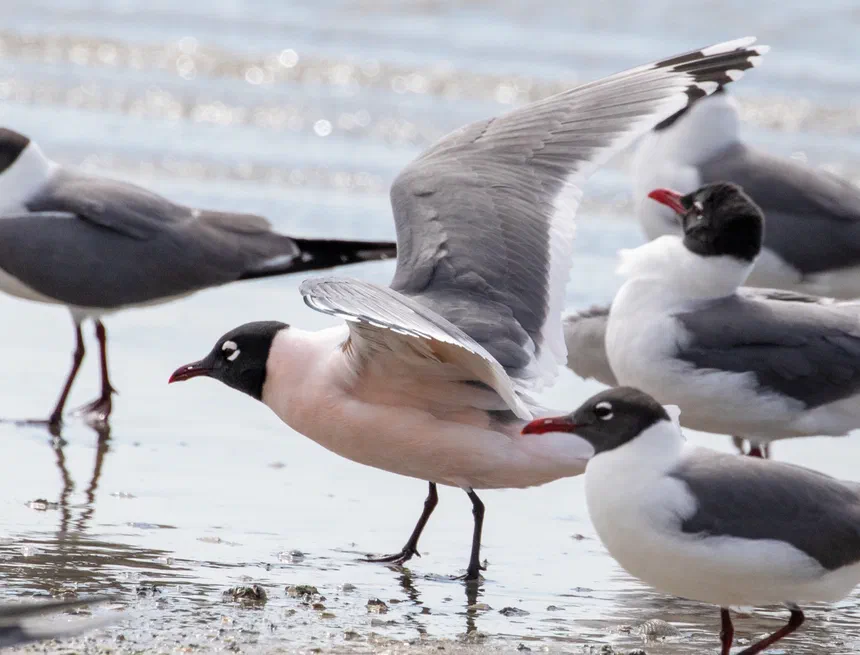
Franklin’s Gull is a compact, small-bodied gull. Breeding adults are among the most striking of their family, with a solid black hood, bold white crescents above and below the eye, a slate-gray back, and clean white underparts often washed with a delicate rosy pink. The bill and legs turn deep red in the breeding season. In flight, the wingtips show a distinctive pattern: black near the tips broken by white spots, separated from the gray wing by a white band. In nonbreeding plumage the hood recedes to a dark “half-hood” over the rear of the head, and the bill darkens. Juveniles are browner and duller, gradually acquiring adult colors over their first years.
Habitat and Range
This gull breeds across the northern Great Plains and prairie provinces, from the north-central United States into central Canada. It favors large freshwater and brackish marshes with dense stands of emergent vegetation such as cattails and bulrushes, where floating nests can be anchored. During migration and winter, birds shift to coastal waters, estuaries, agricultural fields, and open lakes. Wintering flocks concentrate along the Pacific coast of South America, particularly off Peru and Chile, making the species a true long-distance migrant.
Diet
Franklin’s Gull is an opportunistic omnivore. On the breeding grounds it feeds heavily on insects, including grasshoppers, dragonflies, midges, and beetles, often caught in the air or picked from the water’s surface. It also takes earthworms, especially when following plows across newly turned farmland, along with seeds, small fish, and aquatic invertebrates. This flexible diet lets the species exploit seasonal abundances, from insect swarms over the prairie to marine and estuarine food on the wintering grounds.
Behavior
Highly social, Franklin’s Gulls gather in noisy colonies during the breeding season and travel in large, coordinated flocks on migration. They are agile fliers, frequently hawking insects on the wing with quick, buoyant maneuvers. Foraging birds commonly follow agricultural machinery to snap up exposed prey. Their calls are a mix of shrill laughs and softer notes that carry across the marsh. Unusually among gulls, this species is thought to undergo two complete molts each year, keeping its plumage in fresh condition across its demanding annual travels.
Life Cycle and Reproduction
Breeding pairs nest colonially in marshes, sometimes numbering in the thousands. Both members of a pair build a floating nest of reeds and aquatic plants, continually adding material to keep it afloat as vegetation shifts and water levels change. The female typically lays two to three spotted eggs, and both parents share incubation over roughly three weeks. Chicks are semi-precocial, staying near the nest while both adults bring food. Young fledge within a few weeks and join postbreeding flocks before the long southward migration. Birds generally begin breeding at two to three years of age.
Conservation Status
The IUCN lists Franklin’s Gull as Least Concern, reflecting a large global population and broad range. However, because it concentrates in relatively few large marsh colonies, the species is vulnerable to the draining, drought, and degradation of prairie wetlands. Fluctuating water levels can flood or expose nests, and colonies may shift or fail in dry years. Protecting healthy prairie marsh systems is important to keeping populations stable over the long term.
Frequently Asked Questions
Why is it called Franklin’s Gull? The bird honors Sir John Franklin, the British explorer whose Arctic expeditions helped document North American wildlife in the 19th century.
How far does it migrate? It is one of the longest-distance migrants among gulls, traveling from prairie breeding grounds in North America to the Pacific coast of South America and back each year.
Is the pink color on its chest real? Yes. Breeding adults often show a subtle rosy-pink blush on the underparts, a natural pigment that is most visible in fresh plumage and fades over the season.