Birds Guide
Fox Sparrow
What Is a Fox Sparrow? The fox sparrow (Passerella iliaca) is a large, robust New World sparrow named for the fox-red tones that wash across many of its populations. It is one of the heftier sparrows in North America, …
At a glance
What Is a Fox Sparrow?
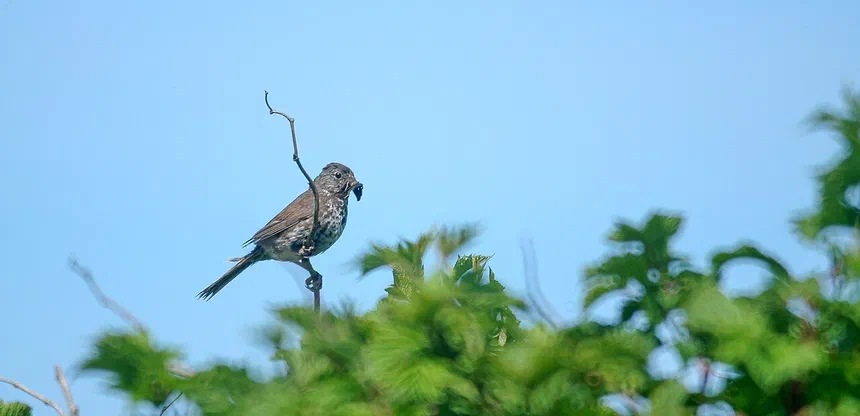
The fox sparrow (Passerella iliaca) is a large, robust New World sparrow named for the fox-red tones that wash across many of its populations. It is one of the heftier sparrows in North America, known for its vigorous, two-footed scratching in leaf litter and its rich, musical song.
Appearance and Identification
Fox sparrows are chunky, round-bodied sparrows with a fairly long tail and a stout, seed-cracking bill. Plumage varies dramatically across the continent, and ornithologists recognize several distinct groups. “Red” birds of the far north and east are bright rusty-brown above with bold rust-and-white streaking below that often converges into a central breast spot. “Sooty” birds of the Pacific coast are dark chocolate-brown, “slate-colored” birds of the interior mountains are gray-headed with a rufous tail, and “thick-billed” birds of California carry an especially large bill. Across all forms the underparts are heavily marked with triangular or blurry streaks, and the face tends to be plainer than the busy breast.
Habitat and Range
This species breeds across a broad swath of northern and western North America, from Alaska and much of Canada south through the mountains of the western United States. It favors dense, brushy habitats: willow and alder thickets, streamside shrubbery, coniferous forest edges, and montane chaparral. In winter, most populations move south to milder parts of the United States and northern Mexico, where they occupy woodland understory, hedgerows, brush piles, and shrubby suburban yards. Fox sparrows are strongly migratory in the north, while some coastal and montane populations move only short distances.
Diet
Fox sparrows are omnivores with a seasonally shifting menu. For much of the year they feed heavily on seeds and fallen fruit, including the seeds of grasses, weeds, and shrubs, plus berries when available. During the breeding season they take more insects, spiders, and other small invertebrates, which provide protein for growing chicks. They forage almost entirely on the ground, using a distinctive double-scratch, hopping backward with both feet at once to kick aside leaves and expose food hidden beneath.
Behavior
Outside the breeding season fox sparrows are often solitary or loosely social, skulking in dense cover and darting into the open only briefly. Their energetic ground-scratching is a reliable field mark, frequently audible as a rustle in the undergrowth before the bird itself is seen. Males are strong singers, delivering a clear, whistled, and warbling song from exposed perches to defend territory in spring. When alarmed, fox sparrows give a sharp smacking call note and quickly retreat into thickets. At feeders they favor seed scattered on the ground beneath shrubs rather than elevated platforms.
Life Cycle and Reproduction
Fox sparrows are generally seasonally monogamous. The female builds the nest, either low in a shrub or on the ground beneath protective cover, weaving a cup of grasses, twigs, moss, and rootlets lined with finer material. A typical clutch holds about two to five pale, heavily spotted eggs. The female does most of the incubation, which lasts roughly two weeks, and both parents feed the nestlings. Young birds leave the nest after around ten days to two weeks, often before they can fly well, and remain dependent on their parents for a time afterward. Pairs may raise one or two broods per season depending on location and climate.
Conservation Status
The fox sparrow is listed as Least Concern by the IUCN, reflecting a large range and a sizable, generally stable population. Because it depends on dense shrubby habitat, it can be sensitive to the loss of thickets and understory to development, overgrazing, or intensive land management, but no continent-wide decline threatens the species at present. Maintaining brushy edges, native shrubs, and healthy forest understory benefits fox sparrows and the many other birds that share those habitats.
Frequently Asked Questions
Why is it called a fox sparrow? The name refers to the rich, fox-red coloring found in many populations, especially the bright rusty birds of the northern and eastern forests.
Where can I see a fox sparrow? Look in dense shrubs, brush piles, and woodland edges, often on the ground beneath feeders in winter, where the bird’s vigorous backward scratching gives it away.
Are fox sparrows all the same color? No. Plumage varies widely across the continent, from bright rusty and gray-headed forms in the interior and north to dark sooty-brown birds along the Pacific coast.