Birds Guide
Forster's Tern
What Is a Forster’s Tern? The Forster’s tern (Sterna forsteri) is a medium-sized, graceful waterbird in the tern family, Laridae. It is named for the naturalist Johann Reinhold Forster and is the only tern species that …
At a glance
What Is a Forster’s Tern?
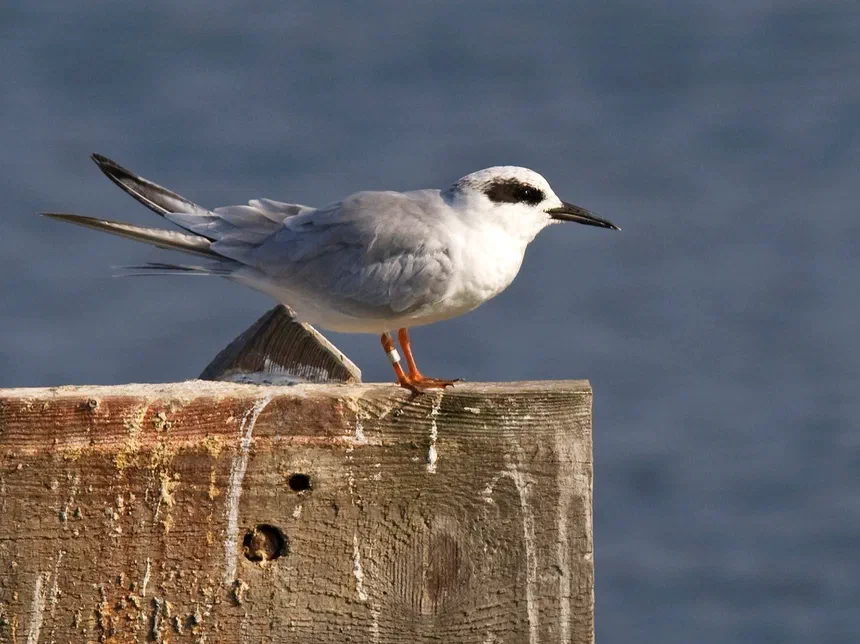
The Forster’s tern (Sterna forsteri) is a medium-sized, graceful waterbird in the tern family, Laridae. It is named for the naturalist Johann Reinhold Forster and is the only tern species that breeds almost exclusively within North America. Elegant in flight and closely tied to wetlands, it is often seen hunting over marshes and shallow coastal waters.
Appearance and Identification
In breeding plumage, adults are pale silvery-gray above and white below, with a sharply defined glossy black cap that extends from the bill through the eyes and over the crown. The bill is orange with a black tip, and the legs are orange. The tail is deeply forked, giving the bird a slim, streamlined profile. In non-breeding plumage the black cap recedes to a distinctive black “mask” or eye patch on each side of an otherwise white head, which is a key mark separating it from the very similar common tern. The wingtips appear frosty and pale, and the underparts stay clean white year-round.
Habitat and Range
Forster’s terns favor freshwater and brackish wetlands, especially cattail and bulrush marshes, as well as coastal bays, estuaries, lakes, and lagoons. Breeding populations are concentrated across the interior marshes of the northern and central United States and the Prairie Provinces of Canada, along with scattered coastal colonies. In winter the species shifts south to the coasts of the southern United States, Mexico, and Central America, where it frequents sheltered bays, tidal creeks, and open shorelines. This close reliance on healthy wetland habitat makes it sensitive to marsh drainage and water-level changes.
Diet
This tern is a carnivore that feeds chiefly on small fish, supplemented by aquatic and flying insects, small crustaceans, and occasionally amphibians. It hunts on the wing, flying and hovering above the water before making a swift plunge-dive to seize prey at or just below the surface. Over marshes it also hawks insects in mid-air. Feeding usually takes place in shallow, open water where fish are easy to spot from above.
Behavior
Forster’s terns are agile, buoyant fliers, frequently hovering with rapid wingbeats before diving. They are social birds that nest in loose colonies, sometimes alongside other terns and marsh-nesting species. Their calls are harsh and nasal, often a descending “kerr” note. Away from the breeding season they gather in loose flocks to feed and roost, and they are strongly migratory, moving between interior breeding grounds and coastal wintering areas.
Life Cycle and Reproduction
Pairs form seasonal bonds reinforced by courtship flights and ritual fish-feeding, in which a male presents a small fish to a prospective mate. Nests are typically shallow scrapes or platforms of dead vegetation placed on floating mats of marsh plants, muskrat lodges, or low mounds near water. The female usually lays two to four buff, brown-blotched eggs, which both parents incubate for roughly three to four weeks. Chicks are semi-precocial, downy and mobile soon after hatching but dependent on their parents for food. Young fledge in about three to four weeks and continue to be fed for a time afterward as they learn to fish.
Conservation Status
The Forster’s tern is listed as Least Concern by the IUCN, reflecting a broad range and a sizable overall population. Even so, it depends heavily on wetlands, and local numbers can fall where marshes are drained, degraded, or disturbed. Fluctuating water levels can flood nests, and contaminants that accumulate in wetland food chains pose additional concern in some regions. Wetland protection and restoration are the most important measures for maintaining healthy breeding colonies.
Frequently Asked Questions
How do you tell a Forster’s tern from a common tern? In winter and immature plumages, the Forster’s tern shows an isolated black eye patch on each side of a white head rather than a connected black cap across the nape, and its wingtips look paler and frostier.
What does a Forster’s tern eat? It feeds mainly on small fish caught by plunge-diving, along with aquatic and flying insects taken over marshes and open water.
Where does the Forster’s tern nest? It nests in colonies within freshwater and coastal marshes, building shallow nests on floating vegetation, muskrat lodges, or low ground close to water.