Birds Guide
Flamingo
What Is a Flamingo? The flamingo is a tall, long-legged wading bird famous for its vivid pink coloring and its habit of standing on one leg. The American, or Caribbean, flamingo (Phoenicopterus ruber) is one of the …
At a glance
What Is a Flamingo?
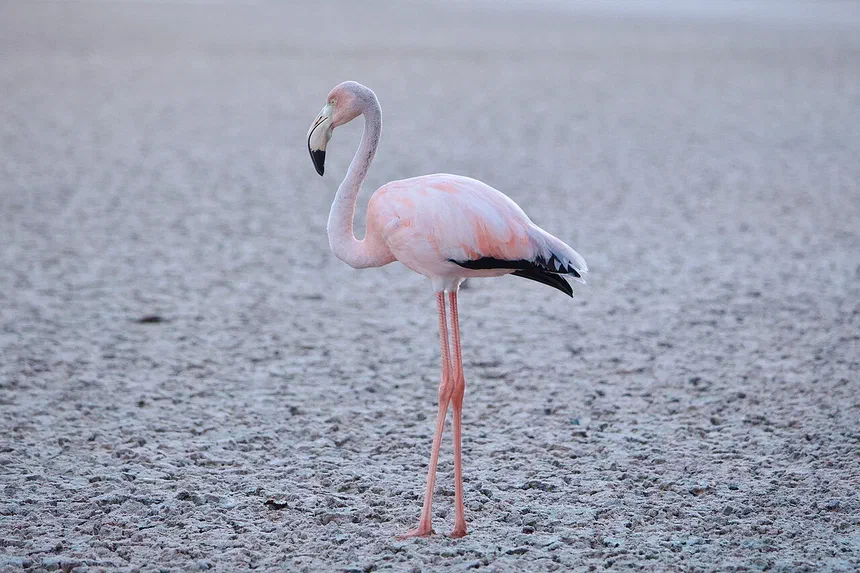
The flamingo is a tall, long-legged wading bird famous for its vivid pink coloring and its habit of standing on one leg. The American, or Caribbean, flamingo (Phoenicopterus ruber) is one of the largest and most brightly colored of the world’s six flamingo species. These sociable birds gather in flocks that can number in the thousands along shallow coastal and inland waters.
Appearance and Identification
Flamingos are unmistakable. Adults stand roughly 4 to 5 feet tall and carry rose-pink to deep coral plumage, with black flight feathers that are usually hidden until the wings open. The bill is thick and sharply bent downward near the middle, pale pink at the base and black at the tip. Long, gangly legs and webbed feet are pink as well. The characteristic color comes not from pigment the bird produces itself but from carotenoids in its diet; a flamingo deprived of these compounds fades to pale gray or white. Males and females look alike, though males tend to be slightly larger. Young birds hatch grayish and take two to three years to develop full adult coloring.
Habitat and Range
The American flamingo favors shallow, salty, or alkaline environments where its specialized feeding style works best. Typical habitats include coastal lagoons, estuaries, mudflats, and inland saline lakes. These waters are often too harsh for most other animals, which reduces competition and predation. The species ranges across the Caribbean, the Yucatan Peninsula, the Galapagos Islands, and parts of northern South America. Flamingos may move between feeding and nesting sites in response to water levels and food availability, sometimes traveling long distances at night.
Diet
Flamingos are filter feeders. A bird lowers its head, holds its bent bill upside down in the water, and pumps water through with its tongue while comb-like plates called lamellae trap food. The diet includes algae, diatoms, brine shrimp, small mollusks, insect larvae, and other tiny aquatic organisms. The reddish pigments in brine shrimp and blue-green algae are exactly the carotenoids that keep the plumage bright. Because of this feeding method, the health of a flamingo flock is closely tied to the water chemistry and productivity of its wetland.
Behavior
Flamingos are highly social and rarely seen alone. Large flocks offer safety in numbers and appear to trigger the synchronized displays that precede breeding. Groups perform coordinated head-flagging, wing-saluting, and marching routines. The one-legged resting posture, though long debated, appears to help conserve body heat and requires little muscular effort. Flamingos are strong fliers despite their ungainly look, flying with neck and legs outstretched, often in long lines or V-formations.
Life Cycle and Reproduction
Breeding is a communal affair. Pairs build cone-shaped nests of mud, several inches high, to keep the single egg above the water and away from ground heat. Both parents incubate the egg for about a month. Once hatched, the chick is fed a nutritious secretion known as crop milk, produced by both the mother and father, which is bright red from the same pigments that color the adults. Chicks gather into large groups called creches, watched over by a few adults, while their parents forage. Young flamingos reach breeding age at around three to six years and may live two to three decades in the wild, and often longer in managed care.
Conservation Status
The American flamingo is currently listed as Least Concern by the IUCN, with a stable overall population. Even so, the species depends on a narrow band of specialized wetlands, and it remains vulnerable to habitat loss, water pollution, disturbance at nesting colonies, and changes in water levels driven by development and a shifting climate. Protecting key breeding lagoons and maintaining healthy wetland ecosystems are the most important steps for keeping populations secure.
Frequently Asked Questions
Why are flamingos pink? Their color comes from carotenoid pigments in the algae and small crustaceans they eat. Without these foods in their diet, their feathers would be pale gray or white.
Why do flamingos stand on one leg? The behavior appears to help them conserve body heat in cool water and costs almost no muscular effort, making it a comfortable resting position.
Do flamingos really feed their chicks red “milk”? Yes. Both parents produce a protein-rich secretion called crop milk that is bright red from the same pigments that color adult feathers, and they feed it to their chick during its first weeks.