Birds Guide
Fish Crow
What Is a Fish Crow? The fish crow (Corvus ossifragus) is a small, all-black member of the crow family (Corvidae) native to the eastern and southeastern United States. It closely resembles the more widespread American …
At a glance
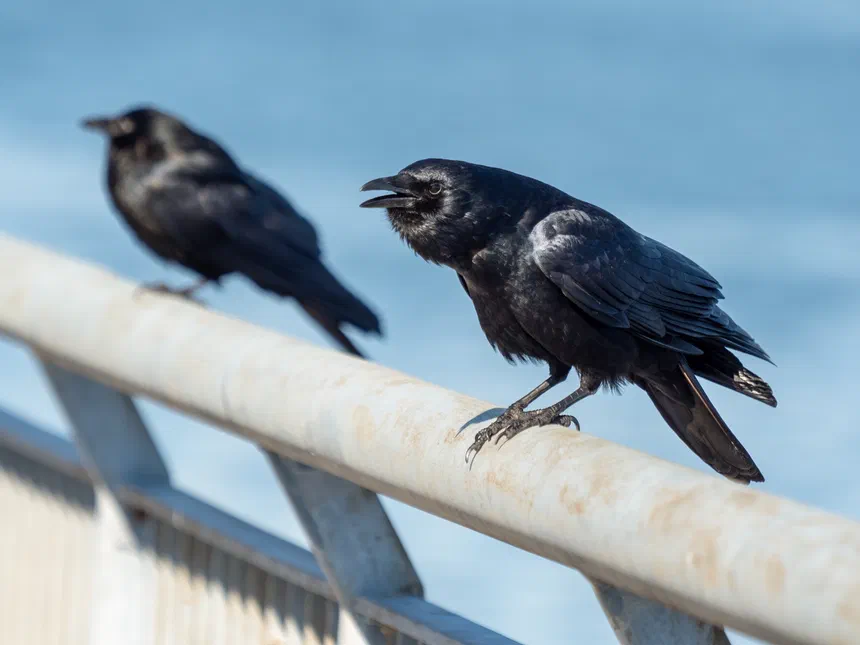
Image: Rhododendrites — CC BY-SA 4.0 · source
What Is a Fish Crow?
The fish crow (Corvus ossifragus) is a small, all-black member of the crow family (Corvidae) native to the eastern and southeastern United States. It closely resembles the more widespread American crow but is slightly smaller and is most reliably told apart by its distinctive nasal call. As its name suggests, it favors watery habitats and often forages along coasts, rivers, and wetlands.
Appearance and Identification
The fish crow is entirely glossy black, from its bill and legs to its plumage, which can show a faint blue or purple sheen in good light. It typically measures about 14 to 16 inches (36 to 41 cm) in length, with a wingspan in the neighborhood of 33 to 36 inches (84 to 91 cm), and weighs roughly 6 to 11 ounces (180 to 330 grams). Visually it is nearly identical to the American crow, though it averages smaller with a slightly slimmer bill and, when perched, may appear to have more pointed wingtips. Because the two species overlap so closely in appearance, birders rely most heavily on voice: the fish crow gives a short, nasal, almost duck-like “uh-uh” or “caw” that sounds noticeably different from the clearer call of the American crow.
Habitat and Range
Fish crows are strongly associated with water. They inhabit coastal beaches, tidal marshes, estuaries, and the banks of rivers, lakes, and swamps, and they have also adapted well to human-altered landscapes such as farmland, parks, and urban areas near water. Their range centers on the southeastern United States, extending up the Atlantic coast into New England and inland along major river systems such as the Mississippi. In recent decades the species has expanded its range northward and inland, following waterways and taking advantage of food available in developed areas.
Diet
As an omnivore, the fish crow eats a broad and opportunistic diet. Along shorelines it takes fish, crabs, shrimp, crayfish, and other aquatic invertebrates, and it readily raids the nests of other birds for eggs and nestlings, including those of herons, terns, and other colonial waterbirds. It also consumes insects, small reptiles and amphibians, carrion, berries, grain, and human refuse. Like other crows, it is intelligent and adaptable, foraging on the ground, in shallow water, and among trees, and it will scavenge in parking lots and around picnic areas.
Behavior
Fish crows are highly social and are usually seen in pairs or small groups, though they gather in large communal roosts outside the breeding season, sometimes numbering in the hundreds or thousands. These roosts may mix with American crows. They are strong, agile fliers and are often noisy, using their nasal calls to stay in contact. Like their relatives, fish crows are clever problem-solvers and are quick to exploit new food sources. They can be bold around people, and their intelligence shows in their curiosity and their willingness to investigate and manipulate objects.
Life Cycle and Reproduction
Breeding generally takes place in spring. Pairs are monogamous, and both members help build a bulky nest of sticks lined with softer material, usually placed high in a tree. The female typically lays around four to five eggs, which are incubated for roughly 16 to 18 days. Both parents care for the young, and fledglings leave the nest a few weeks after hatching but may remain with the family group for a time afterward. Fish crows sometimes nest in loose colonies, and helpers from previous broods may assist a breeding pair. In the wild they may live around 6 to 14 years, with some individuals reaching greater ages.
Conservation Status
The fish crow is listed as Least Concern by the IUCN. Its population is stable and even increasing in many areas, and its range has been expanding. The species has benefited from human activity, exploiting agricultural land, urban food sources, and reservoirs. No special conservation measures are currently needed, though like all wildlife it can be affected by habitat change and pollution in coastal and wetland environments.
Frequently Asked Questions
How do you tell a fish crow from an American crow? The most reliable difference is voice. The fish crow gives a short, nasal, two-note “uh-uh” call, while the American crow has a clearer, higher “caw.” The fish crow is also slightly smaller, but this is hard to judge in the field.
Do fish crows only eat fish? No. Despite the name, they are opportunistic omnivores. They eat fish and other aquatic animals but also take eggs, insects, fruit, grain, carrion, and human scraps.
Where are fish crows found? They live mainly in the eastern and southeastern United States, especially near coasts, rivers, marshes, and lakes, and they have been expanding northward and inland along waterways.