Birds Guide
Fieldfare
What Is a Fieldfare? The fieldfare (Turdus pilaris) is a large, boldly patterned thrush native to Europe and northern Asia. A close relative of the American robin and the song thrush, it is best known in much of Europe …
At a glance
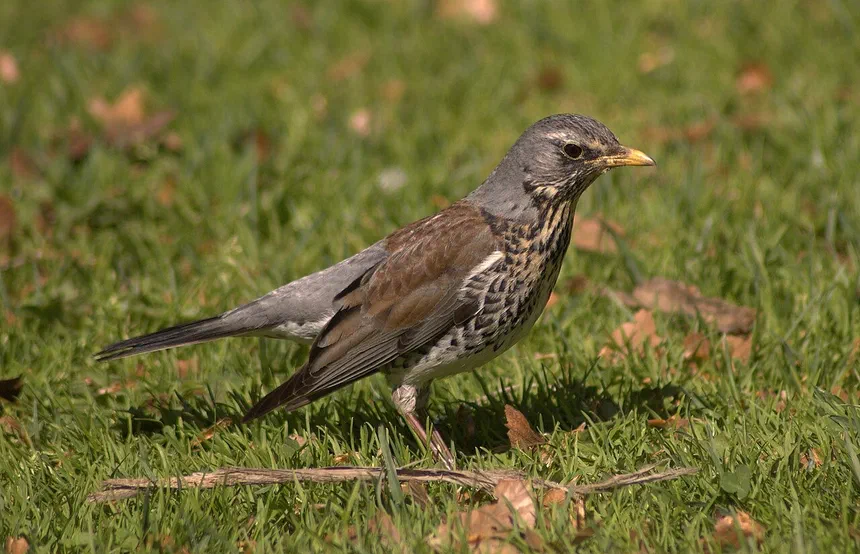
Image: Martin Olsson (mnemo) — CC BY-SA 3.0 · source
What Is a Fieldfare?
The fieldfare (Turdus pilaris) is a large, boldly patterned thrush native to Europe and northern Asia. A close relative of the American robin and the song thrush, it is best known in much of Europe as a hardy winter visitor that arrives in noisy, roving flocks to feed on berries and fallen fruit.
Appearance and Identification
The fieldfare is a sturdy, medium-sized thrush, similar in size to a blackbird and typically about 25 centimeters long. It has a distinctive color scheme that makes it fairly easy to recognize: a blue-gray head, nape, and rump contrast with a rich chestnut-brown back and wings, and the tail is nearly black. The underparts are pale, with a warm buff-yellow wash across the breast that is heavily marked with dark arrowhead-shaped spots along the flanks and chest. In flight, the pale gray rump and whitish underwings are useful field marks. Males and females look broadly similar, though males can appear slightly brighter. The bird’s upright posture and loud, chuckling “chack-chack-chack” call are also good clues to its identity.
Habitat and Range
Fieldfares breed across a broad swath of northern and central Europe and eastward through Siberia and northern Asia. During the breeding season they favor open woodland edges, birch and conifer forest, parkland, and tundra scrub, often nesting in loose colonies. In autumn many populations move south and west, and large numbers spend the winter in Britain, western and southern Europe, and parts of southwest Asia and North Africa. In winter they are birds of open country, ranging over farmland, pastures, orchards, hedgerows, and berry-laden gardens. The species is highly nomadic in the non-breeding season, and flocks may travel widely in search of good feeding conditions.
Diet
The fieldfare is an omnivore with a strongly seasonal diet. In the warmer months it feeds heavily on invertebrates, including earthworms, snails, beetles, caterpillars, and other insects, often hopping across grassland to hunt on the ground. As autumn arrives, its diet shifts toward fruit and berries. Hawthorn, rowan, holly, juniper, and windfall apples are all important winter foods, and flocks will strip berry-bearing shrubs and trees in a matter of days. This flexible diet allows fieldfares to exploit whatever food is most abundant, which is one reason they can survive harsh northern winters.
Behavior
Fieldfares are highly social and gregarious, especially outside the breeding season, when they gather in flocks that may number from a few dozen to several hundred birds, often mixing with redwings. They are noisy and conspicuous, keeping in contact with harsh chattering calls. Despite their sociable nature, fieldfares can be strikingly bold in defense of their nests: breeding birds will mob predators such as crows and even mammals, sometimes dive-bombing intruders and defecating on them to drive them off. This communal defense is one reason they nest in loose colonies.
Life Cycle and Reproduction
Breeding takes place from spring into summer. The nest is a cup of grass, twigs, and mud, usually built in the fork of a tree or on a sheltered ledge. The female typically lays around four to six eggs, which are pale blue-green with reddish speckling. She incubates them for roughly two weeks, and both parents then feed the nestlings, which fledge after about another two weeks. A pair may raise one or two broods in a season. Young fieldfares reach breeding age the following year, and while many birds do not survive their first winter, those that do can live several years.
Conservation Status
The fieldfare is classified as Least Concern by the IUCN, reflecting its very large range and substantial global population. Numbers can fluctuate from year to year, and there have been local declines at the southern edges of the breeding range, but the species remains widespread and common overall. Like many farmland and woodland birds, it can be affected by changes in agriculture and land use, and severe winters may cause temporary local mortality.
Frequently Asked Questions
Is the fieldfare a type of thrush? Yes. The fieldfare belongs to the thrush family and is closely related to the blackbird, song thrush, and American robin.
Where do fieldfares go in winter? Many fieldfares migrate south and west from their northern breeding grounds, spending the winter in Britain, western and southern Europe, and parts of North Africa and southwest Asia.
What do fieldfares eat in gardens? In winter they are especially fond of berries and fallen fruit, and they will readily feed on windfall apples, hawthorn, and rowan berries in gardens and orchards.