Birds Guide
Ferruginous Hawk
What Is a Ferruginous Hawk? The ferruginous hawk (Buteo regalis) is the largest hawk native to North America, a broad-winged raptor of open western landscapes. Its name comes from the Latin for “rusty,” a nod to the …
At a glance
What Is a Ferruginous Hawk?
The ferruginous hawk (Buteo regalis) is the largest hawk native to North America, a broad-winged raptor of open western landscapes. Its name comes from the Latin for “rusty,” a nod to the reddish-brown tones that mark many adults. Powerful and long-winged, it is well suited to hunting over wide, treeless country.
Appearance and Identification
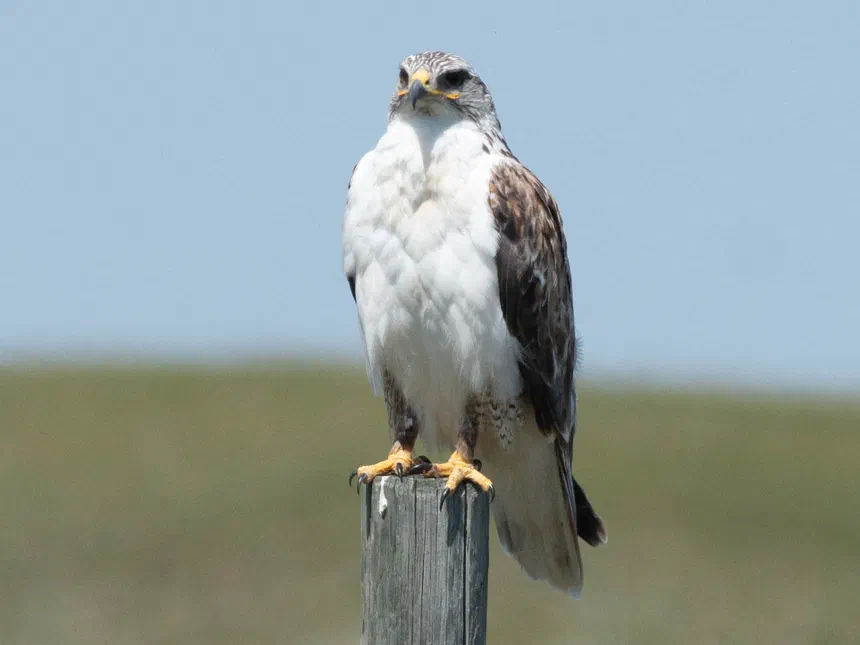
Ferruginous hawks come in two color forms, or morphs. The common light morph has a pale head and underside, rusty-brown shoulders and back, and rich reddish feathering on the legs that can form a dark “V” against the white belly in flight. The much rarer dark morph is deep chocolate-brown overall with paler flight feathers. Both morphs show large, gaping mouths and, in the light morph, strikingly white undersides to the wings and tail. Females tend to be larger than males, as is typical among hawks. The species is notable for its size, with a wingspan approaching that of a small eagle.
Habitat and Range
This hawk is a bird of open spaces. It favors grasslands, sagebrush steppe, semidesert scrub, and the edges of prairie, generally avoiding forests, high mountains, and heavily developed areas. Its breeding range covers much of western and central North America, from the Canadian prairie provinces south through the Great Plains and Intermountain West. In winter many birds move south, with some reaching the southwestern United States and northern Mexico, while others remain on the plains where prey is available.
Diet
The ferruginous hawk is a carnivore that specializes in small and medium-sized mammals. Ground squirrels, prairie dogs, rabbits, and hares make up much of its diet, and in some regions it relies heavily on colonial rodents. It also takes birds, reptiles, and large insects when the opportunity arises. Hunting styles are varied: the hawk may soar and stoop, watch from a low perch or the ground, hover on the wind, or wait beside a burrow entrance for prey to emerge.
Behavior
Ferruginous hawks are strong, buoyant fliers that often hunt over long distances across open terrain. They may perch on the ground, on low rises, on fence posts, or on utility poles while scanning for prey. Outside the breeding season they are usually solitary or found in loose groups, sometimes gathering where prey such as prairie dogs is abundant. The species can be sensitive to human disturbance near its nests.
Life Cycle and Reproduction
Pairs are typically monogamous and may reuse and enlarge the same nest over several years. Nests are built of sticks and can be placed on the ground, on low outcrops or hillsides, in isolated trees, or on artificial structures such as poles and platforms. The female usually lays two to four eggs, though clutch size can vary with prey abundance. Incubation lasts roughly a month, and both parents help feed the young. Chicks fledge at around six to seven weeks of age but may depend on the adults for a time afterward. Wild birds can live into their late teens, though many die younger.
Conservation Status
The ferruginous hawk is listed as Least Concern by the IUCN, but it faces real pressures across parts of its range. Conversion of grassland to cropland, loss of prey through prairie dog and ground squirrel control, energy development, and disturbance at nest sites can all reduce local populations. In some regions the species is a focus of monitoring and management, including the use of artificial nesting platforms to support breeding pairs.
Frequently Asked Questions
Is the ferruginous hawk really the largest hawk in North America? Yes. Among the true hawks (genus Buteo) of North America, it is the largest, with a wingspan that rivals some small eagles.
Why is it called “ferruginous”? The word means “rust-colored,” describing the reddish-brown feathering on the back and legs of typical light-morph adults.
What does it eat most often? Small and medium mammals dominate its diet, especially ground squirrels, prairie dogs, rabbits, and hares, supplemented by birds, reptiles, and insects.