Birds Guide
Fairywren
What Is a Fairywren? The superb fairywren (Malurus cyaneus) is a tiny, energetic songbird native to southeastern Australia. It belongs to the Australasian wren family, Maluridae, a group unrelated to the true wrens of …
At a glance
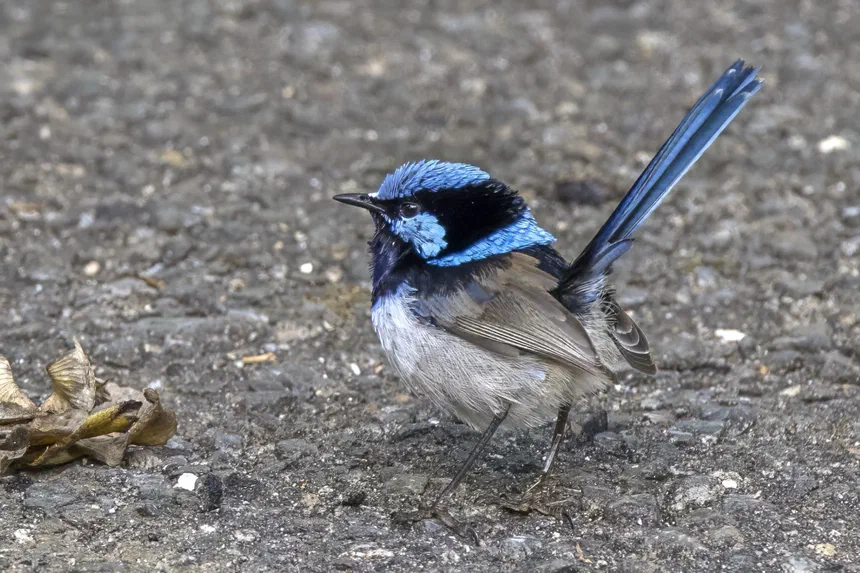
Image: Charles J. Sharp — CC BY-SA 4.0 · source
What Is a Fairywren?
The superb fairywren (Malurus cyaneus) is a tiny, energetic songbird native to southeastern Australia. It belongs to the Australasian wren family, Maluridae, a group unrelated to the true wrens of the Northern Hemisphere. The species is best known for the dazzling sky-blue plumage of breeding males and for its lively, social behavior.
Appearance and Identification
Superb fairywrens are very small, measuring roughly 5.5 inches (14 cm) from bill to tail tip, with much of that length taken up by a long, often upright tail. They weigh only about 8 to 13 grams. Breeding males are unmistakable, sporting a rich cobalt-blue crown, cheeks, upper back, and throat contrasted with black bands and a bluish-gray tail. Females, juveniles, and non-breeding males are far plainer, cloaked in soft grayish-brown above and paler below, with a reddish-orange bill and eye patch in females that helps separate them from similar species. The long tail is frequently cocked upward, giving these birds a distinctive, jaunty silhouette.
Habitat and Range
The species is restricted to southeastern Australia, including Tasmania, ranging across New South Wales, Victoria, the southeastern corner of South Australia, and parts of southeastern Queensland. It favors habitats with dense low cover, such as shrubby undergrowth, thickets, heathland, grassy woodland edges, and reed beds. Superb fairywrens have adapted readily to human-altered landscapes and are a common sight in suburban parks and well-vegetated gardens, provided there is enough low, protective vegetation nearby.
Diet
Superb fairywrens are primarily insectivores. They forage close to or on the ground, hopping through leaf litter and low foliage in search of small insects, spiders, and other invertebrates such as ants, beetles, grasshoppers, and caterpillars. They may occasionally take small seeds or fruit, but animal prey makes up the bulk of the diet. Foraging is usually done in small groups, with birds staying near cover so they can dart to safety when threatened.
Behavior
These birds are highly social and typically live in small cooperative groups built around a dominant breeding pair and several helpers, often the pair’s grown offspring from previous seasons. They are active, restless foragers, constantly flicking their tails and calling to keep in contact. Although breeding males display in brilliant blue, the species is famous among biologists for a striking gap between social pairing and genetic parentage: females frequently mate with males outside their own group, making the superb fairywren one of the least sexually faithful birds known. Males may present flower petals to females as part of courtship displays.
Life Cycle and Reproduction
Breeding generally takes place during the Australian spring and summer, roughly from spring into late summer, and a pair may raise more than one brood in a season. The female builds a small, domed nest of grasses and spider webs, usually hidden low in dense vegetation, and lays a clutch of about three to four eggs. She incubates them for roughly two weeks. Both parents and any helpers feed the nestlings, which fledge after about ten to fourteen days but remain dependent on the group for some time afterward. Cooperative helpers improve the survival odds of each brood. Superb fairywrens are also frequent hosts to parasitic cuckoos, and adults have evolved ways to detect and reject foreign chicks.
Conservation Status
The superb fairywren is listed as Least Concern by the IUCN. It is common and widespread across its range, and its ability to thrive in gardens, parks, and other modified habitats has helped keep populations stable. The main local threats are habitat clearing and predation by introduced animals such as domestic cats and foxes, but at the species level the bird remains secure.
Frequently Asked Questions
Why are only some fairywrens bright blue? Only breeding males develop the vivid blue-and-black plumage. Females, juveniles, and males outside the breeding season are a subdued grayish-brown, which provides better camouflage.
Are superb fairywrens related to European wrens? No. Despite the shared name and small size, they belong to the Australasian family Maluridae and are not closely related to the true wrens found in Europe and the Americas.
Do fairywrens live in groups? Yes. They typically form small cooperative groups in which older offspring help raise the young of a dominant breeding pair.