Birds Guide
European Goldfinch
What Is a European Goldfinch? The European goldfinch (Carduelis carduelis) is a small, brightly marked finch known for its crimson face and golden wing flashes. It belongs to the finch family, Fringillidae, and is a …
At a glance
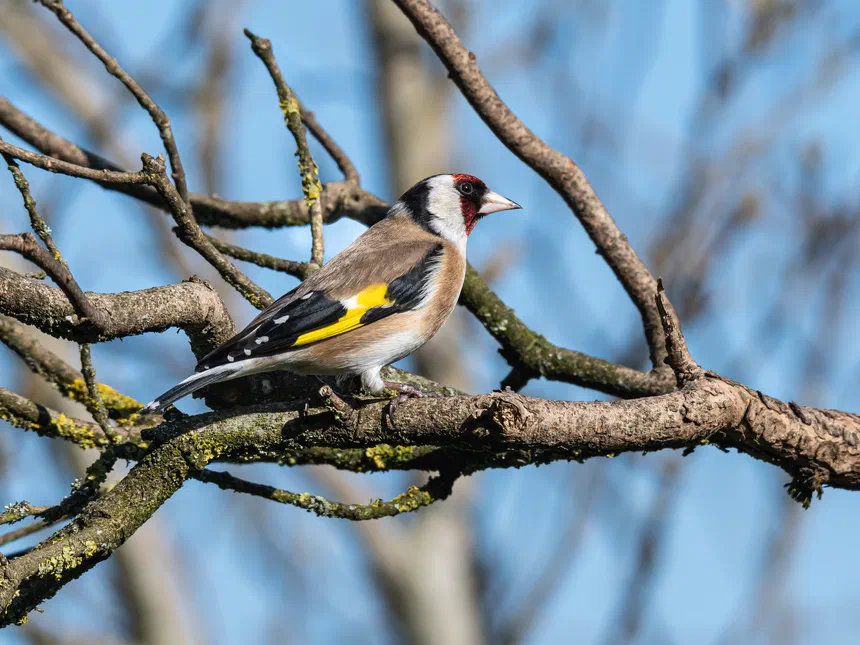
Image: Isiwal — CC BY-SA 4.0 · source
What Is a European Goldfinch?
The European goldfinch (Carduelis carduelis) is a small, brightly marked finch known for its crimson face and golden wing flashes. It belongs to the finch family, Fringillidae, and is a familiar sight across gardens, farmland, and open woodland throughout much of Europe. Its cheerful, tinkling song and specialized seed-eating habits have made it one of the continent’s best-loved songbirds.
Appearance and Identification
The European goldfinch is unmistakable among European finches. Adults have a vivid red mask around the bill, bordered by white cheeks and a black-and-white head pattern. The back and flanks are warm buff-brown, while the wings are black with a broad, bright yellow bar that flashes in flight. The tail is black with white spots. Both sexes look similar, though the red mask tends to extend slightly farther behind the eye in males. Juveniles lack the red face entirely and appear plain grayish-brown with streaking, but they already show the diagnostic gold wing bars. The slender, pointed, ivory-colored bill is well suited to extracting seeds from spiny seed heads.
Habitat and Range
This finch favors semi-open landscapes rather than dense forest or bare open ground. Typical habitats include woodland edges, orchards, parks, gardens, hedgerows, and weedy waste ground where thistles and other seed-bearing plants flourish. It is native to Europe, North Africa, and western and central Asia. Northern populations are partly migratory, moving south in autumn, while birds in milder regions are largely resident. The species has also been introduced to parts of Australia, New Zealand, and South America, where it has established wild populations.
Diet
The European goldfinch is primarily a seed-eater, and it is especially associated with the seeds of thistles, teasels, dandelions, and similar composite plants. Its fine bill and agile feeding style allow it to reach seeds that many other finches cannot, and it will cling acrobatically to swaying seed heads. During the breeding season adults also take small insects and feed them to their nestlings, providing extra protein for rapid growth. In gardens the birds readily visit feeders stocked with niger (nyjer) or sunflower hearts.
Behavior
Outside the breeding season goldfinches are highly social and often gather in loose, restless flocks known traditionally as “charms,” a name that echoes their light, twittering calls. These flocks roam the countryside in search of ripe seed heads. The birds have a bouncing, undulating flight and are constantly vocal, keeping in contact with liquid, silvery notes. They are generally tolerant of people and have adapted well to suburban gardens, though they remain quick and wary at feeders.
Life Cycle and Reproduction
Breeding usually begins in late spring, somewhat later than many songbirds, timed to coincide with an abundance of ripening seeds. The female builds a neat, compact cup nest of moss, plant fibers, and lichen, typically well out on the branch of a tree or tall shrub. She lays around four to six pale, speckled eggs and incubates them for roughly two weeks while the male brings food. Both parents feed the chicks, which fledge about two to three weeks after hatching. A pair may raise two broods in a good season. In the wild many goldfinches live only a few years, though some survive considerably longer.
Conservation Status
The European goldfinch is listed as Least Concern by the IUCN, reflecting a large range and a substantial, generally stable global population. It has benefited from garden feeding in some regions, which has helped local numbers. Historically the species suffered from large-scale trapping for the cage-bird trade because of its beauty and song, and illegal trapping still affects some populations. Loss of weedy field margins and heavy herbicide use can reduce the wild seed supply it depends on, so maintaining seed-rich habitat remains important for its long-term health.
Frequently Asked Questions
Why is it called a goldfinch? The name comes from the broad golden-yellow bar across each wing, which is most striking when the bird spreads its wings in flight.
What do European goldfinches eat? They feed mainly on small seeds, favoring thistles, teasels, and dandelions, and they add insects to the diet when feeding young.
Are European goldfinches endangered? No. They are classified as Least Concern, though they can be affected by illegal trapping and by the loss of weedy, seed-rich habitat.