Birds Guide
Eurasian Eagle-Owl
What Is a Eurasian Eagle-Owl? The Eurasian eagle-owl (Bubo bubo) is one of the largest owls in the world and among the most powerful nocturnal predators of the Northern Hemisphere. A member of the true owl family …
At a glance
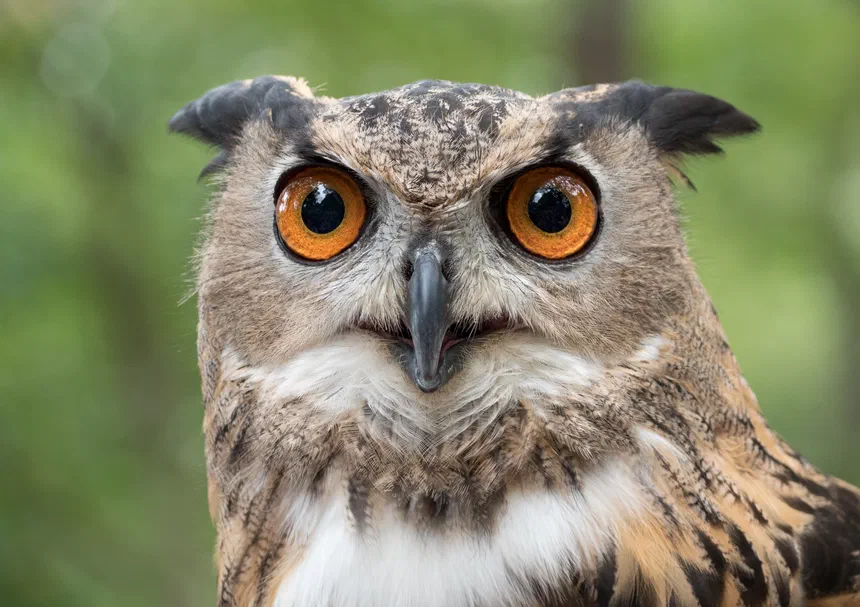
Image: Rhododendrites — CC BY-SA 4.0 · source
What Is a Eurasian Eagle-Owl?
The Eurasian eagle-owl (Bubo bubo) is one of the largest owls in the world and among the most powerful nocturnal predators of the Northern Hemisphere. A member of the true owl family (Strigidae), it is instantly recognizable by its imposing size, prominent ear tufts, and striking orange eyes.
Appearance and Identification
This is a heavily built owl with a broad, rounded head and a barrel-shaped body. Its plumage is a mottled blend of tawny brown, buff, and black streaking that provides excellent camouflage against rock and bark. The chest is marked with bold vertical streaks that fade to finer barring on the belly. Two long, tuftlike feathers rise from the head; these are not ears but display feathers. The facial disc is grayish-buff, and the large forward-facing eyes glow deep orange. As with most owls, females are noticeably larger and heavier than males. The talons are formidable, and the legs and toes are densely feathered.
Habitat and Range
The Eurasian eagle-owl has an enormous range spanning much of Europe, the Middle East, Central Asia, and eastward across Russia into China and Korea. It favors rugged, rocky landscapes such as cliff faces, canyons, and quarries, but it also occupies coniferous and mixed forests, steppe, semi-desert margins, and river valleys. The species generally avoids dense unbroken forest and open lowlands lacking cover or nesting ledges. Individuals often remain resident year-round within an established territory.
Diet
An opportunistic and versatile hunter, the Eurasian eagle-owl preys mainly on small to medium-sized mammals such as voles, rats, rabbits, and hares. It also takes birds ranging from small passerines up to ducks, crows, and even other raptors and owls. Reptiles, amphibians, large insects, and fish round out the diet where available. It hunts chiefly at dusk and after dark, using keen hearing and near-silent flight to ambush prey from a perch or in low quartering flight, then dispatching it with its powerful talons.
Behavior
Largely nocturnal and solitary outside the breeding season, the eagle-owl spends daylight hours roosting quietly on a sheltered ledge or in dense foliage. Its deep, resonant “ooh-hu” call carries far across the landscape and is used to advertise territory, especially in late winter. Territories are defended vigorously, and the birds may live for many years in the same area. Despite their size, they are generally shy and difficult to observe.
Life Cycle and Reproduction
Eurasian eagle-owls form long-term pair bonds. Courtship and calling intensify in late winter, and the female typically lays a clutch of one to four eggs in a simple scrape on a cliff ledge, in a rock crevice, among boulders, or occasionally in an abandoned nest of another large bird. She incubates for roughly five weeks while the male provides food. The chicks hatch covered in white down and grow quickly; they begin to leave the nest and clamber about at around five to seven weeks, before they can truly fly. Young owls remain dependent on their parents for several months before dispersing to find territories of their own.
Conservation Status
The IUCN lists the Eurasian eagle-owl as Least Concern, reflecting its vast range and large overall population. Numbers declined in parts of Europe during the twentieth century due to persecution, poisoning, and habitat loss, but reintroduction programs and legal protection have allowed recovery in several regions. Collisions with vehicles, electrocution on power lines, and disturbance at nest sites remain ongoing threats in some areas.
Frequently Asked Questions
How big is a Eurasian eagle-owl? It is among the largest owls, standing roughly 23 to 30 inches tall with a wingspan of about 5 to 6 feet. Females typically outweigh males.
What do Eurasian eagle-owls eat? They are carnivores that take mostly small mammals such as voles, rats, and rabbits, along with birds, reptiles, and large insects.
Are those tufts on its head really ears? No. The prominent tufts are display feathers used in communication and camouflage; the owl’s actual ear openings are hidden on the sides of its head beneath the facial disc.