Birds Guide
Emu
What Is a Emu? The emu (Dromaius novaehollandiae) is a large, flightless bird native to Australia and the second-tallest living bird after the ostrich. It belongs to the ratite group, a lineage of flightless birds that …
At a glance
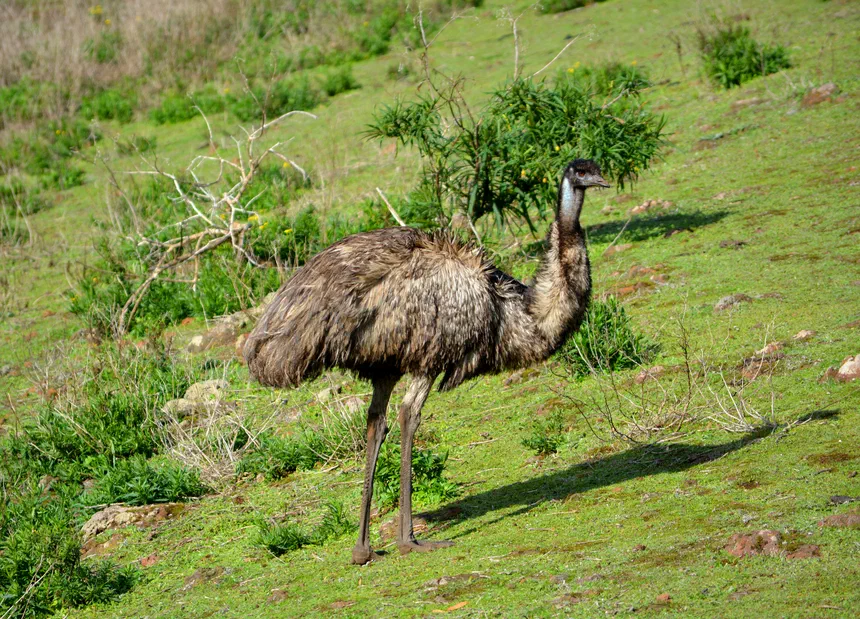
Image: fry_theonly — CC BY-SA 2.0 · source
What Is a Emu?
The emu (Dromaius novaehollandiae) is a large, flightless bird native to Australia and the second-tallest living bird after the ostrich. It belongs to the ratite group, a lineage of flightless birds that also includes ostriches, rheas, cassowaries, and kiwis. Emus are a familiar sight across much of the Australian mainland and are woven into the country’s national identity, appearing on its coat of arms.
Appearance and Identification
Emus are tall, long-legged birds standing roughly 1.5 to 1.9 meters in height and weighing anywhere from about 18 to 55 kilograms, with females generally a little larger than males. Their soft, shaggy plumage is brownish-gray and hangs loosely, giving the birds a somewhat unkempt look. Each feather has a double shaft, and the feathers help insulate the bird against both heat and cold. The neck is largely bare and often shows bluish skin, while the head is small relative to the body. Emus have three forward-facing toes on each foot and, unlike flighted birds, only tiny vestigial wings hidden beneath their plumage.
Habitat and Range
Emus are found across most of mainland Australia, favoring open habitats such as savanna woodland, sclerophyll forest edges, scrubland, and semi-arid plains. They tend to avoid dense forest and the most extreme deserts, though they will move through arid country when food and water allow. Emus are highly nomadic, and populations travel long distances in response to seasonal rainfall and the availability of food, sometimes covering hundreds of kilometers over a year.
Diet
Emus are omnivores with a varied, opportunistic diet. They feed heavily on seeds, fruits, flowers, fresh shoots, and other plant material, and they also consume insects and other small invertebrates such as grasshoppers, beetles, and caterpillars. Like many birds, emus swallow small stones, or gastroliths, which sit in the gizzard and help grind up tough plant matter. They can go for extended periods without eating when food is scarce and will drink large amounts of water when it is available.
Behavior
Emus are active during the day and spend much of their time foraging as they wander across the landscape. They are strong runners, capable of sprinting at speeds around 40 to 50 kilometers per hour, and are also able swimmers when they need to cross water. Although often seen alone or in pairs, emus may gather into loose groups, particularly when moving toward food or water. Communication includes a range of deep drumming, booming, and grunting sounds, produced in part by an inflatable throat pouch.
Life Cycle and Reproduction
Breeding in emus features a notable role reversal. After a female lays a clutch of large, dark green eggs, usually numbering around five to fifteen, the male takes over incubation. He sits on the nest for roughly eight weeks, during which he barely eats, drinks, or leaves the eggs, living largely off stored body reserves. The striped chicks hatch ready to move about and are guarded and led by the father for several months. Young emus reach full size within their first year and are typically able to breed by two to three years of age.
Conservation Status
The emu is listed as Least Concern by the IUCN, reflecting a large range and a generally stable, widespread population across mainland Australia. The species has adapted well to some agricultural landscapes, and its overall numbers are not considered threatened. However, several distinct island populations, such as those once found on King Island and Kangaroo Island, went extinct after European settlement, and localized pressures from habitat change and vehicle collisions still affect some populations.
Frequently Asked Questions
Can emus fly? No. Emus are flightless ratites with only tiny vestigial wings, but they are fast runners and rely on their long, powerful legs to escape danger.
Which parent raises the chicks? The male does nearly all of the parenting. He incubates the eggs for about eight weeks and then guards and leads the chicks for several months after hatching.
How big can an emu get? Adults commonly stand between about 1.5 and 1.9 meters tall and weigh from roughly 18 to 55 kilograms, making the emu the tallest bird native to Australia.