Birds Guide
Elf Owl
What Is a Elf Owl? The elf owl (Micrathene whitneyi) is the smallest owl in the world by weight, a sparrow-sized nocturnal raptor of the arid Southwest. Despite its tiny stature, it is a capable hunter of insects and …
At a glance
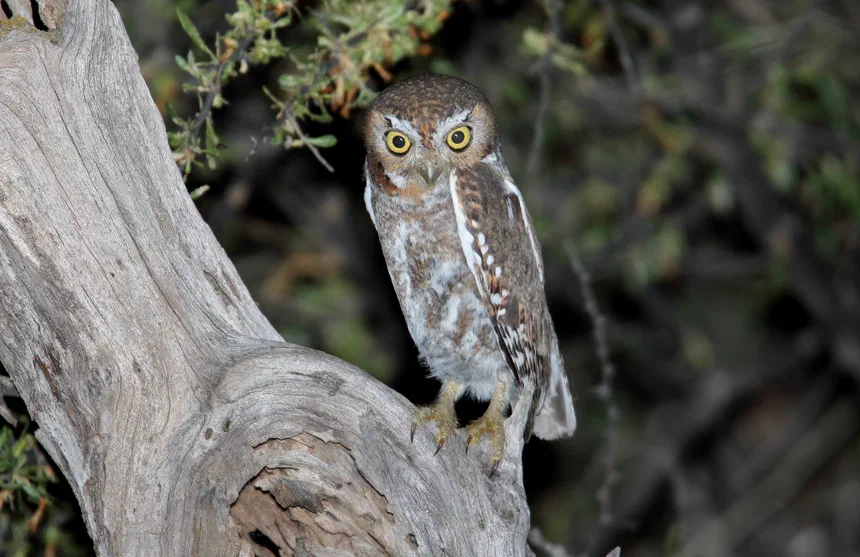
Image: Dominic Sherony — CC BY-SA 2.0 · source
What Is a Elf Owl?
The elf owl (Micrathene whitneyi) is the smallest owl in the world by weight, a sparrow-sized nocturnal raptor of the arid Southwest. Despite its tiny stature, it is a capable hunter of insects and other small prey, and it is closely tied to the desert landscapes where it nests inside abandoned woodpecker cavities.
Appearance and Identification
The elf owl is remarkably small, measuring only about 5 to 6 inches (13 to 15 cm) in length and weighing roughly 1.4 to 1.9 ounces (40 to 55 grams) - about the size of a sparrow. Its plumage is a soft grayish-brown mottled with rusty and white markings that provide excellent camouflage against tree bark and cactus. The species has a rounded head with no ear tufts, pale eyebrow-like markings above bright yellow eyes, and a short tail. Its overall rounded, compact shape and diminutive size make it distinctive among North American owls.
Habitat and Range
Elf owls favor arid and semi-arid environments, including saguaro-dominated Sonoran desert, desert scrub, oak and pine woodlands in foothills, and riparian corridors lined with cottonwood and sycamore. They depend heavily on cavities, especially old woodpecker holes in saguaro cacti, agaves, and trees. Their breeding range covers the southwestern United States, from Arizona and New Mexico into parts of Texas and southeastern California, and extends south through much of Mexico. Many northern populations are migratory, wintering in central and southern Mexico.
Diet
The elf owl is primarily insectivorous, feeding on a wide variety of arthropods. Common prey includes moths, beetles, crickets, grasshoppers, and other flying and crawling insects, as well as spiders, scorpions, and centipedes. When taking scorpions, the owl often removes the stinger before eating. On occasion it will capture small vertebrates such as lizards. Elf owls typically hunt at dusk and through the night, catching insects in flight, gleaning them from foliage, or dropping onto prey on the ground.
Behavior
Strictly nocturnal, the elf owl is most active during the first hours after sunset and again before dawn. It is a vocal bird, and its high-pitched, yipping or chattering calls are a familiar sound of spring desert nights. When threatened, an elf owl may play dead or freeze rather than fight, relying on its cryptic plumage to avoid detection. Rather than tearing at large prey, it favors small food items it can handle quickly. Its buoyant, fluttering flight allows it to maneuver among branches and cactus arms with agility.
Life Cycle and Reproduction
Elf owls are cavity nesters and do not build their own holes; instead they use cavities excavated by woodpeckers such as gila woodpeckers and northern flickers in saguaros, agave stalks, or trees. Breeding generally occurs in spring, with pairs forming after males establish and defend a nest site. The female typically lays around 2 to 4 white eggs and does most of the incubating, which lasts roughly three weeks, while the male brings food. After hatching, both parents feed the young, which fledge at about four to five weeks of age. Pairs commonly raise a single brood per year.
Conservation Status
The elf owl is currently classified as Least Concern by the IUCN, reflecting its broad range and generally stable populations across the core of its distribution. Even so, local declines have occurred, particularly at the northern and eastern edges of its range, where riparian habitat loss along desert rivers has reduced available nesting sites. Continued protection of saguaro deserts and riparian woodlands is important for maintaining healthy populations of this cavity-dependent species.
Frequently Asked Questions
How small is the elf owl? It is the world’s lightest owl, weighing only about 1.4 to 1.9 ounces (40 to 55 grams) and standing roughly the size of a sparrow.
What do elf owls eat? They are mainly insectivores, taking moths, beetles, crickets, and other arthropods, including scorpions, whose stingers they often remove before eating.
Where do elf owls nest? They nest in abandoned woodpecker cavities, most famously in saguaro cacti, but also in agave stalks and trees in desert and riparian areas.