Birds Guide
Egyptian Goose
What Is a Egyptian Goose? The Egyptian goose (Alopochen aegyptiaca) is a large, distinctively marked waterfowl native to Africa. Despite its common name, it is more closely related to shelducks than to true geese, …
At a glance
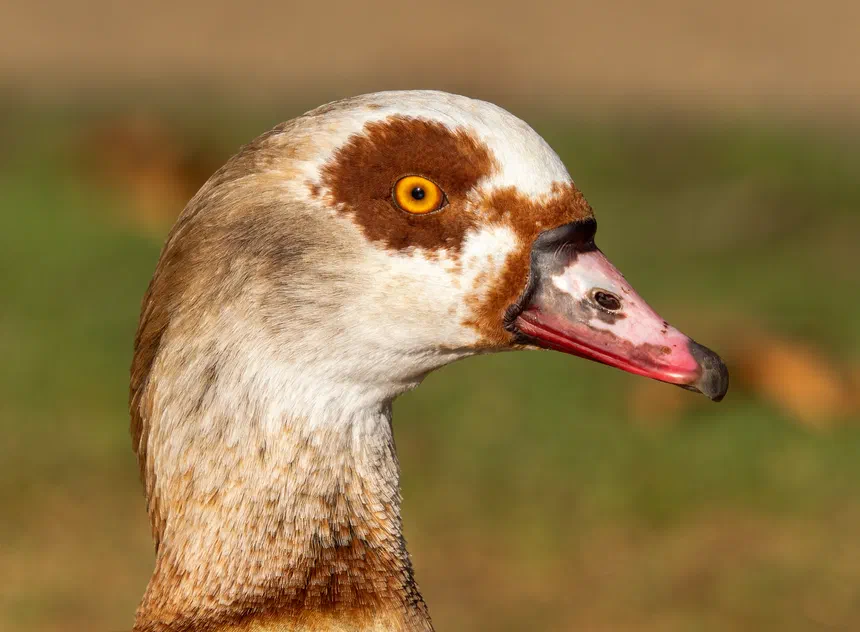
Image: Rhododendrites — CC BY-SA 4.0 · source
What Is a Egyptian Goose?
The Egyptian goose (Alopochen aegyptiaca) is a large, distinctively marked waterfowl native to Africa. Despite its common name, it is more closely related to shelducks than to true geese, sitting in its own genus within the duck, goose, and swan family Anatidae. Revered in ancient Egyptian art, it remains one of the continent’s most recognizable and widespread waterbirds.
Appearance and Identification
This is a fairly large bird, roughly the size of a small goose, with long legs and a fairly long neck. Its plumage is mostly pale buff to gray-brown, warming to chestnut on the back and wings. The most striking features are the dark chocolate patches around each eye and a matching brown collar at the base of the neck, along with a distinct dark spot on the center of the chest. The legs and bill are pink, and in flight the bird flashes bold white forewing panels bordered with black and iridescent green. Males and females look alike, though males tend to be slightly larger; juveniles are duller and lack the crisp eye patches.
Habitat and Range
Egyptian geese favor open freshwater habitats such as lakes, rivers, reservoirs, marshes, and floodplains, and they readily use adjacent grasslands, farmland, and parkland for grazing. They are native to sub-Saharan Africa and the Nile Valley, where they are abundant. Highly adaptable, the species has established feral breeding populations in parts of western Europe, including the United Kingdom, the Netherlands, and Germany, and smaller pockets elsewhere after escaping from captivity. They tolerate human-modified landscapes well and are a common sight on urban ponds and golf courses within their range.
Diet
The Egyptian goose is primarily herbivorous, feeding on grasses, leaves, seeds, grain, and aquatic vegetation. It grazes on land much like a true goose, cropping shoots and picking up spilled cereal crops, and it also dabbles in shallow water for roots and tubers. Young birds and, occasionally, adults may take small invertebrates such as worms and insects, adding protein especially during the growing season. Where the birds are common, their grazing can bring them into conflict with farmers over crops and pasture.
Behavior
These birds are noisy and conspicuous, often seen in pairs or small family groups, though they may gather in larger flocks outside the breeding season. They are notably territorial and aggressive, and pairs will vigorously defend feeding and nesting sites against rivals and other waterfowl. Communication involves harsh honking and hissing calls, with males producing a wheezy, labored sound and females a louder cackling honk. Strong fliers and confident swimmers, they perch readily on trees, buildings, and other elevated structures, which is unusual among waterfowl.
Life Cycle and Reproduction
Egyptian geese form strong, often long-lasting pair bonds. Breeding timing varies with region and rainfall, and pairs are flexible in their choice of nest site, using dense ground vegetation, burrows, cliff ledges, old nests of other large birds, and even tree holes or man-made structures. The female typically lays around 5 to 12 creamy eggs, which she incubates for roughly four weeks while the male stands guard nearby. The downy goslings can walk, swim, and feed themselves soon after hatching, but both parents escort and protect them. Fledging takes about two to three months, and young birds reach breeding age at around two years.
Conservation Status
The Egyptian goose is classified as Least Concern by the IUCN, reflecting a very large range and a stable or increasing population. In its native Africa it is common and faces no major threats. In Europe, by contrast, its expanding introduced populations are treated as invasive in some countries, where the birds can displace native waterfowl, damage crops, and hybridize concerns arise. Management there sometimes includes population control, but the species overall is in no danger.
Frequently Asked Questions
Is the Egyptian goose really a goose? Not exactly. Despite the name, it belongs to a group closer to the shelducks, and it is placed in its own genus, Alopochen, rather than among the true geese.
Where can I see Egyptian geese? They are widespread across sub-Saharan Africa and the Nile Valley, and introduced populations are now common on lakes, parks, and farmland in parts of western Europe such as England, the Netherlands, and Germany.
Are Egyptian geese aggressive? They can be. Pairs are strongly territorial, especially when nesting, and will chase off other birds and even people that stray too close to their young.