Birds Guide
Eastern Screech Owl
What Is a Eastern Screech Owl? The Eastern screech owl (Megascops asio) is a small, stocky owl native to the woodlands and suburbs of eastern North America. Despite its name, its calls are less a screech than a soft, …
At a glance
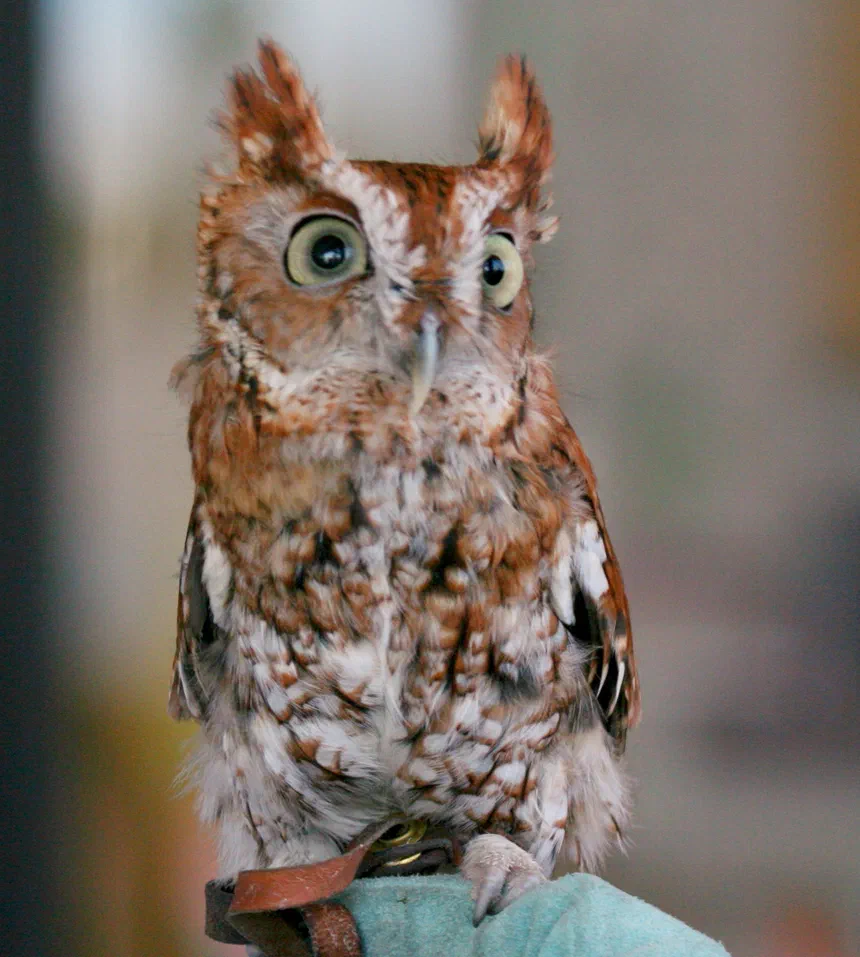
Image: Dick Daniels (http://theworldbirds.org/) — CC BY-SA 3.0 · source
What Is a Eastern Screech Owl?
The Eastern screech owl (Megascops asio) is a small, stocky owl native to the woodlands and suburbs of eastern North America. Despite its name, its calls are less a screech than a soft, whinnying trill or an even-pitched tremolo. Compact and superbly camouflaged, it is one of the most common yet rarely seen owls across its range.
Appearance and Identification
This is a diminutive owl, standing roughly 6.5 to 10 inches tall with a wingspan of about 18 to 24 inches and weighing somewhere between 4 and 9 ounces. Females tend to be slightly larger than males. The species is famous for its two color morphs: a gray form and a rufous (reddish-brown) form, with occasional brownish intermediates. Both morphs are heavily marked with dark streaks and fine barring that mimic tree bark, providing outstanding camouflage. Prominent ear tufts, which can be raised or flattened, and bright yellow eyes complete its distinctive profile. When alarmed, the owl can stretch thin and elongate against a trunk, becoming nearly invisible.
Habitat and Range
The Eastern screech owl ranges across eastern North America, from southern Canada south through the eastern and central United States into northeastern Mexico. It is highly adaptable, thriving in deciduous and mixed woodlands, forest edges, orchards, riparian corridors, city parks, and leafy suburban neighborhoods. It readily accepts tree cavities as well as artificial nest boxes, which has helped it persist even in developed areas. A permanent resident throughout its range, it does not undertake long migrations.
Diet
A versatile nocturnal hunter, the Eastern screech owl eats a remarkably broad diet. Insects and other invertebrates such as moths, beetles, crickets, earthworms, and crayfish are staples, especially in warmer months. It also takes small mammals like mice, voles, and shrews, along with small birds, lizards, frogs, and occasionally small fish. This dietary flexibility allows it to exploit whatever prey is locally abundant. It typically hunts from a perch, dropping onto prey detected by sight and its keen hearing.
Behavior
Strictly nocturnal, the Eastern screech owl spends daylight hours roosting in tree cavities or against trunks, relying on its camouflage to avoid detection. It is largely solitary outside the breeding season and defends a territory year-round. Its vocal repertoire includes a descending, horse-like whinny used in territorial contexts and a steady, even-pitched trill exchanged between mates. Though small, it is a bold and capable predator. In turn, it is preyed upon by larger owls, hawks, and mammals, making its cryptic coloration essential to survival.
Life Cycle and Reproduction
Eastern screech owls are generally monogamous, and many pairs remain together across breeding seasons. Nesting occurs in spring, with the female laying a clutch of roughly two to six white eggs in a tree cavity or nest box; no nesting material is added. She incubates the eggs for about 26 to 30 days while the male delivers food. After hatching, the young are brooded by the female and fed by both parents. Owlets typically leave the nest around four weeks of age but continue to depend on the adults for some weeks afterward as they learn to hunt. Birds reach breeding age in their first year.
Conservation Status
The Eastern screech owl is listed as Least Concern by the IUCN, reflecting its wide range and large, stable population. Its willingness to use nest boxes and tolerate suburban habitat has helped buffer it against habitat loss. Local threats include collisions with vehicles, pesticide exposure that reduces insect prey, and loss of large cavity-bearing trees. Providing nest boxes and preserving mature trees are effective ways to support local populations.
Frequently Asked Questions
Why is it called a screech owl if it does not screech? The name is somewhat misleading. Its typical calls are a soft descending whinny and an even trill rather than a harsh screech. The name likely stems from historical usage applied broadly to small owls.
What is the difference between the gray and red owls? They are the same species in two color morphs. Both gray and rufous individuals occur throughout the range and can even appear within the same brood; the coloration is genetic and not related to age or sex.
Are Eastern screech owls dangerous to people? No. They are small and pose no threat to humans. Like most owls, they may defend a nest if approached closely, but they are otherwise shy and elusive.