Birds Guide
Eastern Kingbird
What Is a Eastern Kingbird? The Eastern Kingbird (Tyrannus tyrannus) is a medium-sized flycatcher of the tyrant flycatcher family, well known across North America for its bold, aggressive defense of its territory. …
At a glance
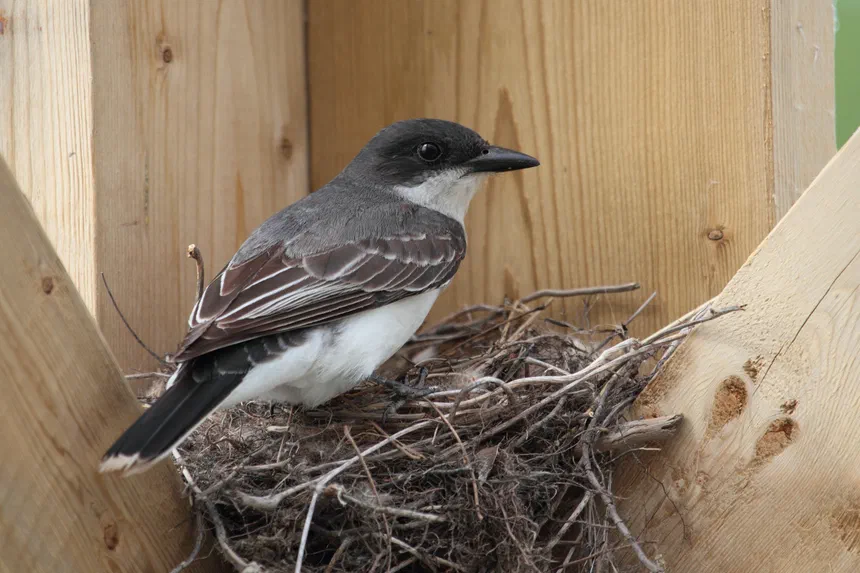
Image: Cephas — CC BY-SA 3.0 · source
What Is a Eastern Kingbird?
The Eastern Kingbird (Tyrannus tyrannus) is a medium-sized flycatcher of the tyrant flycatcher family, well known across North America for its bold, aggressive defense of its territory. Despite its modest size, it will readily chase off much larger birds, a trait that earned it the regal-sounding name “kingbird.” It is a familiar summer sight perched upright on fences, wires, and treetops in open country.
Appearance and Identification
The Eastern Kingbird has a clean, contrasting pattern that makes it easy to recognize. The upperparts, head, and wings are a dark blackish-gray, while the throat, chest, and belly are crisp white. The most distinctive field mark is the black tail tipped with a broad white band across its end, visible in flight and at rest. A concealed patch of red-orange feathers sits on the crown but is rarely seen except during displays. Males and females look alike, and juveniles resemble adults but appear slightly duller. Adults measure roughly 7.5 to 9 inches long with a wingspan near 13 to 15 inches, and they typically weigh between about 33 and 55 grams.
Habitat and Range
This species favors open and semi-open landscapes. During the breeding season it occupies fields, meadows, farmland, orchards, forest edges, roadsides, and the margins of wetlands, ponds, and rivers, where scattered trees or shrubs provide perches and nest sites. Eastern Kingbirds breed widely across much of the United States and Canada, from the East Coast into the western interior. They are long-distance migrants, leaving North America in late summer and fall to winter in South America, especially in the forests and forest edges of the western Amazon Basin, where their behavior shifts noticeably.
Diet
Through the breeding season, the Eastern Kingbird is primarily an insect eater. It hunts using a “sit-and-wait” technique, watching from an exposed perch and then sallying out to snatch flying insects from the air before returning to the same or a nearby perch. Bees, wasps, beetles, flies, grasshoppers, and winged ants are common prey. In its tropical wintering grounds its diet changes dramatically, becoming heavily reliant on fruit, and it often gathers in flocks to feed in fruiting trees.
Behavior
The Eastern Kingbird is famous for its fearless temperament. It vigorously defends its nesting territory, attacking crows, hawks, and even much larger birds by diving at them and sometimes landing on their backs while pecking. It is highly active and vocal, giving a series of sharp, buzzy, sputtering calls. On its breeding grounds it is often solitary or found in pairs, but on migration and in winter it becomes strikingly social, traveling and roosting in flocks.
Life Cycle and Reproduction
Eastern Kingbirds are seasonally monogamous, forming pairs each breeding season. The female builds a bulky cup nest of twigs, grass, and plant fibers, usually placed on a horizontal branch of a tree or shrub, and sometimes on human-made structures near water. She lays a clutch of about three to five eggs, which are creamy with dark blotches, and incubates them for roughly two weeks. Both parents feed the nestlings, which fledge in about two to three weeks after hatching. Pairs generally raise a single brood each year, and the young remain dependent on the adults for some time after leaving the nest.
Conservation Status
The Eastern Kingbird is listed as Least Concern by the IUCN, reflecting its large range and sizable population. However, like many aerial insectivores, it has shown gradual long-term population declines in parts of its range. These trends are thought to be linked to habitat loss, reduced insect availability, and pressures along its migratory route. It remains a common and widespread bird, but continued monitoring is important given the broader declines seen in insect-eating birds.
Frequently Asked Questions
Why is it called a kingbird? The name comes from its bold, dominant behavior. It fearlessly attacks and drives away birds far larger than itself, including hawks and crows, ruling its territory like a king.
Where do Eastern Kingbirds go in winter? They migrate to South America, spending the non-breeding season largely in the western Amazon Basin, where they switch from eating insects to feeding heavily on fruit.
Are Eastern Kingbirds aggressive to people? They are not a threat to people, but they are extremely territorial toward other birds and predators near their nests, often putting on dramatic aerial chases.