Birds Guide
Eastern Bluebird
What Is a Eastern Bluebird? The Eastern Bluebird (Sialia sialis) is a small, brightly colored thrush native to eastern and central North America. A member of the family Turdidae, it is one of three bluebird species in …
At a glance
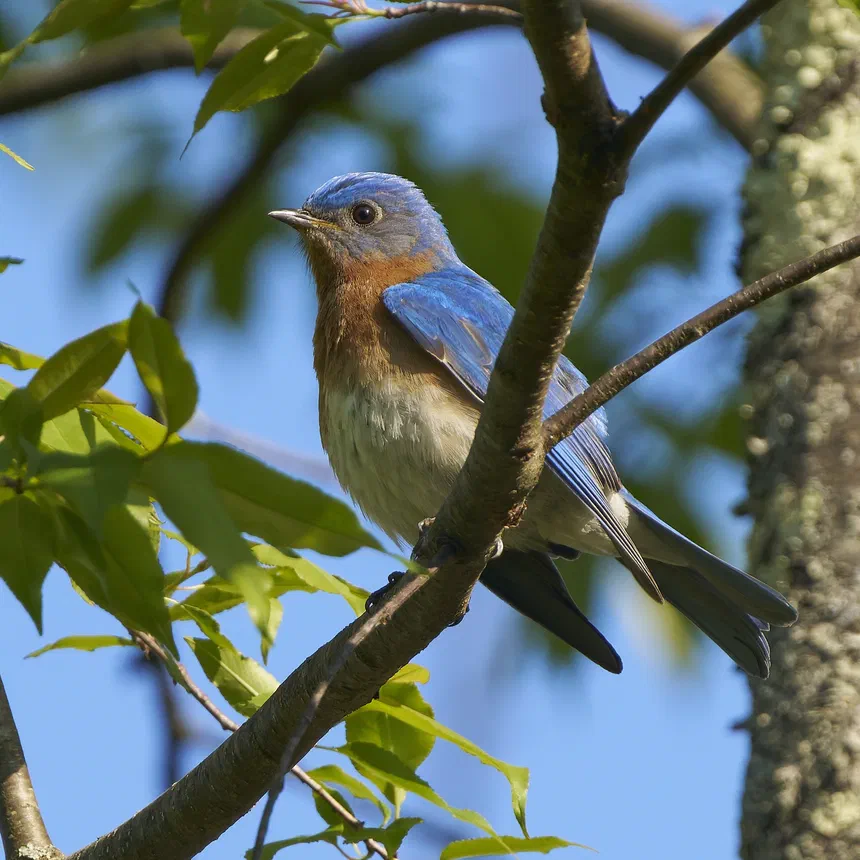
Image: Paul Danese — CC BY-SA 4.0 · source
What Is a Eastern Bluebird?
The Eastern Bluebird (Sialia sialis) is a small, brightly colored thrush native to eastern and central North America. A member of the family Turdidae, it is one of three bluebird species in the genus Sialia and is beloved by backyard birders for its vivid plumage and gentle song.
Appearance and Identification
The Eastern Bluebird is a compact, round-bodied songbird measuring roughly 16 to 21 centimeters in length, with a wingspan of about 25 to 32 centimeters and a weight typically between 27 and 34 grams. Adult males are striking, with deep royal-blue upperparts, a warm rusty-orange throat and breast, and a white lower belly. Females are more subdued, showing grayish heads and backs washed with blue, paler orange underparts, and blue tints on the wings and tail. Juveniles are spotted on the breast, a trait shared across the thrush family, and gradually acquire adult colors. The species has a short, straight bill, large dark eyes, and a habit of perching upright.
Habitat and Range
Eastern Bluebirds favor open and semi-open country, including meadows, pastures, farmland edges, orchards, golf courses, cemeteries, and roadsides where scattered trees or fence posts provide perches. They need open ground for foraging and cavities for nesting. Their breeding range covers much of eastern and central North America, from southern Canada south through the eastern United States, with populations extending into Mexico and parts of Central America. Northern birds migrate south for winter, while those in milder southern regions may remain year-round.
Diet
The Eastern Bluebird is an omnivore with a seasonally shifting diet. During the warmer months it feeds heavily on insects and other invertebrates, including beetles, grasshoppers, crickets, caterpillars, and spiders. It commonly hunts by perching and then dropping to the ground to seize prey, a technique known as “drop-hunting.” In fall and winter, when insects are scarce, the bird turns to fruits and berries such as those of dogwood, sumac, holly, and wild grape. This dietary flexibility helps it survive colder seasons and remain in northern areas.
Behavior
Eastern Bluebirds are relatively social and are often seen in loose flocks outside the breeding season, sometimes gathering to roost together in cavities for warmth on cold nights. They are cavity nesters and readily adopt nest boxes, a behavior that has helped their populations recover. Males sing a soft, warbling series of notes to defend territory and attract mates. The species is generally mild-mannered but will defend nest sites against competitors such as House Sparrows and European Starlings, which compete aggressively for the same cavities.
Life Cycle and Reproduction
Breeding typically occurs from early spring through late summer, during which a pair may raise two or sometimes three broods. The female builds a cup-shaped nest of grasses and pine needles inside a natural tree cavity, old woodpecker hole, or nest box. She lays about three to seven pale blue (occasionally white) eggs and incubates them for roughly 12 to 14 days. Both parents feed the nestlings, which fledge about 15 to 20 days after hatching. Young from earlier broods sometimes help feed later siblings. In the wild, Eastern Bluebirds commonly live six to ten years, though many do not survive their first year.
Conservation Status
The Eastern Bluebird is currently listed as Least Concern by the IUCN, and its populations are considered stable or increasing. This was not always the case: during the twentieth century, numbers declined sharply due to habitat loss and competition from introduced cavity-nesting birds. A widespread campaign to install and monitor nest boxes, supported by dedicated “bluebird trails,” has been credited with helping the species rebound across much of its range.
Frequently Asked Questions
Are Eastern Bluebirds truly blue? Their feathers contain no blue pigment. The blue color comes from the microscopic structure of the feathers, which scatters light to produce the vivid hue.
Do Eastern Bluebirds use nest boxes? Yes. They readily nest in properly designed and placed boxes, and such boxes have been vital to the species’ recovery.
Where do Eastern Bluebirds go in winter? Northern populations migrate south, while birds in milder regions often stay year-round, switching to a berry-rich diet when insects are scarce.
References
The conservation status and key facts in this profile are supported by these sources:
- Animal Diversity Web — Sialia sialis (Eastern Bluebird) (accessed 2026-07-29)
- GBIF — Sialia sialis (accessed 2026-07-29)
Found an error, source problem, or image concern? Report this page.