Birds Guide
Dusky Grouse
What Is a Dusky Grouse? The dusky grouse (Dendragapus obscurus) is a large, ground-dwelling game bird native to the mountains of western North America. It belongs to the grouse family and was once grouped with the …
At a glance
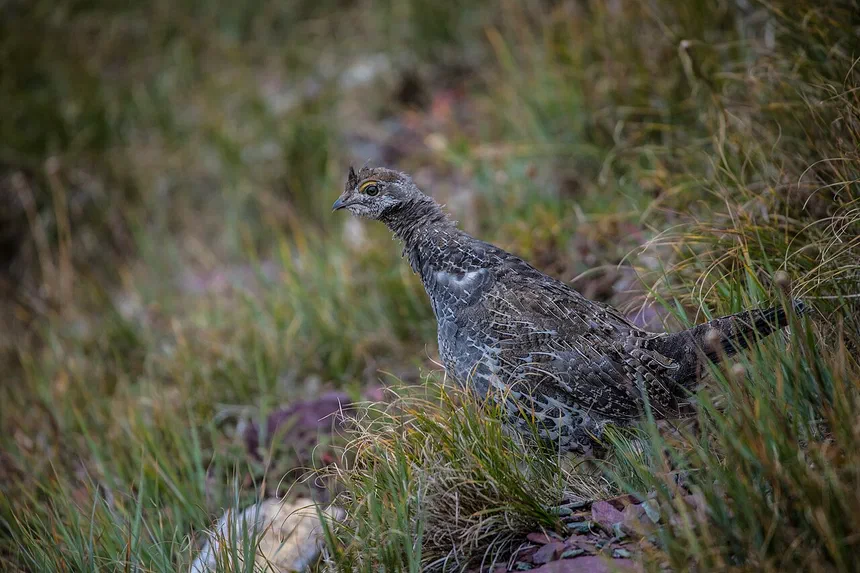
Image: GlacierNPS — Public domain · source
What Is a Dusky Grouse?
The dusky grouse (Dendragapus obscurus) is a large, ground-dwelling game bird native to the mountains of western North America. It belongs to the grouse family and was once grouped with the closely related sooty grouse under the name “blue grouse” until the two were recognized as separate species.
Appearance and Identification
Adult dusky grouse are stocky birds with small heads, short bills, and broad tails. Males are largely slate-gray to sooty in color, with a darker tail that usually shows a pale gray terminal band. During display, males reveal patches of bare skin on the neck, often reddish to purplish, framed by white-based feathers, and small fleshy combs above the eyes that swell to a yellow or orange-red hue. Females are more cryptically colored in mottled brown, gray, and buff tones that help them blend with forest litter while nesting. Both sexes have feathered legs. The species can be told from the similar sooty grouse of coastal ranges by subtle differences in tail pattern and neck-sac color, along with their separate geographic ranges.
Habitat and Range
Dusky grouse inhabit the interior mountains of western North America, from Alaska and the Yukon south through the Rocky Mountains to Arizona and New Mexico. They favor a mix of open conifer forest, aspen groves, forest edges, and brushy or shrubby slopes. Unusually among birds, many dusky grouse make a reverse altitudinal migration: they move to lower, more open habitats to breed in spring and summer, then climb upslope into dense conifer forest to spend the winter.
Diet
The dusky grouse is primarily herbivorous, and its diet shifts markedly with the seasons. In winter, birds subsist largely on the needles and buds of conifers such as fir, pine, and Douglas-fir, an energy-poor food that they process with a large crop and gizzard. During the warmer months they eat a wider variety of green leaves, flowers, seeds, and berries. Chicks rely heavily on insects and other invertebrates in their first weeks, which supply the protein needed for rapid growth.
Behavior
Dusky grouse are generally solitary or found in small family groups rather than large flocks. They spend much of their time on the ground foraging and will often freeze or walk away quietly when approached, flushing into flight only at close range with a burst of loud wingbeats. In spring, males perform territorial displays to attract females, inflating the colorful skin sacs on their necks and producing a series of deep, low-pitched hooting notes that can be surprisingly hard to locate. Males may also perform short flutter-flights and strut with tail fanned.
Life Cycle and Reproduction
The dusky grouse has a polygynous mating system in which males display to attract multiple females but take no part in raising young. After mating, the female builds a simple, shallow nest scrape on the ground, usually sheltered beneath a shrub, log, or clump of vegetation. She typically lays around 5 to 10 buff, lightly spotted eggs and incubates them alone for roughly 25 to 28 days. The chicks are precocial, leaving the nest within a day of hatching and feeding themselves under the hen’s guidance. They can make short flights within a week or two and become independent later in their first summer.
Conservation Status
The dusky grouse is listed as Least Concern by the IUCN, reflecting a broad range and generally stable populations across the mountainous West. It is a legally hunted game bird in many states and provinces, with regulated seasons. Local numbers can be affected by habitat changes from logging, fire suppression, and development, but no major range-wide threats are currently recognized.
Frequently Asked Questions
Is the dusky grouse the same as the blue grouse? “Blue grouse” was the old name for a single species that has since been split into two: the dusky grouse of the interior mountains and the sooty grouse of the Pacific coastal ranges.
Where do dusky grouse go in winter? Many climb uphill into dense conifer forest for the winter, where they feed largely on evergreen needles, then descend to more open ground to breed in spring.
What do dusky grouse eat? They are mainly herbivorous, eating conifer needles and buds in winter and a mix of leaves, berries, seeds, and some insects in the warmer months; chicks depend heavily on insects.