Birds Guide
Dunlin
What Is a Dunlin? The dunlin (Calidris alpina) is a small, plump shorebird belonging to the sandpiper family, Scolopacidae. It is one of the most abundant and widespread wading birds of the Northern Hemisphere, familiar …
At a glance
What Is a Dunlin?
The dunlin (Calidris alpina) is a small, plump shorebird belonging to the sandpiper family, Scolopacidae. It is one of the most abundant and widespread wading birds of the Northern Hemisphere, familiar to birdwatchers as it gathers in large, restless flocks on coastal mudflats. Its name and its striking seasonal plumage changes make it a favorite subject for anyone learning to identify shorebirds.
Appearance and Identification
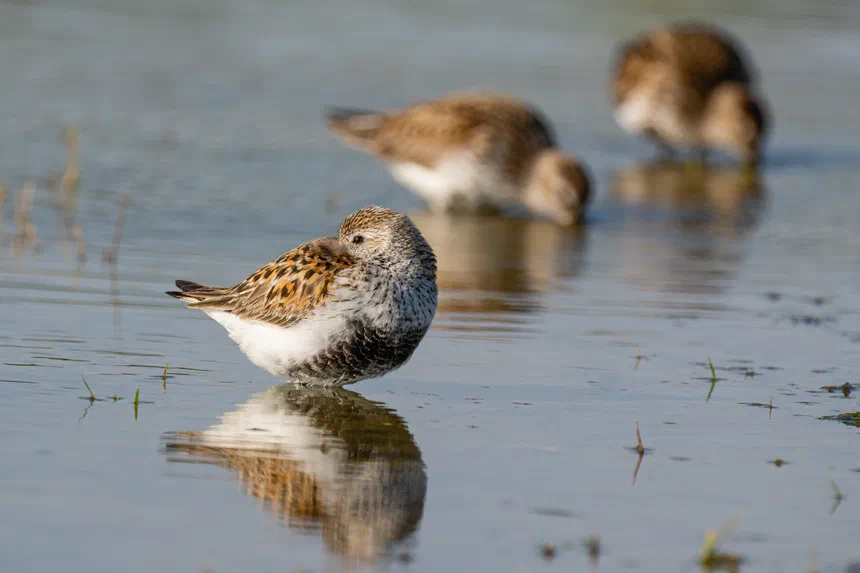
The dunlin is a compact bird with a slightly hunched posture and a distinctive black bill that is longer than the head and curves gently downward at the tip. In breeding plumage it is unmistakable: a bright rusty-red back, finely streaked breast, and a large black patch across the belly. In non-breeding (winter) plumage the bird is far plainer, showing a uniform gray-brown above and a whitish underside. Its legs are black, and in flight it reveals a narrow white wing stripe and a dark central line down the rump and tail. Adults measure roughly 6.5 to 8.5 inches long, weigh around 1.4 to 2.3 ounces, and show only modest differences between the sexes, with females averaging slightly larger.
Habitat and Range
Dunlins have a broad circumpolar distribution. During the breeding season they nest on wet Arctic and subarctic tundra, favoring areas with a mix of sedges, grasses, and low hummocks near water. Several subspecies breed across northern North America, Greenland, Iceland, northern Europe, and Siberia. When the northern summer ends, dunlins migrate to milder coasts, spending the winter on estuaries, tidal mudflats, sandy beaches, and sheltered bays across temperate and subtropical regions of the Northern Hemisphere. Some populations undertake long migrations, while others move only relatively short distances.
Diet
The dunlin is a carnivore that feeds on small invertebrates. On its wintering mudflats it probes soft sediment for marine worms, tiny mollusks, crustaceans, and other buried prey, using the sensitive tip of its bill to detect movement below the surface. On the breeding grounds it takes insects and their larvae, along with spiders and other small tundra invertebrates. Dunlins often feed by walking steadily forward, making rapid stitching motions with the bill, a technique sometimes described as “sewing-machine” feeding.
Behavior
Dunlins are highly social outside the breeding season and are famous for their dense, coordinated flocks. When disturbed by a falcon or other predator, thousands of birds may wheel and turn together in tight, shimmering formations that confuse attackers. Their feeding activity is tied closely to the tides, resting at high water and spreading out to forage as mudflats are exposed. During migration and winter, roosting flocks may number in the tens of thousands. Their calls include a distinctive rasping or buzzing note given in flight.
Life Cycle and Reproduction
On the Arctic breeding grounds, dunlins are generally monogamous for the season. The nest is a simple shallow scrape on the ground, lined with grass and lined leaves and often hidden among vegetation. The female typically lays four eggs, which both parents help incubate for roughly three weeks. The young are precocial, leaving the nest soon after hatching and feeding themselves under parental supervision. Chicks grow quickly in the brief Arctic summer, and the female frequently departs before the young fledge, leaving the male to tend the brood. Young birds are usually flying within about three weeks of hatching.
Conservation Status
The dunlin is currently listed as Least Concern by the IUCN, reflecting its enormous global population and wide range. Even so, some regional populations have declined, and the species faces pressures common to migratory shorebirds, including the loss and degradation of coastal wetlands, disturbance at key stopover and wintering sites, and the effects of a changing climate on Arctic breeding habitat. Protecting networks of estuaries and mudflats along migration routes is considered essential to keeping populations healthy.
Frequently Asked Questions
How do you recognize a dunlin in summer? Look for the combination of a rusty back and a bold black patch on the belly, together with a slightly down-curved black bill. No other similar-sized sandpiper in its range shows that black belly in breeding plumage.
Why do dunlins fly in such large flocks? Flocking provides safety in numbers. Tight, synchronized aerial maneuvers make it hard for predators such as falcons to single out and catch an individual bird.
Where do dunlins go in winter? They leave the Arctic tundra and move to temperate and subtropical coasts, where they feed on tidal mudflats, estuaries, and beaches throughout the Northern Hemisphere.