Birds Guide
Downy Woodpecker
What Is a Downy Woodpecker? The Downy Woodpecker (Dryobates pubescens) is the smallest woodpecker in North America and one of the most familiar backyard birds across the continent. Its checkered black-and-white plumage …
At a glance
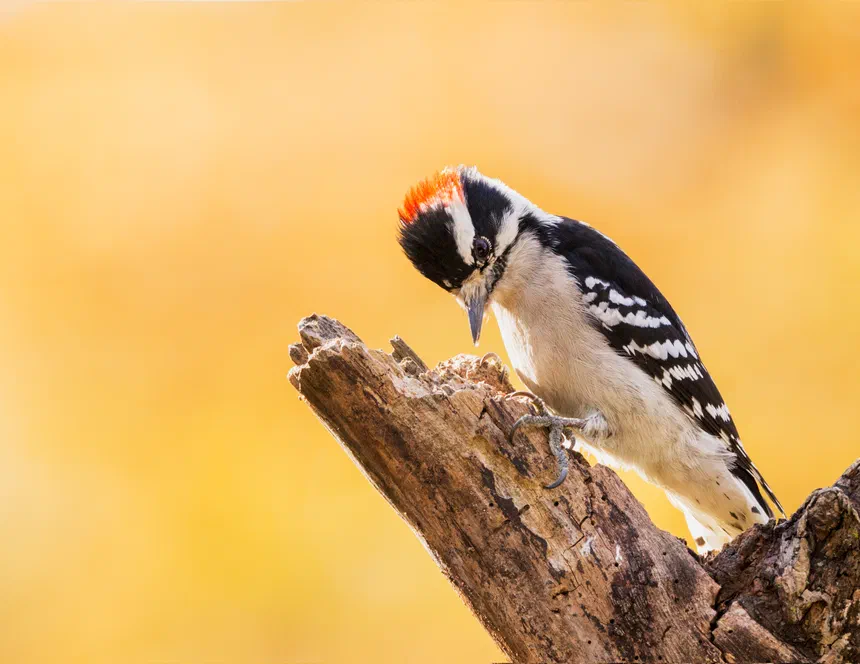
Image: ShenandoahNPS — Public domain · source
What Is a Downy Woodpecker?
The Downy Woodpecker (Dryobates pubescens) is the smallest woodpecker in North America and one of the most familiar backyard birds across the continent. Its checkered black-and-white plumage and gentle habits make it a common and welcome visitor at winter feeders.
Appearance and Identification
The Downy Woodpecker is a compact bird, measuring roughly 5.5 to 7 inches long with a wingspan of about 10 to 12 inches. Its upperparts are boldly patterned in black and white, with a broad white stripe down the center of the back, white spots on the wings, and a striking black-and-white striped face. Males can be told apart from females by a small red patch on the back of the head, which females lack.
The species is very similar in appearance to the larger Hairy Woodpecker, but the Downy is noticeably smaller and has a distinctly short, stubby bill that is shorter than the width of its head. This proportionally tiny bill is one of the most reliable ways to separate the two look-alikes in the field.
Habitat and Range
Downy Woodpeckers are found throughout most of North America, ranging from Alaska and much of Canada southward across the United States. They are highly adaptable and occupy a wide variety of wooded settings, including deciduous forests, wooded stream corridors, orchards, city parks, and suburban gardens. Because they tolerate human presence so well, they are among the woodpeckers most likely to be seen in residential neighborhoods. Most populations are non-migratory, remaining on or near their breeding territory year-round.
Diet
This woodpecker is an omnivore with a strong preference for insects. It feeds heavily on beetle larvae, ants, caterpillars, and other invertebrates that it extracts from bark, twigs, and plant stems. Its small size lets it forage on slender branches and even the stalks of weeds and grasses, where larger woodpeckers cannot easily perch. In colder months, when insects are scarce, it supplements its diet with seeds, berries, and grains, and it readily visits backyard feeders for suet, sunflower seeds, and peanuts.
Behavior
Downy Woodpeckers are active, acrobatic foragers, often creeping along branches and hitching up tree trunks in search of hidden prey. They communicate with a sharp “pik” call and a descending whinny, and both sexes drum on resonant surfaces to advertise territory and attract mates. Drumming is especially frequent in late winter and early spring. Although they defend territories during the breeding season, in winter they frequently join mixed-species flocks alongside chickadees, nuthatches, and other small birds, which offers extra protection from predators.
Life Cycle and Reproduction
Breeding typically takes place from spring into early summer. Pairs excavate a fresh nest cavity each year, usually in a dead tree or dead limb, with both members of the pair sharing the digging work. The female lays a clutch of roughly three to eight white eggs, which both parents incubate over about 12 days. The young hatch naked and helpless, and both adults feed them in the cavity. Nestlings fledge in around three weeks but continue to be fed by their parents for a period after leaving the nest. In the wild, Downy Woodpeckers commonly live two to five years, though some individuals survive considerably longer.
Conservation Status
The Downy Woodpecker is listed as Least Concern by the IUCN. Its populations are large, widespread, and generally stable, aided by its flexibility in habitat and diet and its comfort in human-altered landscapes. Retaining dead trees and dead limbs where safe to do so benefits the species by providing nesting and foraging sites.
Frequently Asked Questions
How can I tell a Downy from a Hairy Woodpecker? The Downy is smaller and has a short, stubby bill much shorter than its head width, while the Hairy is larger with a longer, heavier bill roughly as long as its head is wide.
Do male and female Downy Woodpeckers look different? Yes. Males have a small red patch on the back of the head, whereas females show only black and white and lack the red mark.
What do Downy Woodpeckers eat at feeders? They are especially fond of suet but also take sunflower seeds, peanuts, and cracked grains, making them frequent guests at backyard feeding stations.