Birds Guide
Dovekie
What Is a Dovekie? The dovekie (Alle alle), also known as the little auk, is one of the smallest members of the auk family and among the most abundant seabirds in the North Atlantic. Barely larger than a starling, it …
At a glance
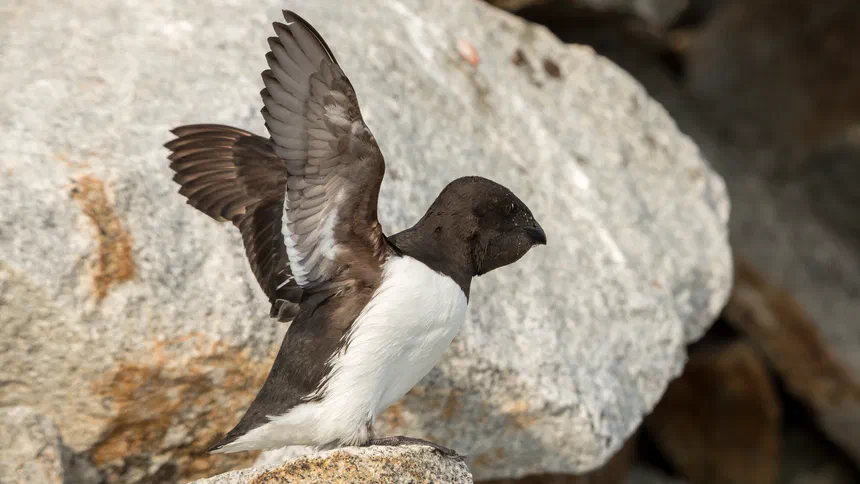
Image: AWeith — CC BY-SA 4.0 · source
What Is a Dovekie?
The dovekie (Alle alle), also known as the little auk, is one of the smallest members of the auk family and among the most abundant seabirds in the North Atlantic. Barely larger than a starling, it spends most of its life on the open ocean, coming ashore only to nest in vast, noisy colonies on High Arctic coasts.
Appearance and Identification
The dovekie is a compact, plump little seabird with a short neck, a stubby black bill, and small, narrow wings. In breeding plumage the head, neck, back, and upperparts are glossy black, contrasting sharply with a clean white belly. Fine white streaks mark the scapulars along the back. In winter the throat and lower face turn white, giving the bird a paler, more open-faced look. The sexes appear alike. Its whirring, rapid wingbeats and diminutive size help distinguish it from larger auks such as murres and puffins.
Habitat and Range
Dovekies are birds of cold Arctic and subarctic waters. They breed in enormous colonies on rocky slopes, sea cliffs, and boulder scree in the High Arctic, with major populations in Greenland, Svalbard, Franz Josef Land, and other Arctic islands, plus smaller colonies around Iceland and the Bering Sea region. Outside the breeding season they disperse widely across the open North Atlantic, ranging south in winter into waters off the northeastern United States, the British Isles, and northern Europe. Strong onshore storms occasionally push flocks close to coastlines in an event sometimes called a “wreck.”
Diet
The dovekie is a specialized planktivore and carnivore, feeding chiefly on small marine invertebrates. Copepods and other tiny crustaceans make up the bulk of its diet, supplemented by amphipods, krill, and small fish or larvae. It forages by diving from the surface and “flying” underwater with its wings, gathering prey in a specialized throat pouch to carry back to chicks. Because it targets cold-water zooplankton, the species is closely tied to the productivity of Arctic seas.
Behavior
Highly social, dovekies gather in dense breeding colonies that can number in the hundreds of thousands or even millions of pairs. Their colonies are alive with a chattering, laughter-like chorus of calls. At sea they often form large rafts on the water and fly in fast, low, tightly packed flocks. Agile swimmers and divers, they are far less graceful on land, shuffling awkwardly near their nesting crevices. They are well insulated against extreme cold by dense plumage and a rounded, heat-conserving body shape.
Life Cycle and Reproduction
Dovekies are seasonal breeders that arrive at colonies in late spring. Pairs are largely monogamous and often return to the same nesting site each year. The female lays a single pale blue-white egg in a crevice among rocks or scree, where it is hidden from predators such as glaucous gulls and Arctic foxes. Both parents share incubation, which lasts roughly four weeks, and both feed the chick after it hatches. The young bird grows quickly on protein-rich crustaceans and departs the colony after about three to four weeks, heading to sea while still accompanied for a time by a parent.
Conservation Status
The dovekie is listed as Least Concern by the IUCN, reflecting a very large global population estimated in the tens of millions of birds. Despite this abundance, the species faces longer-term pressures. Because it depends on cold-water zooplankton, warming Arctic seas and shifts in prey distribution could affect breeding success. Oil pollution, entanglement in fishing gear, and predation at colonies pose additional localized threats. Ongoing monitoring of Arctic colonies helps track how this key seabird responds to a changing climate.
Frequently Asked Questions
Is a dovekie the same as a little auk? Yes. “Dovekie” is the common name used mainly in North America, while “little auk” is the standard name in Europe; both refer to Alle alle.
How small is a dovekie? It is one of the smallest auks, roughly the size of a starling at about 7.5 to 9 inches long and weighing only around 4.5 to 7 ounces.
Where do dovekies spend the winter? After breeding in the High Arctic, they winter far out on the open North Atlantic, sometimes appearing off the northeastern U.S., Britain, and northern Europe, especially after storms.