Birds Guide
Double-Crested Cormorant
What Is a Double-Crested Cormorant? The double-crested cormorant (Nannopterum auritum) is a large, dark waterbird widespread across North America. It is one of the most familiar cormorants on the continent, often seen …
At a glance
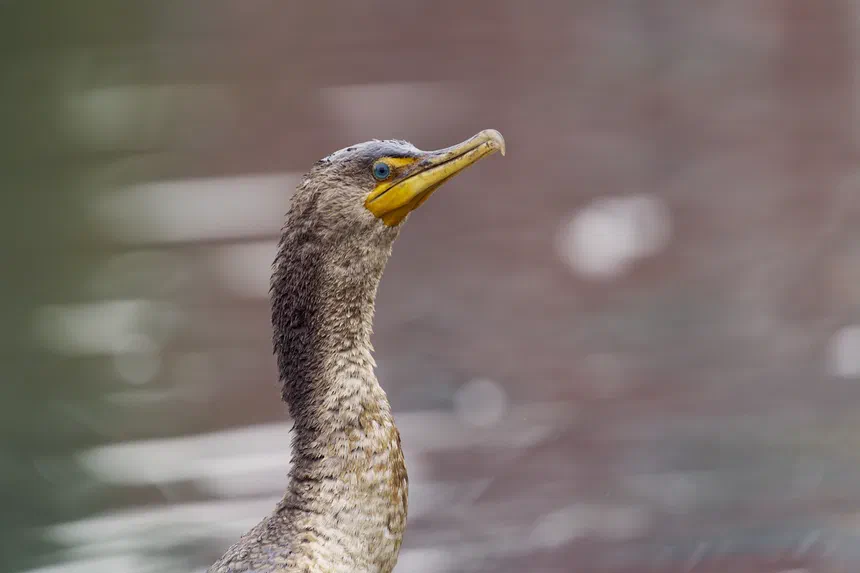
Image: Paul Danese — CC BY-SA 4.0 · source
What Is a Double-Crested Cormorant?
The double-crested cormorant (Nannopterum auritum) is a large, dark waterbird widespread across North America. It is one of the most familiar cormorants on the continent, often seen perched with wings spread to dry after diving for fish in both fresh and salt water.
Appearance and Identification
Adults are mostly blackish with a slight greenish or bronze sheen in good light. The species is best identified by the patch of bare orange-yellow skin on the face and throat, which is more vivid than in similar cormorants. Bird length is roughly 28 to 35 inches, with a wingspan near 45 to 52 inches and a body weight commonly between about 2.6 and 5.5 pounds. The bill is slender and hooked at the tip, an adaptation for gripping fish. The “double crest” that gives the bird its name refers to two tufts of feathers on the head that appear only briefly on breeding adults; these are often white in western birds and dark in eastern birds, and they are absent for most of the year. Juveniles are browner, with a paler chest and neck.
Habitat and Range
This cormorant occupies a broad range of aquatic habitats, including lakes, reservoirs, slow rivers, coastal bays, and estuaries. It is highly adaptable and readily uses human-made water bodies. The breeding range extends across much of Canada and the United States, and populations shift southward in winter to the southern United States, Mexico, and coastal regions where waters remain open. Birds nesting inland tend to migrate, while some coastal populations are more sedentary.
Diet
The double-crested cormorant is a carnivore that feeds almost entirely on fish, targeting a wide variety of species depending on what is locally abundant. It also takes crustaceans, amphibians, aquatic insects, and occasionally other small prey. Hunting is done by diving from the surface and pursuing prey underwater, propelled mainly by the feet. Its plumage is not fully waterproof, which reduces buoyancy and helps the bird dive efficiently; this is also why cormorants are frequently seen holding their wings open to dry.
Behavior
These birds are social and often gather in flocks for feeding, roosting, and nesting. They fly in loose lines or V-formations and swim low in the water with the bill tilted slightly upward. After foraging, they perch on rocks, pilings, buoys, or bare branches with wings outstretched. Their vocalizations are mostly low grunts and croaks, given chiefly at colonies rather than in flight.
Life Cycle and Reproduction
Double-crested cormorants nest colonially, sometimes alongside herons, egrets, and other waterbirds. Nests are built of sticks and debris on the ground, on cliffs, or in trees, and are often reused and enlarged over successive years. A typical clutch contains about three to four eggs, which both parents incubate for roughly four weeks. Chicks hatch naked and helpless and are fed regurgitated food by both adults. Young birds fledge in several weeks but may remain dependent for a time afterward, and they generally begin breeding at two to three years of age.
Conservation Status
The double-crested cormorant is listed as Least Concern by the IUCN, and its overall population is large and stable. Numbers declined in the mid-20th century due to pesticides such as DDT but rebounded strongly after those chemicals were restricted. Because the species eats fish, it sometimes comes into conflict with aquaculture operations and sport fisheries, and it has been the subject of localized management programs. Overall, however, the species remains abundant and adaptable.
Frequently Asked Questions
Why do cormorants hold their wings out? Their feathers are not fully waterproof, so they spread their wings to dry after diving. Wetter plumage reduces buoyancy and helps them dive, but it must be dried afterward.
Where does the name “double-crested” come from? It refers to two tufts of feathers on the head of breeding adults. These crests are seasonal and often go unnoticed because they are present only briefly.
Are double-crested cormorants a threat to fish populations? They can affect local fisheries and aquaculture, which has led to management in some areas, but at a broad scale they are a natural part of aquatic ecosystems and their overall populations are healthy.