Birds Guide
Dodo
What Is a Dodo? The dodo (Raphus cucullatus) was a large, flightless bird that lived only on the island of Mauritius in the Indian Ocean. A member of the pigeon and dove family, it evolved in isolation and became one of …
At a glance
What Is a Dodo?
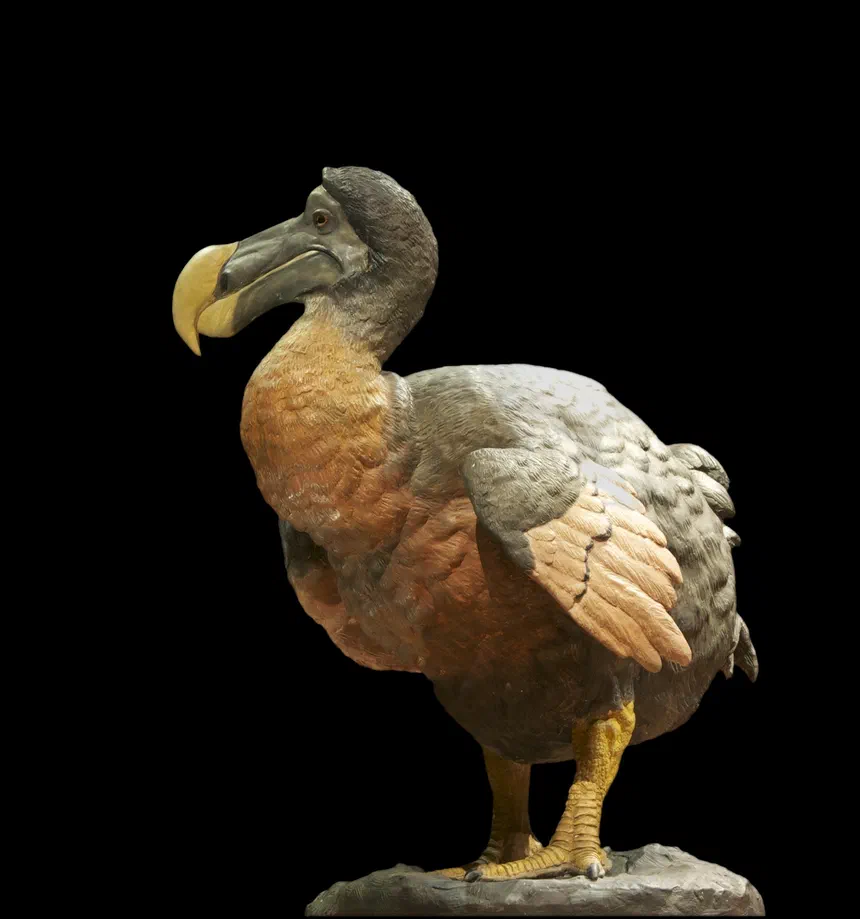
The dodo (Raphus cucullatus) was a large, flightless bird that lived only on the island of Mauritius in the Indian Ocean. A member of the pigeon and dove family, it evolved in isolation and became one of history’s most famous examples of human-caused extinction, disappearing within roughly a century of its first recorded sighting by Europeans.
Appearance and Identification
The dodo was a bulky, ground-dwelling bird standing around 1 meter tall. Contemporary accounts and surviving remains suggest a body covered in grayish-brown plumage, with a tuft of curly feathers at the rear in place of functional flight feathers. Its most distinctive feature was a large, hooked bill set on a bare, pale face. The wings were small and useless for flight, and the sturdy yellowish legs ended in strong toes suited to walking over forest floors. Weight estimates vary widely, from about 10 to 18 kilograms, and the plumper depictions in old paintings may reflect captive, overfed birds rather than typical wild individuals.
Habitat and Range
The dodo was endemic to Mauritius, meaning it existed nowhere else on Earth. It inhabited the island’s lowland forests and drier coastal woodlands, foraging on the ground beneath the canopy. Because Mauritius had no native land predators before humans arrived, the dodo had no need to fly or flee, and it evolved accordingly. This isolation, which allowed the bird to thrive for thousands of years, ultimately left it defenseless once sailors and their animals reached the island.
Diet
The dodo was primarily a herbivore. It is thought to have fed on fallen fruit, seeds, nuts, roots, and bulbs gathered from the forest floor, and it may have supplemented this with small invertebrates. Like many birds, it likely swallowed stones, called gastroliths, to help grind tough plant matter in its gizzard. Some researchers have proposed that the dodo depended on seasonal fruiting cycles and stored fat during times of plenty, which could explain the seasonal variation in body condition described by early observers.
Behavior
Relatively little is known about dodo behavior, since few detailed observations survive and no dodo was ever studied scientifically in life. The bird appears to have been terrestrial and possibly solitary or loosely social. Early European accounts described the dodo as unafraid of people, a trait born of evolving without predators rather than of stupidity, despite its later reputation. This tameness made it easy to approach and capture. It was likely most active on the ground during daylight, nesting and foraging within its forest habitat.
Life Cycle and Reproduction
The dodo is believed to have nested on the ground, laying a single egg at a time, a reproductive strategy common among birds on predator-free islands. Ground nesting left eggs and chicks highly vulnerable once introduced animals arrived. Details of incubation, chick development, and lifespan are largely unknown, though as a large bird it may have been long-lived and slow to reproduce. A low reproductive rate would have made the population especially slow to recover from losses.
Conservation Status
The dodo is classified as Extinct. First documented by Dutch sailors around 1598, it vanished by the late 1600s, with the last widely accepted sightings around 1662 to 1681. Its extinction was driven less by direct hunting than by the animals humans brought to Mauritius: pigs, rats, monkeys, cats, and dogs that raided ground nests and ate eggs and chicks, alongside habitat loss. The dodo has since become a global symbol of extinction and the fragility of island species, lending its name to the phrase “dead as a dodo.”
Frequently Asked Questions
Was the dodo related to any living bird? Yes. Genetic and anatomical studies place the dodo within the pigeon and dove family, and its closest living relative is thought to be the Nicobar pigeon of Southeast Asia.
Why did the dodo go extinct so quickly? It had evolved without predators, nested on the ground, and reproduced slowly. Introduced animals raided its nests while people cleared its forest habitat, and the small island population could not recover.
Could the dodo fly? No. The dodo was flightless, with small wings and a heavy body. Flight was unnecessary on a predator-free island, so it never developed the ability.