Birds Guide
Diamond Dove
What Is a Diamond Dove? The diamond dove (Geopelia cuneata) is one of the smallest doves native to Australia, named for the scattering of tiny white “diamond” spots across its wings. It is a ground-feeding bird of the …
At a glance
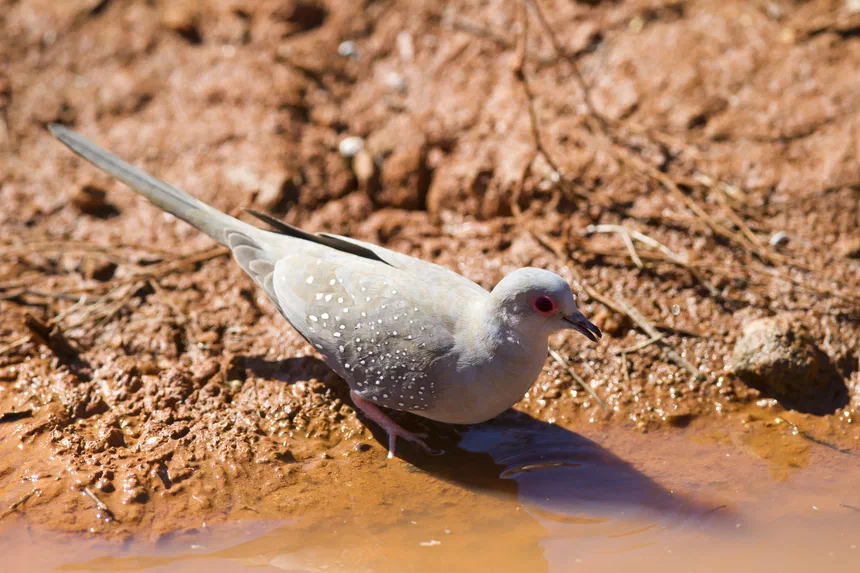
Image: Jim Bendon from Karratha, Australia — CC BY-SA 2.0 · source
What Is a Diamond Dove?
The diamond dove (Geopelia cuneata) is one of the smallest doves native to Australia, named for the scattering of tiny white “diamond” spots across its wings. It is a ground-feeding bird of the continent’s dry interior and a long-standing favorite in aviculture, where it is kept and bred around the world.
Appearance and Identification
This is a delicate, slender pigeon measuring roughly 7.5 to 8.5 inches (19 to 22 cm) from bill to tail tip, much of that length made up of a long, tapering tail. Adults weigh only about 1 to 1.4 ounces (30 to 40 grams). The plumage is soft blue-gray over the head, breast, and back, fading to paler gray underneath. The folded wings are dotted with small white spots ringed in darker feathering, the feature that gives the species its common name. A striking bare ring of orange-red skin surrounds each eye, more prominent and broader in males than in females. Females tend to be a touch browner and duller overall. In flight, chestnut tones show in the primary feathers, and the outer tail feathers are tipped white.
Habitat and Range
Diamond doves occur across much of central and northern Australia, favoring arid and semi-arid country. They frequent open grasslands, lightly wooded savanna, scrub, and the margins of watercourses, and they readily use farmland, parks, and gardens. Access to drinking water is a strong influence on where they settle, so they are often seen near dams, waterholes, and bore drains. The species is partly nomadic, shifting in response to rainfall and the availability of seeding grasses, and it may appear in large numbers where conditions are briefly favorable.
Diet
The diamond dove is a seed specialist and essentially herbivorous. It feeds mainly on the small seeds of grasses and low herbaceous plants, gleaned directly from the ground. Foraging birds walk with a quick, bobbing gait, picking up fallen seed, and they will also take some green shoots and the occasional small invertebrate. Like other pigeons and doves, they drink by sucking water up continuously rather than tilting the head back, and regular access to water shapes their daily movements.
Behavior
These doves are usually seen in pairs or small flocks, though they can gather in larger groups at water or abundant food. They spend much of the day on the ground and are generally tame and approachable. The male’s cooing call is a soft, rolling coo often repeated in a rhythmic series, given both to attract a mate and to defend a small territory. Courting males perform a bowing display, spreading and lifting the tail to flash the white-tipped feathers while cooing. Flight is fast and direct on whirring wings.
Life Cycle and Reproduction
Breeding is closely tied to rainfall and food supply, so nesting can occur through much of the year when conditions allow. The nest is a flimsy, loosely built platform of thin twigs and grass stems, typically placed low in a shrub or tree. The female usually lays two white eggs, and both parents share incubation over roughly two weeks. Newly hatched young are fed “crop milk,” a nutritious secretion produced by both adults, before graduating to regurgitated seed. Chicks develop quickly and generally leave the nest within about two weeks of hatching, becoming independent soon after. Pairs may raise several broods in a good season.
Conservation Status
The diamond dove is listed as Least Concern by the IUCN. It has a very large range, a sizable and generally stable population, and adapts well to human-modified landscapes such as farmland and towns. It is not considered globally threatened. The species is also widely and easily bred in captivity, which further secures its numbers outside the wild.
Frequently Asked Questions
How big is a diamond dove? It is among Australia’s smallest doves, roughly 7.5 to 8.5 inches (19 to 22 cm) long and weighing only about 1 to 1.4 ounces, with much of its length in a long tail.
What do diamond doves eat? They are seed eaters, feeding mainly on grass and weed seeds picked up from the ground, along with a little green plant matter and rarely a small insect.
Are diamond doves endangered? No. They are classified as Least Concern, with a broad range across Australia and populations that tolerate farmland and settled areas well.