Birds Guide
Demoiselle Crane
What Is a Demoiselle Crane? The demoiselle crane (Grus virgo) is the smallest of the world’s cranes, an elegant, long-legged bird of open grasslands and steppes across central Eurasia. Its name, meaning “young lady” in …
At a glance
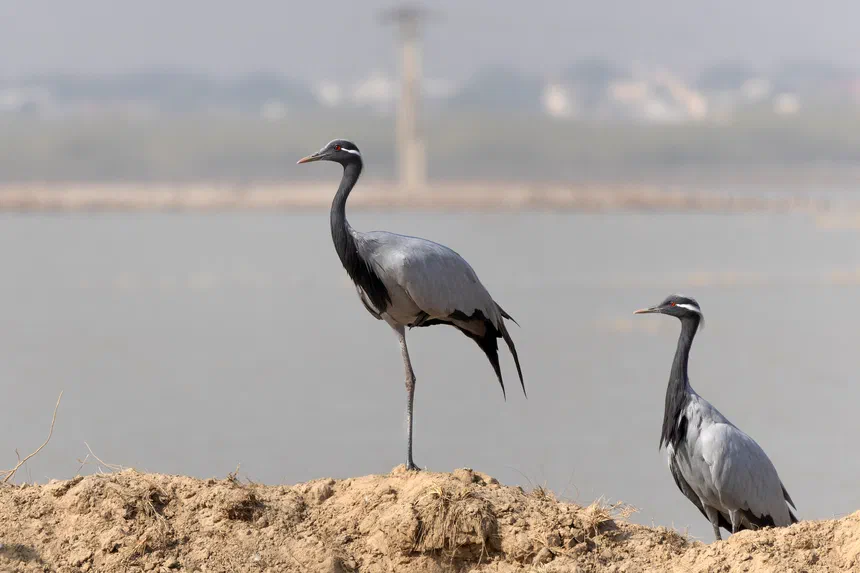
Image: Tisha Mukherjee — CC BY-SA 4.0 · source
What Is a Demoiselle Crane?
The demoiselle crane (Grus virgo) is the smallest of the world’s cranes, an elegant, long-legged bird of open grasslands and steppes across central Eurasia. Its name, meaning “young lady” in French, is said to have been coined by Marie Antoinette for the bird’s graceful, dignified bearing. Despite its slight build, it is a powerful long-distance migrant.
Appearance and Identification
The demoiselle crane stands roughly 3 feet (85-100 cm) tall and weighs about 4 to 7 pounds (2-3 kg), making it noticeably more compact than most other cranes. Its plumage is a soft, pale bluish-gray over the body, contrasting sharply with a black head, throat, and long feathered plumes that drape down the front of the neck and breast. A striking feature is the tuft of elongated white feathers that extends back from behind each eye, along with a bright red-orange iris. The bill is short and pale, tipped with a subtle blush of color, and the legs are dark. Males and females look alike, though males average slightly larger.
Habitat and Range
Demoiselle cranes breed across a broad swath of central Eurasia, from the Black Sea region and Ukraine eastward through Kazakhstan, Mongolia, and northern China. They favor open landscapes such as grassy steppes, semi-deserts, and savannas, usually within reach of shallow water like lakes, rivers, or wetlands. Unlike some cranes, they readily use cultivated farmland. In winter they undertake long migrations south, chiefly to the Indian subcontinent and to parts of sub-Saharan Africa, including the Nile Valley.
Diet
The demoiselle crane is an omnivore with a varied, opportunistic diet. Plant matter forms a large share of its intake, especially seeds, grains, and the shoots and roots of grasses and other vegetation. It also takes insects, worms, and other small invertebrates, and occasionally small vertebrates when available. Foraging birds walk steadily across fields and grassland, pecking and probing the ground, and they often gather in large flocks at agricultural sites during migration and winter.
Behavior
Demoiselle cranes are highly social outside the breeding season, forming flocks that can number in the thousands at wintering and staging grounds. They are best known for their remarkable migration, during which many populations cross the Himalayas, flying at high altitudes over some of the tallest mountains on Earth to reach their wintering grounds. Like other cranes, they are famous for elaborate dancing displays, bowing, leaping, and tossing vegetation, which help strengthen pair bonds. Their calls are loud, rolling, and trumpet-like, carrying over long distances.
Life Cycle and Reproduction
Demoiselle cranes form long-lasting, often lifelong pair bonds. Breeding takes place in spring and summer on the open steppe, where a pair defends a nesting territory. Rather than building an elaborate nest, the female typically lays her eggs, usually two, on the bare ground or amid sparse vegetation, sometimes in a shallow scrape lined with a few pebbles or bits of plant material. Both parents share incubation, which lasts about four weeks. The chicks are precocial, able to walk and follow their parents soon after hatching, and they fledge in roughly two months. Young birds stay with their parents through the first migration.
Conservation Status
The demoiselle crane is currently listed as Least Concern by the IUCN, reflecting a large overall population and an extensive range. Nevertheless, some regional populations have declined due to habitat loss from agricultural expansion, wetland drainage, hunting along migration routes, and disturbance at breeding sites. In several areas, particularly parts of India, the species is protected and even celebrated, with communities providing supplemental feeding for wintering flocks.
Frequently Asked Questions
Why is it called a demoiselle crane? The name comes from the French word for a young lady or maiden, a nod to the bird’s slender, graceful appearance and delicate movements.
How high do demoiselle cranes fly during migration? Migrating flocks are known to cross the Himalayas, flying at altitudes of several thousand meters, among the most demanding migrations of any bird.
What is the smallest crane species? The demoiselle crane holds that title, standing only about 3 feet tall and weighing far less than larger relatives such as the sarus or common crane.