Birds Guide
Dalmatian Pelican
What Is a Dalmatian Pelican? The Dalmatian pelican (Pelecanus crispus) is one of the largest freshwater birds in the world and the biggest of the eight living pelican species. It is a heavy-bodied waterbird of southern …
At a glance
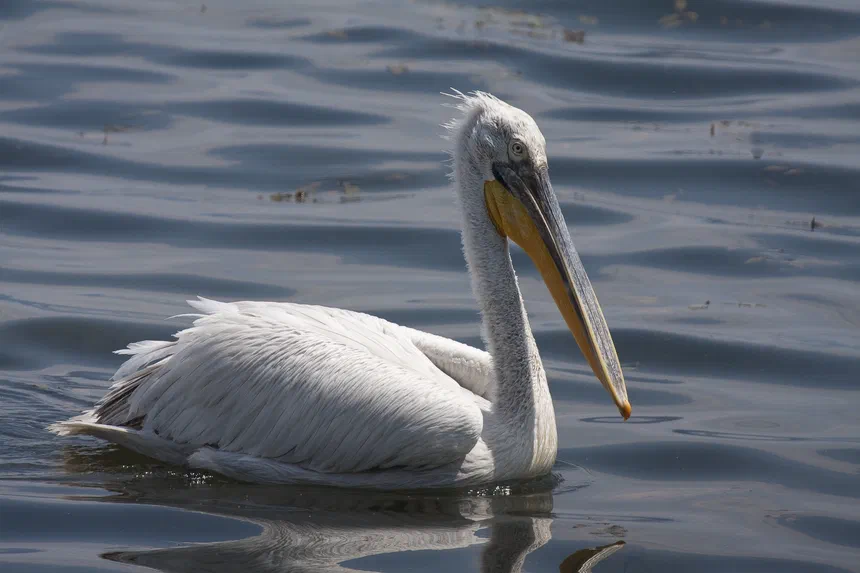
Image: Mike_Charitakis — CC BY-SA 4.0 · source
What Is a Dalmatian Pelican?
The Dalmatian pelican (Pelecanus crispus) is one of the largest freshwater birds in the world and the biggest of the eight living pelican species. It is a heavy-bodied waterbird of southern and eastern Europe and Asia, easily recognized by its curly nape feathers and enormous fish-catching bill.
Appearance and Identification
This is a massive pelican with a total length of roughly 160 to 183 cm and a wingspan that can stretch from about 290 to 345 cm, making it one of the largest of all flying birds. Adults typically weigh between 10 and 13 kg. The plumage is silvery-white to pale gray, and loose, curly feathers on the crown and nape give the bird a shaggy appearance. The legs are gray, and unlike the white pelican it lacks black underwing contrast that is obvious in flight. During the breeding season the throat pouch turns a vivid orange-red, and the bare skin around the eye brightens, while for much of the year the pouch fades to a duller yellowish tone.
Habitat and Range
Dalmatian pelicans favor large, shallow wetlands including freshwater lakes, marshes, river deltas, and brackish coastal lagoons. Breeding colonies are scattered from the Balkans and Greece eastward across the Black Sea and Caspian regions into Central Asia, Mongolia, and China. Northern populations are migratory, moving south in winter to the eastern Mediterranean, the Middle East, and the Indian subcontinent, while some southern populations remain closer to their breeding grounds year-round.
Diet
The species is carnivorous and feeds almost entirely on fish. It targets a wide variety of species depending on location, often eels, carp, catfish, perch, and other freshwater or coastal fish. A single bird may eat around 1 to 2 kg of fish per day. Dalmatian pelicans usually forage alone or in small loose groups rather than the coordinated flotillas seen in some other pelicans, dipping the head and scooping prey into the expandable pouch, then draining the water before swallowing.
Behavior
Despite their bulk, Dalmatian pelicans are strong, soaring fliers that use thermals to travel long distances with slow, deliberate wingbeats. They are generally quieter and less gregarious than the great white pelican, though they still nest and roost in colonies. On the water they float high and buoyant, and they spend considerable time preening and resting on sandbars, islands, and reed beds. Outside the breeding season they are largely silent, but at colonies they produce a range of grunts and hisses.
Life Cycle and Reproduction
Breeding usually begins in late winter or spring. Pairs are seasonally monogamous and nest in colonies on islands, dense reed beds, or floating vegetation. The nest is a large, untidy mound of reeds, grass, and sticks bound with droppings. Females typically lay one to three chalky-white eggs, which both parents incubate for roughly 30 to 34 days. The chicks hatch naked and helpless and are fed regurgitated fish; they fledge at around 11 to 12 weeks. Young birds take three to four years to reach breeding maturity, and wild individuals may live 25 to 35 years.
Conservation Status
The Dalmatian pelican is listed as Near Threatened by the IUCN, an improvement from earlier, more worrying assessments thanks to successful protection efforts. Historic declines were driven by wetland drainage, hunting, disturbance at colonies, and collisions with power lines. Conservation measures such as installing artificial nesting rafts, protecting key wetlands, and reducing power-line mortality have helped several populations recover, though the species remains vulnerable to habitat loss and outbreaks of avian influenza.
Frequently Asked Questions
How big is a Dalmatian pelican? It is among the largest flying birds, measuring roughly 160 to 183 cm long with a wingspan up to about 3.4 meters and weighing 10 to 13 kg.
What do Dalmatian pelicans eat? They eat almost exclusively fish, consuming around 1 to 2 kg per day, and typically forage alone rather than in coordinated groups.
Are Dalmatian pelicans endangered? They are currently listed as Near Threatened. Targeted conservation, including artificial nest platforms and wetland protection, has helped populations recover from earlier declines.