Birds Guide
Common Kingfisher
What Is a Common Kingfisher? The common kingfisher (Alcedo atthis) is a small, brilliantly colored bird found beside fresh water across much of Europe, Asia, and North Africa. Despite its jewel-like plumage, it is often …
At a glance
What Is a Common Kingfisher?
The common kingfisher (Alcedo atthis) is a small, brilliantly colored bird found beside fresh water across much of Europe, Asia, and North Africa. Despite its jewel-like plumage, it is often first noticed as a flash of electric blue skimming low over a river. It belongs to the kingfisher family Alcedinidae and is the only kingfisher species regularly seen across most of Europe.
Appearance and Identification
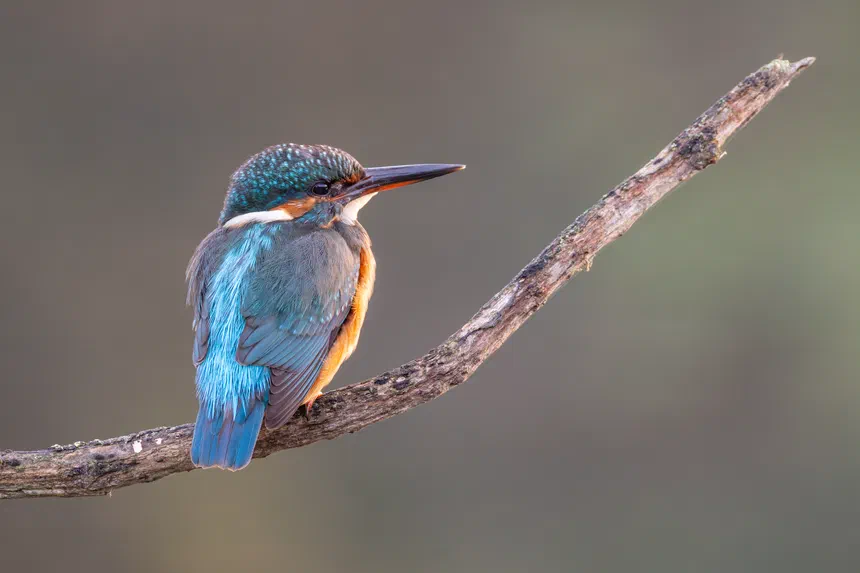
This is a compact, big-headed bird with a short tail and a long, dagger-shaped bill. The upperparts shine with iridescent blue and green, while a bright band down the back can appear almost turquoise in flight. The underparts and a patch behind the eye are warm orange, and there are white flashes on the throat and neck. The colors come largely from the structure of the feathers rather than pigment, so they seem to shift with the angle of light. Males and females look alike except at the bill: the female has an orange-red base to the lower mandible, while the male’s bill is all black. Juveniles are duller with darker legs.
Habitat and Range
Common kingfishers favor clear, slow-moving or still fresh water with plenty of small fish and low perches such as overhanging branches or reeds. Typical sites include rivers, streams, canals, ponds, lakes, and the edges of lowland wetlands. In winter, birds in colder regions may move to coasts, estuaries, and harbors where water stays unfrozen. The species ranges widely from Ireland and Iberia across Europe and Asia to Japan and Southeast Asia, and into North Africa. Northern populations are migratory, while those in milder climates tend to stay year-round.
Diet
The common kingfisher is a fish-eating hunter. Small fish such as minnows and sticklebacks make up most of the diet, supplemented by aquatic insects, tadpoles, and small crustaceans. It usually hunts from a perch overlooking the water, watching for prey below. Spotting a target, it plunges headfirst in a swift dive, seizes the prey in its bill, and returns to the perch. There it beats the fish against the branch to stun it before swallowing it head-first, and later coughs up pellets of indigestible bones and scales. A bird may need to eat close to its own body weight in fish each day.
Behavior
These birds are usually solitary outside the breeding season and can be strongly territorial, defending a stretch of waterway against rivals. Flight is fast and direct, typically just above the water surface, accompanied by a high, shrill whistle that often reveals the bird before it is seen. A hunting kingfisher may hover briefly over open water when no perch is available. It bathes by plunge-diving and preens frequently to keep its plumage waterproof and clean.
Life Cycle and Reproduction
Common kingfishers nest in burrows that both parents dig into a vertical earth bank close to water, tunneling in to a chamber at the end. The female usually lays around six or seven glossy white eggs, and both adults share incubation over roughly three weeks. The chicks hatch naked and are fed a steady supply of small fish by both parents. They fledge at around three to four weeks old and become independent soon after. In favorable conditions a pair may raise two or even three broods in a single season, which helps offset high natural mortality.
Conservation Status
The common kingfisher is listed as Least Concern by the IUCN thanks to its very large range and sizable global population. Even so, local numbers can fluctuate sharply, and hard winters that freeze waterways can cause steep short-term declines. The main long-term threats are water pollution, channel engineering, and the loss of natural earth banks needed for nesting. Clean rivers and undisturbed banks are the keys to healthy local populations.
Frequently Asked Questions
Why is the common kingfisher so blue? The blue and green tones come mainly from the microscopic structure of the feathers scattering light, not from blue pigment, which is why the color seems to shift as the bird moves.
How can you tell a male from a female? Look at the lower bill: females show an orange-red base, while males have an entirely black bill. Their plumage is otherwise very similar.
Where does the common kingfisher build its nest? It excavates a tunnel into a bare vertical bank of earth beside the water, ending in a nesting chamber where the eggs are laid.