Birds Guide
Sulphur-Crested Cockatoo
What Is a Sulphur-Crested Cockatoo? The sulphur-crested cockatoo (Cacatua galerita) is a large, boldly white parrot best known for the striking yellow crest it raises when excited or alarmed. Native to Australia and New …
At a glance
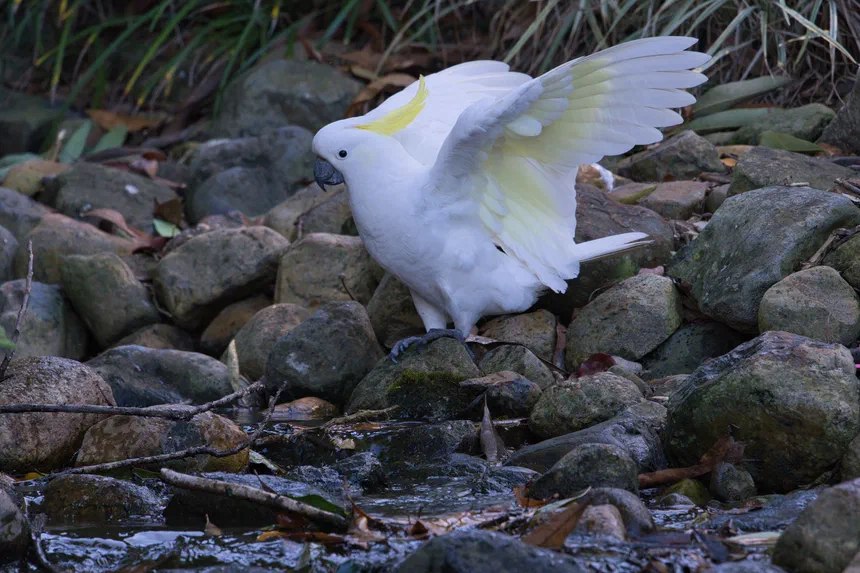
Image: Andrew Mercer (www.baldwhiteguy.co.nz) — CC BY-SA 4.0 · source
What Is a Sulphur-Crested Cockatoo?
The sulphur-crested cockatoo (Cacatua galerita) is a large, boldly white parrot best known for the striking yellow crest it raises when excited or alarmed. Native to Australia and New Guinea, it is among the most recognizable and vocal members of the cockatoo family, thriving in both wild bushland and busy city suburbs.
Appearance and Identification
This cockatoo is a big, sturdy parrot with brilliant white body feathers and a forward-curving crest of narrow yellow plumes. Adults typically measure about 44 to 55 centimeters (17 to 22 inches) from head to tail and weigh roughly 800 to 1,000 grams, with birds from some regions running larger. The underside of the wings and tail shows a soft wash of yellow, most visible in flight. The bill is heavy and dark gray to black, and the bare skin around the eye is whitish. Males and females look nearly identical, though the female’s iris tends toward a reddish-brown while the male’s is dark, a difference usually visible only at close range.
Habitat and Range
The species occupies a broad range across northern and eastern Australia, extending into New Guinea and several nearby islands. It is highly adaptable, occupying tropical and subtropical rainforest edges, open eucalypt woodlands, savanna, agricultural land, and increasingly the parks and gardens of towns and cities. Introduced populations also persist in parts of New Zealand and elsewhere. Access to water and to tall trees with hollows for nesting shapes where flocks settle.
Diet
Sulphur-crested cockatoos are omnivorous foragers with a strong preference for plant matter. Their diet centers on seeds, grains, nuts, berries, fruit, bulbs, and roots, supplemented by leaf buds, flowers, and the occasional insect or larva. Powerful jaws and a hooked bill let them crack hard seed casings and dig for underground tubers. Large flocks often feed on the ground and can strip crops or newly sown fields, which has made them unpopular with some farmers. In suburban areas they readily take handouts and raid gardens.
Behavior
These are intelligent, social, and famously noisy birds. They gather in flocks that can number from a handful to several hundred, filling the air with harsh, screeching calls that carry over long distances. While a flock feeds, one or more birds often perch high as sentinels, sounding an alarm if a threat approaches. Cockatoos are strong, curious problem-solvers; wild individuals have learned to open trash-bin lids and manipulate latches, and captive birds can mimic sounds and words. They are known for long lifespans and strong pair bonds, and playful behavior such as hanging upside down or stripping bark is common.
Life Cycle and Reproduction
Sulphur-crested cockatoos form lasting pair bonds and nest in hollows of tall, often old-growth, trees, sometimes lining the cavity with wood chips. Breeding timing varies by region, generally the drier winter months in the north and spring to summer in the south. The female usually lays two to three eggs, and both parents share incubation over roughly a month. Chicks are born helpless and remain in the nest for six to nine weeks before fledging, then stay with their parents for a further period while learning to forage. Birds may not breed until several years old, and in the wild they can live for several decades, with much greater ages recorded in captivity.
Conservation Status
The sulphur-crested cockatoo is listed as Least Concern by the IUCN, reflecting a large population and a wide, stable range. The species has adapted well to human-altered landscapes and is in no immediate danger. Localized pressures do exist, including habitat loss of nesting hollows, capture for the pet trade, and conflict with farmers who regard feeding flocks as agricultural pests. Overall, however, the bird remains common and, in many areas, abundant.
Frequently Asked Questions
Why does the cockatoo raise its yellow crest? The crest is a signal of mood. A bird raises it when excited, curious, alarmed, or displaying to others, and lowers it when calm or relaxed.
How long do sulphur-crested cockatoos live? In the wild they commonly reach 20 to 40 years, and well-cared-for captive birds can live substantially longer, sometimes past 60 years.
Can they really talk? Yes. Like many parrots they are skilled mimics and can learn to imitate words, whistles, and household sounds, though ability varies by individual.