Birds Guide
Cockatiel
What Is a Cockatiel? The cockatiel (Nymphicus hollandicus) is a small, crested parrot native to Australia and the smallest member of the cockatoo family. Recognizable by its upright crest, slender tail, and bright orange …
At a glance
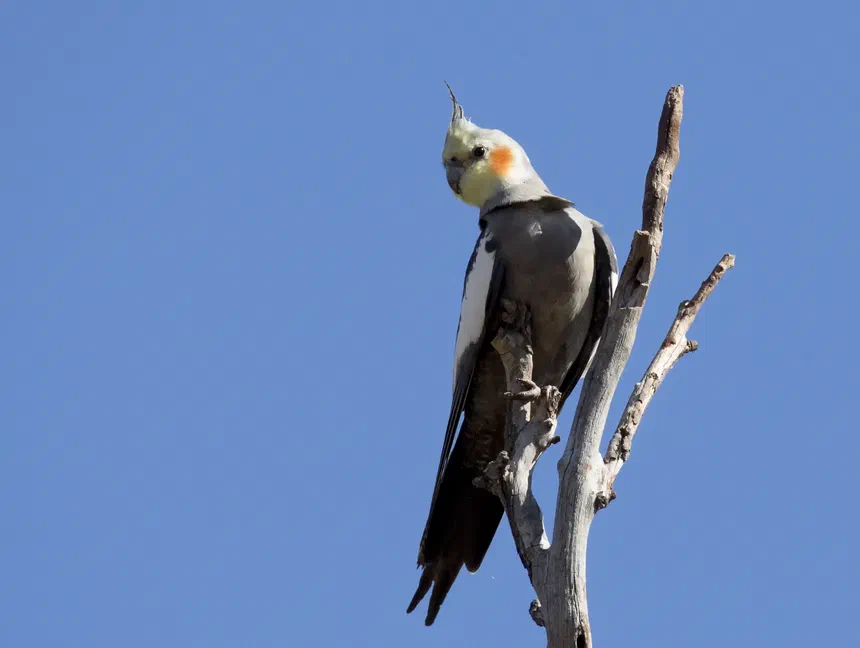
Image: Jim Bendon — CC BY-SA 2.0 · source
What Is a Cockatiel?
The cockatiel (Nymphicus hollandicus) is a small, crested parrot native to Australia and the smallest member of the cockatoo family. Recognizable by its upright crest, slender tail, and bright orange cheek patch, it is one of the most popular companion birds in the world, second only to the budgerigar among pet parrots.
Appearance and Identification
Cockatiels are slim, medium-tailed parrots measuring roughly 12 to 13 inches (30 to 33 cm) from head to tail tip, with much of that length made up by the pointed tail. They weigh only about 2.5 to 4.5 ounces (70 to 125 grams). Wild birds are predominantly gray with a paler underside, a distinctive expressive crest, white or pale-gray wing patches, and a round orange spot on each cheek. Males typically have a brighter yellow face and head, while females and juveniles show duller facial coloring and often display barring or spotting on the underside of the tail. Decades of captive breeding have produced numerous color mutations, including lutino (yellow-white), pied, pearl, cinnamon, and whiteface varieties.
Habitat and Range
Cockatiels are found across the arid and semi-arid interior of the Australian mainland, avoiding the coastal fringes and dense forests. They favor open country such as savanna, scrubland, grassland, and lightly wooded areas, and are strongly tied to the presence of water. Flocks are highly nomadic, moving in response to rainfall and the availability of food and water, and they frequently gather near watercourses, farmland, and inland wetlands. Their range has likely expanded in some regions as land clearing and the spread of livestock watering points have created new foraging opportunities.
Diet
Cockatiels are herbivores, feeding mainly on the seeds of grasses and other plants. They forage largely on the ground, gathering fallen and ripening seeds, and will also take grains, berries, fruit, and the occasional plant shoot. In agricultural regions they sometimes feed on cultivated cereal crops such as sorghum and wheat. Access to drinking water is essential, and flocks commonly visit waterholes in the early morning and evening.
Behavior
Cockatiels are social, gregarious birds that live in pairs or flocks, which can swell into large aggregations of hundreds where food and water are abundant. They are strong, swift fliers capable of covering long distances during their nomadic wanderings. Vocal and communicative, they use a range of whistles and calls, and males in particular are known for elaborate whistling and song, a trait that has made them popular in captivity. The crest is a useful mood indicator: raised sharply when the bird is alert or startled, held at a relaxed angle when calm, and flattened when the bird is defensive or agitated.
Life Cycle and Reproduction
Breeding is closely tied to rainfall, so timing varies with local conditions rather than a fixed season. Cockatiels nest in tree hollows, typically near water, where the female lays a clutch of about four to seven eggs. Both parents share incubation duties, which last roughly three weeks, and both feed the hatched chicks. Young birds fledge at around four to five weeks of age but may remain dependent on their parents for a time afterward. Pairs often form long-term bonds and may raise more than one brood when conditions are favorable.
Conservation Status
The cockatiel is classified as Least Concern by the IUCN. It remains widespread and abundant across its natural range, and its adaptability to modified landscapes has helped keep populations stable. It is not considered globally threatened, though local numbers fluctuate with drought and rainfall cycles.
Frequently Asked Questions
Are cockatiels a type of cockatoo? Yes. Despite their small size, cockatiels are the smallest members of the cockatoo family, sharing features such as an erectile crest and similar breeding biology.
How can you tell males from females? In typical wild-colored birds, males usually have a brighter yellow face and lack the tail barring seen in females and juveniles, though many captive color mutations make visual sexing more difficult.
Why do cockatiels raise and lower their crest? The crest reflects the bird’s mood: it rises when the bird is curious or alarmed, sits at a relaxed angle when the bird is content, and flattens when it feels threatened or aggressive.