Birds Guide
Cattle Egret
What Is a Cattle Egret? The Cattle Egret (Bubulcus ibis) is a small, stocky white heron best known for foraging alongside grazing livestock and other large animals. Unlike most members of the heron family, which hunt in …
At a glance
What Is a Cattle Egret?
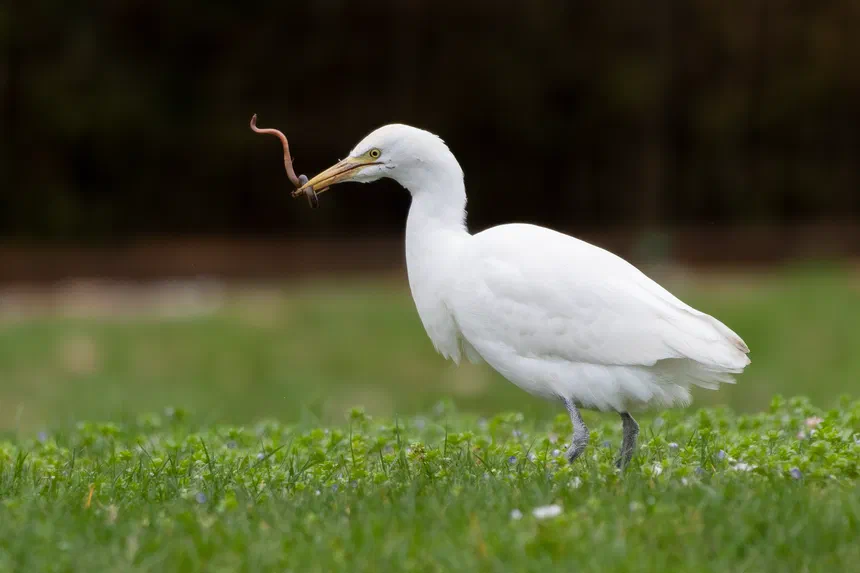
The Cattle Egret (Bubulcus ibis) is a small, stocky white heron best known for foraging alongside grazing livestock and other large animals. Unlike most members of the heron family, which hunt in water, it feeds mainly on dry land, snapping up insects flushed from the grass by moving hooves. It is one of the most successful and widely distributed birds in the world.
Appearance and Identification
The Cattle Egret is a compact heron, noticeably shorter and thicker-necked than the herons it is often confused with. Its plumage is white for most of the year, set off by a yellow bill and dull yellowish legs. During the breeding season adults develop striking buff-orange plumes on the crown, chest, and back, and the bill, legs, and facial skin can flush reddish or orange at the height of courtship. The species has a rounded head, a short thick neck usually held in a hunched posture, and a relatively short bill compared with the slender, dagger-like bills of larger egrets. In flight it shows rapid wingbeats and holds its neck tucked in the typical heron fashion.
Habitat and Range
Originally native to parts of Africa, southern Europe, and Asia, the Cattle Egret has undergone one of the most remarkable natural range expansions of any bird. It crossed the Atlantic on its own, reaching South America in the late 1800s, spread through the Americas over the following decades, and now breeds on every continent except Antarctica. It favors open, dry habitats rather than the marshes preferred by other herons: pastures, meadows, grasslands, agricultural fields, and the edges of wetlands. It readily uses human-modified landscapes and is often seen at rubbish dumps, along roadsides, and on irrigated farmland. Colonies typically nest in trees or shrubs near water, often mixed with other wading birds.
Diet
The Cattle Egret is primarily an insect eater, and grasshoppers, crickets, flies, and beetles make up much of its diet. It also takes spiders, frogs, small lizards, earthworms, and occasionally small rodents or nestling birds. Its signature feeding strategy is to follow cattle, buffalo, horses, or wild grazers such as elephants and rhinoceroses, catching the insects and small animals disturbed by their movement. Studies have shown that birds feeding beside livestock capture more prey with less effort than those foraging alone. The species also follows tractors and other farm machinery, exploiting the same flushing effect.
Behavior
Cattle Egrets are highly social and gregarious, feeding, roosting, and nesting in groups. Away from their large mammal companions they forage in loose flocks across open fields. At dusk they gather at communal roosts, often in waterside trees, that may hold hundreds or thousands of birds along with other herons and egrets. They are generally quiet away from the colony but become noisy at breeding sites, producing a range of croaks and rattling calls. Their close association with grazing animals is a form of commensal foraging in which the egret benefits while the mammal is largely unaffected, though the birds may also remove ticks and flies.
Life Cycle and Reproduction
Cattle Egrets breed in colonies, frequently alongside other wading birds. The male establishes a display territory and attracts a mate with plume-raising and posturing, showing off his breeding colors. The pair builds a relatively flimsy platform nest of sticks in a tree or shrub, and the female typically lays 3 to 5 pale bluish eggs. Both parents share incubation, which lasts around three to four weeks, and both feed the chicks by regurgitation. Young birds clamber about near the nest before they can fly and generally fledge at about a month to six weeks old. Cattle Egrets can begin breeding at one to two years of age and may live well over a decade in the wild.
Conservation Status
The Cattle Egret is listed as Least Concern by the IUCN. Its population is very large and its range continues to be broad and stable, aided by the spread of cattle ranching and irrigated agriculture that create ideal feeding grounds. Rather than declining, the species has expanded dramatically over the past century, making it a rare example of a wild bird that has thrived alongside human land use. Local populations can fluctuate, but there are no significant global conservation concerns.
Frequently Asked Questions
Why do Cattle Egrets follow cattle? The birds feed on grasshoppers, flies, and other small animals stirred up as the livestock graze and walk, which lets the egrets catch far more prey with much less effort than foraging alone.
How did the Cattle Egret spread around the world? It expanded naturally, famously crossing the Atlantic to South America on its own in the late nineteenth century, then spreading through the Americas as ranching and open pasture provided abundant feeding habitat.
Is the Cattle Egret the same as other white egrets? No. Though similar in color, it is a smaller, stockier bird with a shorter yellow bill, and it feeds on dry land near grazing animals rather than wading in water like the Great or Snowy Egret.