Birds Guide
Carolina Wren
What Is a Carolina Wren? The Carolina Wren (Thryothorus ludovicianus) is a small, energetic songbird native to the eastern half of North America. Despite its modest size, it is one of the loudest and most persistent …
At a glance
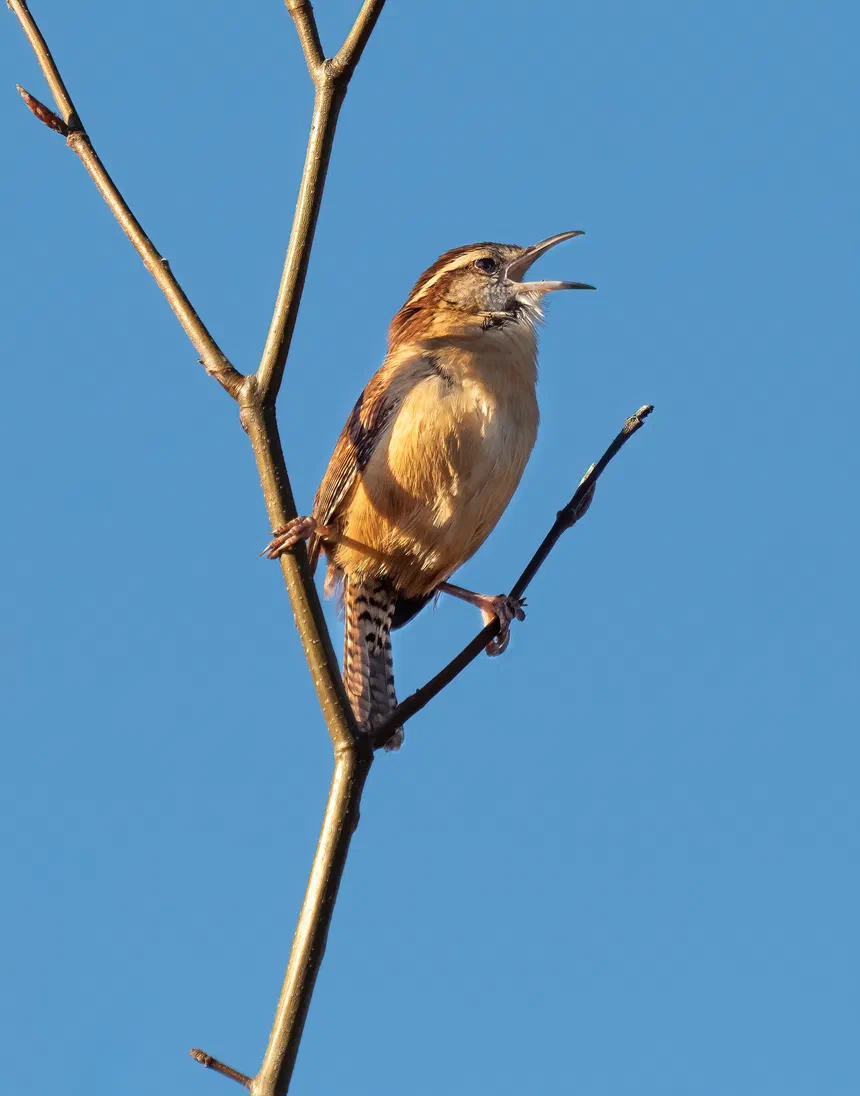
Image: Rhododendrites — CC BY-SA 4.0 · source
What Is a Carolina Wren?
The Carolina Wren (Thryothorus ludovicianus) is a small, energetic songbird native to the eastern half of North America. Despite its modest size, it is one of the loudest and most persistent singers in its range, and it is often heard long before it is seen. It belongs to the wren family, Troglodytidae, a group of mostly small, brown, insect-eating birds.
Appearance and Identification
The Carolina Wren is a compact, round-bodied bird with warm reddish-brown upperparts and a paler, cinnamon-buff belly and throat. Its most distinctive feature is a bold white stripe above each eye, running from the bill toward the back of the head. The tail is often held cocked upward at a jaunty angle, a classic wren posture, and it is marked with fine dark barring. The bill is long, slender, and slightly downcurved, well suited for probing crevices for prey. Males and females look essentially alike. At roughly 12 to 14 centimeters in length and 18 to 23 grams in weight, it is larger and more richly colored than the more widespread House Wren.
Habitat and Range
This species occupies the eastern and southeastern United States, extending south through eastern Mexico into parts of Central America. It favors dense, brushy environments: the undergrowth of moist woodlands, wooded ravines, overgrown farmland edges, swampy thickets, and suburban gardens with plenty of cover. Because it does not migrate, the Carolina Wren stays on its territory year-round. Its northern range limit is largely set by winter severity, and populations have gradually expanded northward in recent decades, likely aided by milder winters and backyard bird feeders. Harsh, snowy winters can cause sharp local declines.
Diet
The Carolina Wren is primarily insectivorous and forages actively low to the ground, hopping through leaf litter, poking into bark crevices, and inspecting tangled vegetation. Its diet is dominated by insects and other invertebrates, including beetles, caterpillars, crickets, ants, and spiders. In colder months, when insects are scarce, it supplements its diet with seeds, small fruits, and berries, and it will readily visit feeders for suet, peanuts, and mealworms. This dietary flexibility helps it survive winters that would challenge a strictly insect-eating bird.
Behavior
Loud, curious, and constantly on the move, the Carolina Wren is best known for its rich, rolling song, often described as a repeated “teakettle-teakettle-teakettle.” Only the male sings this territorial song, and he may repeat it many times per minute throughout the year. The species is monogamous, and paired birds typically remain together on a shared territory that they defend year-round. They are also known for nesting in unusual, human-associated spots such as mailboxes, hanging plants, garages, and flowerpots.
Life Cycle and Reproduction
Carolina Wrens form long-term pair bonds and often raise two or more broods in a single breeding season, generally from early spring into late summer. The domed or cup-shaped nest, built of leaves, grasses, bark, and moss with a side entrance, is tucked into cavities, crevices, or dense vegetation. The female lays a clutch of about 4 to 6 eggs and incubates them for roughly two weeks. Both parents feed the nestlings, which fledge about 12 to 14 days after hatching. Young birds may remain near their parents for a short period before dispersing to establish their own territories.
Conservation Status
The Carolina Wren is listed as Least Concern by the IUCN, reflecting a large range and a generally stable or increasing overall population. It benefits from its adaptability to gardens and suburban habitats and from the popularity of backyard feeding, which aids winter survival. The main natural threat is severe winter weather, which can sharply reduce numbers at the northern edge of its range, though populations typically rebound over subsequent mild years.
Frequently Asked Questions
Why is the Carolina Wren so loud for its size? The male sings a powerful, repeated territorial song to defend his year-round territory and stay in contact with his mate. Its volume and persistence make it seem much larger than it actually is.
Do Carolina Wrens migrate? No. They are year-round residents that hold their territories through all seasons, which is why harsh winters can affect them so strongly.
Will Carolina Wrens use backyards and feeders? Yes. They readily nest in sheltered spots around homes and visit feeders for suet, peanuts, and mealworms, especially in winter.