Birds Guide
California Condor
What Is a California Condor? The California condor (Gymnogyps californianus) is a giant New World vulture and the largest flying land bird in North America. Once teetering on the very edge of extinction, it has become …
At a glance
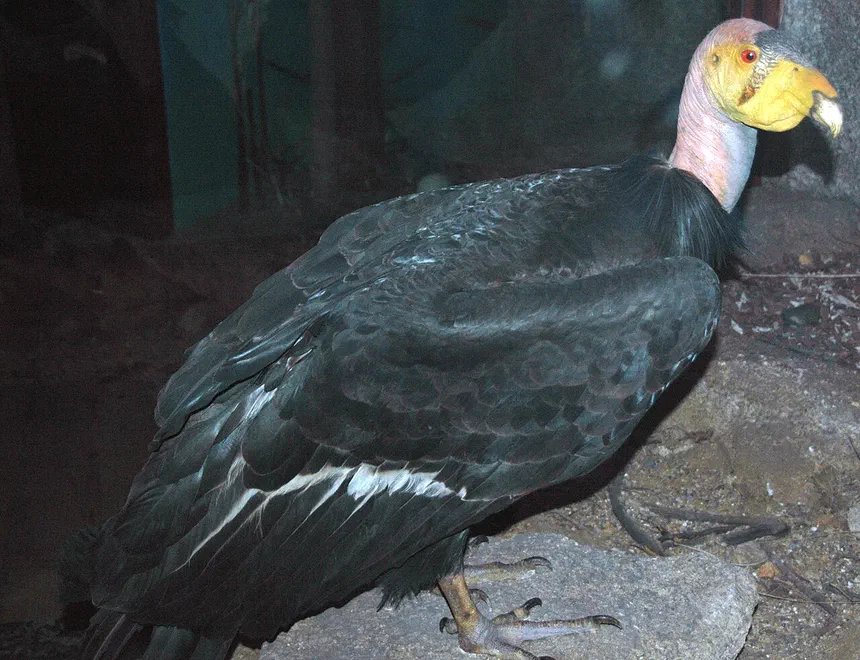
What Is a California Condor?
The California condor (Gymnogyps californianus) is a giant New World vulture and the largest flying land bird in North America. Once teetering on the very edge of extinction, it has become one of the most famous conservation stories in the world, brought back from a wild population of just a few individuals through intensive captive breeding.
Appearance and Identification
Adult California condors are unmistakable. Their plumage is a deep, glossy black, broken by broad triangular patches of white on the underside of each wing that are most visible in flight. The head and upper neck are bare of feathers, ranging from pinkish to orange and even reddish, and the skin color can flush and change with the bird’s mood. A ruff of black feathers encircles the base of the neck. With a wingspan approaching 9 to 10 feet, condors soar on long, broad, finger-tipped wings held nearly flat. Juveniles are duskier, with grayish heads that gradually brighten as the birds mature over several years.
Habitat and Range
Historically, California condors ranged across much of North America. By the twentieth century their range had collapsed to a small area of southern and central California. Today, thanks to reintroduction programs, wild and released birds occur in parts of California, northern Arizona and southern Utah near the Grand Canyon, and Baja California in Mexico. Condors favor open country with cliffs, rocky outcrops, and tall trees for nesting and roosting, combined with nearby foraging grounds such as oak savanna, grassland, and coastal ranges where carcasses can be found.
Diet
Condors are obligate scavengers, meaning they eat only carrion and do not hunt live prey. They feed on the carcasses of large mammals, including deer, cattle, ground squirrels, and, along the coast, marine animals such as sea lions and whales. Their keen eyesight helps them locate carcasses, and they will often follow other scavengers to a meal. Because a large carcass provides a huge quantity of food, condors can gorge themselves and then go for days without eating, storing food in a crop at the base of the neck.
Behavior
California condors are highly social at feeding sites and roosts, where dominance hierarchies determine access to a carcass. They are masters of soaring flight, using thermals and updrafts to travel long distances with little wing-flapping, sometimes covering well over a hundred miles in a single day. Like other vultures, condors practice urohidrosis, excreting onto their own legs to help cool down in hot weather. They are long-lived, intelligent birds that form lasting pair bonds and appear to learn foraging routes and social behaviors over many years.
Life Cycle and Reproduction
Condors are slow to reproduce, which makes their recovery difficult. They do not begin breeding until around six to eight years of age. A mated pair typically lays a single egg, often nesting in a cave, cliff crevice, or large tree cavity, and only breeds every other year in many cases. Both parents share incubation, which lasts roughly two months, and both feed the chick. Young condors are dependent on their parents for many months and may not become fully independent until well over a year old. This extended parental care limits how quickly populations can grow.
Conservation Status
The California condor is listed as Critically Endangered. By 1987 the entire wild population had been captured for a last-ditch captive breeding program, leaving no condors in the wild. Careful breeding and release efforts have since raised the total population into the hundreds, with roughly half now flying free. The greatest ongoing threat is lead poisoning from spent ammunition in carcasses the birds scavenge; other hazards include collisions, microtrash ingestion by chicks, and habitat pressures. Recovery remains dependent on continued human management.
Frequently Asked Questions
How big is a California condor? It is the largest flying land bird in North America, with a wingspan that can approach 9 to 10 feet and a weight of up to about 31 pounds.
Why did California condors nearly go extinct? Lead poisoning, poaching, poisoning, habitat loss, and their naturally slow reproduction drove numbers so low that all remaining wild birds were taken into captivity in 1987.
Are California condors coming back? Yes. Through captive breeding and reintroduction, the population has grown from a couple dozen birds to several hundred, though the species still relies heavily on active conservation.