Birds Guide
Budgerigar
What Is a Budgerigar? The budgerigar (Melopsittacus undulatus), often called a budgie or, in the pet trade, a parakeet, is a small, long-tailed parrot native to Australia. It is the only species in its genus and ranks …
At a glance
What Is a Budgerigar?
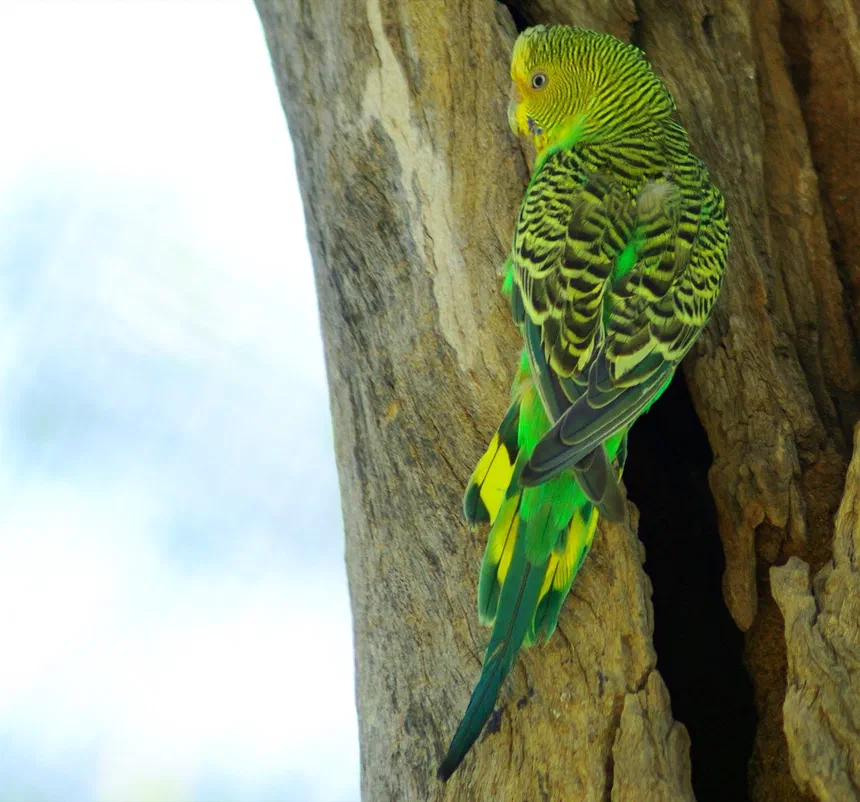
The budgerigar (Melopsittacus undulatus), often called a budgie or, in the pet trade, a parakeet, is a small, long-tailed parrot native to Australia. It is the only species in its genus and ranks among the most popular companion birds in the world, prized for its bright plumage, sociable nature, and ability to mimic human speech.
Appearance and Identification
Wild budgerigars are compact birds roughly 7 inches (18 centimeters) long, including the tapering tail, and weigh about 1 to 1.4 ounces (30 to 40 grams). Their natural plumage is grass-green on the underparts and rump, with a yellow head and fine black scalloped barring across the wings, nape, and back. A patch of small dark throat spots and violet cheek marks help identify adults. The cere, the fleshy area above the beak, is typically blue in males and tan or brown in breeding females, offering a rough guide to sex. Selective breeding in captivity has produced an enormous range of colors, including blue, white, gray, violet, and yellow, that never occur naturally in the wild.
Habitat and Range
Budgerigars are found across the arid and semi-arid interior of Australia. They favor open habitats such as grasslands, scrub, and lightly wooded plains where seeding grasses are abundant. Highly nomadic, flocks move opportunistically in response to rainfall and food availability rather than following fixed migration routes. In dry years they may travel long distances in search of water and fresh seed, and they typically stay within reach of watering points.
Diet
These parrots are herbivores that feed chiefly on the seeds of native grasses and other low-growing plants. They forage on the ground and among seeding stems, often in large flocks that can strip a productive patch quickly. Access to water is essential, and budgerigars usually drink daily, visiting pools and waterholes in the cooler parts of the day. In captivity their diet is commonly supplemented with seed mixes, pelleted foods, and fresh vegetables.
Behavior
Budgerigars are intensely social and are almost always seen in groups, which can swell into flocks of many hundreds or even thousands where conditions are good. Flocking provides safety from predators and helps birds locate scattered food and water. They are active, agile fliers and keep up a constant chatter of chirps and warbles that helps maintain contact within the flock. Their capacity for vocal learning underlies the mimicry that makes them popular pets.
Life Cycle and Reproduction
Breeding is closely tied to rainfall and the flush of seeding grasses that follows, so it can occur at almost any time of year when conditions are right. Budgerigars are cavity nesters, laying their eggs in hollows in trees, logs, or fence posts. A typical clutch contains around four to six eggs, which the female incubates for roughly 18 to 21 days while the male brings food. Chicks hatch naked and helpless and fledge about a month after hatching. Under favorable conditions pairs may raise more than one brood in quick succession.
Conservation Status
The budgerigar is listed as Least Concern by the IUCN. It remains widespread and abundant across its natural range, and its population can fluctuate dramatically with rainfall and food supply. As one of the most widely kept cage birds on Earth, it is in no danger of extinction, though local wild numbers rise and fall with the boom-and-bust cycles of the Australian interior.
Frequently Asked Questions
Are budgerigars and parakeets the same bird? Yes. In much of the world, especially the United States, the budgerigar is commonly sold under the name “parakeet.” “Parakeet” is a broad term for many small, long-tailed parrots, but the budgie is the species most people mean.
Can budgerigars really talk? Many can. Budgerigars are skilled vocal mimics, and some individuals learn to repeat dozens of words and phrases, though ability varies from bird to bird.
How long do budgerigars live? In the wild they usually live only a few years, but well-cared-for pets often reach 5 to 10 years or more.
References
The conservation status and key facts in this profile are supported by these sources:
- Animal Diversity Web — Melopsittacus undulatus (Budgerigar) (accessed 2026-07-29)
- GBIF — Melopsittacus undulatus (Shaw, 1805) (accessed 2026-07-29)
Found an error, source problem, or image concern? Report this page.