Birds Guide
Blue-Footed Booby
What Is a Blue-Footed Booby? The blue-footed booby (Sula nebouxii) is a large seabird of the eastern Pacific, instantly recognized by its vivid blue webbed feet. It belongs to the family Sulidae, which includes gannets …
At a glance
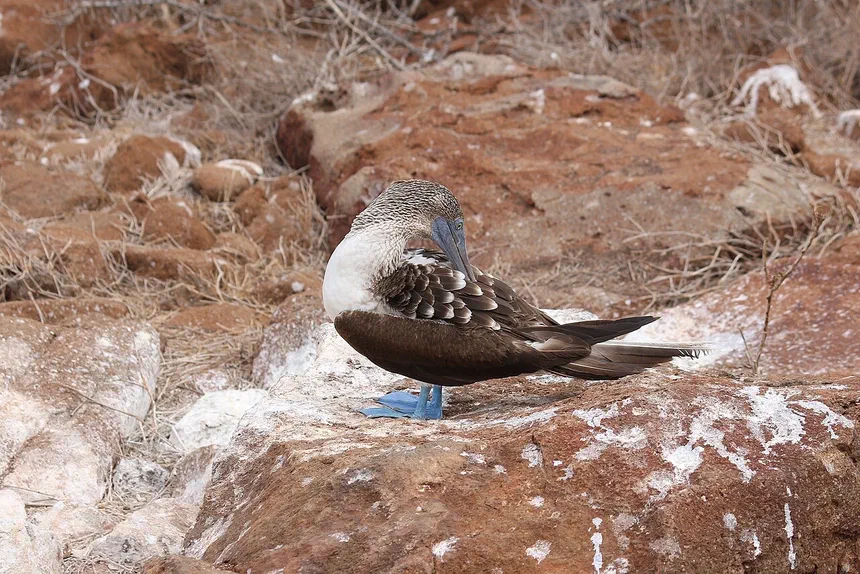
Image: Bernard Gagnon — CC BY-SA 4.0 · source
What Is a Blue-Footed Booby?
The blue-footed booby (Sula nebouxii) is a large seabird of the eastern Pacific, instantly recognized by its vivid blue webbed feet. It belongs to the family Sulidae, which includes gannets and other boobies, and is famous both for its striking coloration and its comical courtship dance.
Appearance and Identification
Adults have mottled brown wings and back, a white underside, and a streaked brown-and-white head and neck. The most distinctive feature is the pair of bright turquoise to cobalt-blue feet, which range in shade from pale blue to deep aqua depending on the bird’s diet and health. The bill is long, pointed, and grayish-blue, and the eyes are yellow, set forward for binocular vision. Females are slightly larger than males and have a darker-looking pupil ringed by more pigment. Standing roughly 32 to 34 inches long with a wingspan near five feet, the species has a streamlined, torpedo-shaped body suited to plunge-diving.
Habitat and Range
Blue-footed boobies live along tropical and subtropical shores of the eastern Pacific Ocean. Their range stretches from the Gulf of California and western Mexico south through Central America to Ecuador and Peru, with a well-known population in the Galapagos Islands. They nest on rocky coasts, cliffs, and flat islands with sparse vegetation, and spend much of their time foraging over coastal and offshore waters. About half the world’s breeding pairs are thought to nest in the Galapagos.
Diet
This bird is a specialized fish-eater, feeding mainly on small schooling species such as sardines, anchovies, mackerel, and flying fish, along with the occasional squid. It hunts by plunge-diving, folding its wings and dropping from heights of up to about 80 feet to spear into the water at high speed. Air sacs in the skull help cushion the impact. Boobies often fish cooperatively in flocks, and males, being lighter, can dive in shallower water than the heavier females, letting a pair exploit slightly different feeding zones.
Behavior
Blue-footed boobies are highly social and gather in large colonies on land. They are best known for an elaborate courtship display in which the male lifts his blue feet one at a time in an exaggerated, high-stepping strut, then points his bill and wings skyward in a posture called “sky-pointing” while whistling. Foot color signals fitness, since the blue pigment comes from carotenoids in fresh fish, so brighter feet advertise a well-fed, healthy mate. On land these birds are somewhat clumsy, but in the air and water they are agile and powerful.
Life Cycle and Reproduction
Pairs form after the courtship display and often reunite in successive breeding seasons, though they are not strictly lifelong mates. Nesting occurs on bare ground, where the female lays one to three eggs in a simple scrape ringed by guano. Both parents share incubation, using their warm, blood-rich feet to cover the eggs since boobies lack a brood patch. Chicks hatch after roughly six weeks and are fed regurgitated fish. In lean years the older, stronger chick may outcompete or eliminate its younger sibling, a survival strategy tied to food availability. Young birds fledge in a few months and reach breeding age at around three to four years.
Conservation Status
The blue-footed booby is listed as Least Concern by the IUCN, reflecting a wide range and a large overall population. Even so, some regional populations, notably in the Galapagos, have shown worrying long-term declines, likely linked to shifts in the abundance of sardines and other prey fish. Overfishing, pollution, climate-driven changes in ocean productivity, and disturbance at nesting colonies are the main pressures the species faces.
Frequently Asked Questions
Why are the booby’s feet blue? The blue color comes from carotenoid pigments obtained through their fish diet. Because only healthy, well-fed birds display vivid blue feet, foot color serves as an honest signal of fitness during courtship.
Where does the name “booby” come from? It likely derives from the Spanish word “bobo,” meaning fool or clown, a nod to the bird’s clumsy movements on land and its apparent tameness around humans.
How do blue-footed boobies catch fish? They plunge-dive, plummeting from considerable heights and hitting the water like darts to seize small schooling fish, often hunting in coordinated flocks.
References
The conservation status and key facts in this profile are supported by these sources:
- Animal Diversity Web — Sula nebouxii (blue-footed booby) (accessed 2026-07-29)
- GBIF — Sula nebouxii Milne-Edwards, 1882 (accessed 2026-07-29)
Found an error, source problem, or image concern? Report this page.