Birds Guide
Belted Kingfisher
What Is a Belted Kingfisher? The belted kingfisher (Megaceryle alcyon) is a stocky, big-headed waterbird found near freshwater and coastal waters across North America. It belongs to the kingfisher family and is best …
At a glance
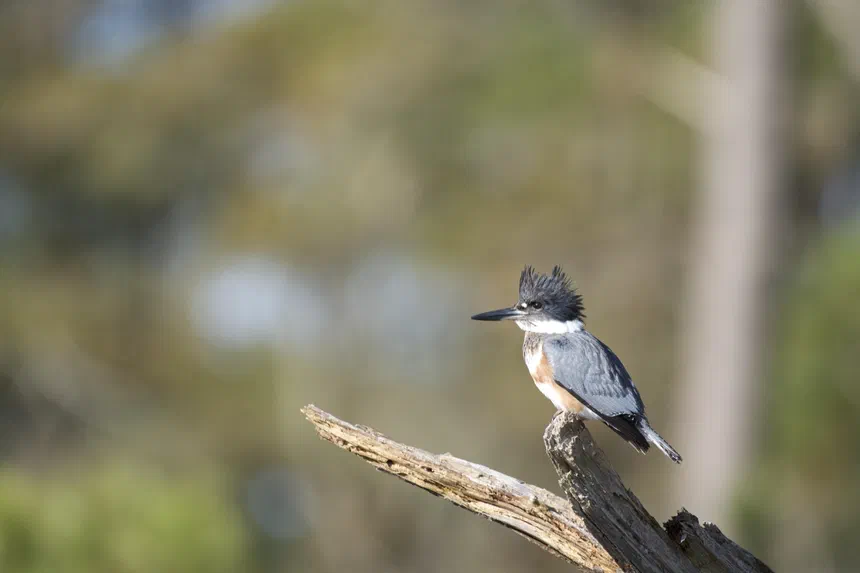
What Is a Belted Kingfisher?
The belted kingfisher (Megaceryle alcyon) is a stocky, big-headed waterbird found near freshwater and coastal waters across North America. It belongs to the kingfisher family and is best known for its rattling call, shaggy crest, and its habit of plunging headfirst into water to catch fish.
Appearance and Identification
This medium-sized bird has a large head with a ragged double-pointed crest, a heavy dagger-like bill, and short legs. Adults are slate blue-gray above and white below, with a blue-gray band across the chest. Unusually among birds, the female is more colorful than the male: she adds a rusty-brown band and flanks below the blue breast band, while the male shows only the single gray band. Both sexes have a white collar around the neck and a small white spot near each eye.
Habitat and Range
Belted kingfishers live along a wide variety of water bodies, including rivers, streams, lakes, ponds, marshes, estuaries, and rocky sea coasts. They favor clear, calm or slow-moving water where fish are visible near the surface, and they need nearby exposed perches for hunting and steep earthen banks for nesting. The species breeds across most of Canada and the United States and winters from the southern United States down through Mexico, Central America, the Caribbean, and occasionally into northern South America. Birds in the far north migrate south as waters freeze, while those in milder regions may remain year-round.
Diet
Fish make up the bulk of the belted kingfisher’s diet, typically small species caught in shallow water. It also takes crayfish, aquatic insects, amphibians, small reptiles, and occasionally young birds or small mammals. The bird hunts by watching from a perch or by hovering above the water, then diving headfirst to seize prey with its bill. Larger catches are carried back to a perch and beaten against it before being swallowed head-first. Like many fish-eating birds, kingfishers cough up compact pellets of indigestible bones and scales.
Behavior
Belted kingfishers are solitary and strongly territorial for much of the year, and they announce themselves with a loud, dry rattling call as they fly along a shoreline. Each bird typically defends a stretch of waterway, patrolling it from favored perches. Their flight is direct and slightly uneven, often low over the water. Outside the breeding season males and females usually hold separate territories rather than staying paired.
Life Cycle and Reproduction
During courtship, pairs form and excavate a nesting burrow together, digging a tunnel one to several feet long into a steep dirt or sand bank, usually near water. The tunnel ends in a chamber where the female lays roughly 5 to 8 white eggs. Both parents share incubation, which lasts about three weeks, and both feed the young. Chicks hatch naked and helpless and remain in the burrow for around a month before fledging. Young birds continue to be fed and taught to fish for a short period after leaving the nest. Kingfishers generally raise one brood per year, though a second is possible in warmer regions.
Conservation Status
The belted kingfisher is listed as Least Concern by the IUCN and remains widespread across its range. However, local populations can decline where water pollution reduces prey, where suitable nesting banks are lost to development, or where shorelines are heavily disturbed. Because it depends on clean water and abundant small fish, the species is often considered a useful indicator of the health of aquatic habitats.
Frequently Asked Questions
Why is the female belted kingfisher more colorful than the male? Females have an extra rusty band and rufous flanks that males lack. This reversed pattern is unusual among birds, and researchers believe it may play a role in mate choice and pair bonding.
How does a belted kingfisher catch fish? It watches from a perch or hovers over the water, then dives headfirst to grab prey with its long bill. It returns to a perch to stun and swallow the catch.
Where do belted kingfishers nest? They dig long tunnels into steep earthen or sandy banks near water, ending in a nesting chamber where the eggs are laid.
References
The conservation status and key facts in this profile are supported by these sources:
- Animal Diversity Web — Megaceryle alcyon (Belted Kingfisher) (accessed 2026-07-29)
- GBIF — Megaceryle alcyon (Belted Kingfisher) (accessed 2026-07-29)
Found an error, source problem, or image concern? Report this page.