Birds Guide
Barred Owl
What Is a Barred Owl? The barred owl (Strix varia) is a large, round-headed owl native to the forests of North America. Named for the horizontal bars on its upper chest and the vertical streaks below, it is one of the …
At a glance
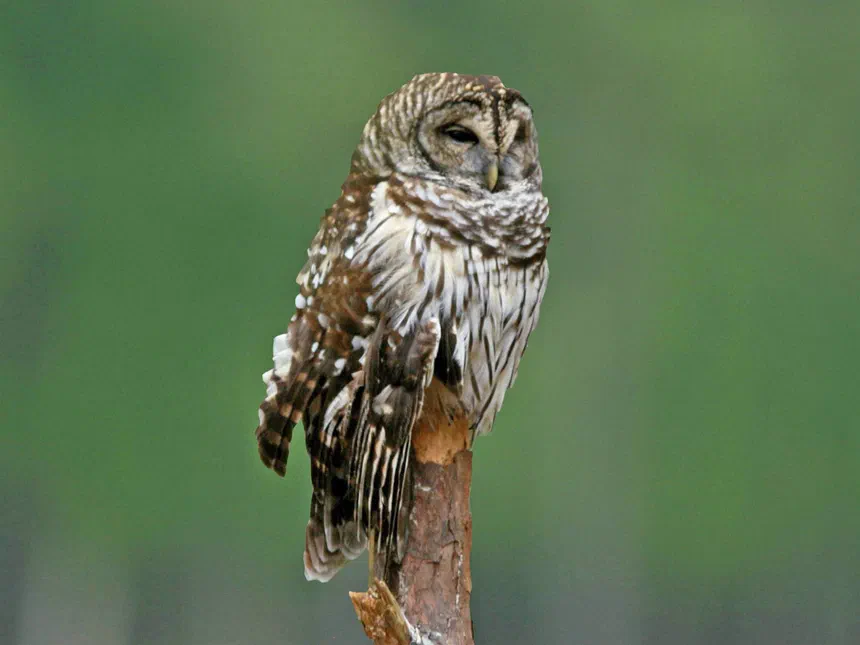
Image: Dick Daniels (http://carolinabirds.org/) — CC BY-SA 3.0 · source
What Is a Barred Owl?
The barred owl (Strix varia) is a large, round-headed owl native to the forests of North America. Named for the horizontal bars on its upper chest and the vertical streaks below, it is one of the continent’s most vocal owls, famous for a hooting call often rendered as “who cooks for you, who cooks for you all.” It belongs to the genus Strix, the wood owls, which lack the ear tufts seen in many other owl groups.
Appearance and Identification
Barred owls are stocky, medium-to-large owls with a smooth, rounded head and no ear tufts. Their plumage is mottled brown, gray, and white, with distinctive horizontal barring across the throat and upper breast giving way to bold vertical streaking on the belly. The facial disc is pale gray-brown, ringed by darker edging. Unlike most North American owls, adults have deep brown to nearly black eyes rather than yellow. The bill and feet are yellowish. Length ranges roughly from 16 to 25 inches, with wingspans commonly between 38 and 49 inches, and females tend to be somewhat larger and heavier than males.
Habitat and Range
This owl favors large tracts of mature, moist forest, including mixed hardwood and coniferous woodlands, wooded swamps, and forests along rivers and streams. Historically an eastern species, the barred owl has expanded steadily westward and northward over the past century, colonizing forests across the Pacific Northwest. Its range now stretches from the eastern United States and much of Canada into parts of the western states, and south into parts of Mexico. It generally avoids open country, preferring continuous canopy with plenty of large trees for roosting and nesting.
Diet
The barred owl is a versatile carnivore that hunts mainly at night but will also take prey around dawn and dusk. Small mammals such as mice, voles, squirrels, and rabbits form the core of its diet. It also captures birds, amphibians, reptiles, and large insects, and readily hunts along water for crayfish, frogs, and even fish. It typically hunts by perching quietly and watching or listening for movement, then dropping silently onto prey with its specialized soft-edged flight feathers that muffle sound.
Behavior
Largely nocturnal, barred owls are among the more likely owls to be heard calling during daylight, especially on cloudy days or during the breeding season. Their varied vocal repertoire includes the classic rhythmic hoot as well as cackles, caws, and gurgling notes exchanged between mates. They are generally non-migratory and defend a home territory year-round. Though usually reclusive, they can be curious and are sometimes seen roosting on exposed branches. Great horned owls are among their most significant natural predators.
Life Cycle and Reproduction
Barred owls form long-term pair bonds and often reuse nesting sites over successive years. They nest primarily in natural tree cavities but will also use abandoned nests built by hawks, crows, or squirrels, and readily accept nest boxes. The female typically lays two to four white eggs, which she incubates for roughly four weeks while the male brings food. Young owls hatch helpless and downy; they begin clambering out onto nearby branches at around four to five weeks, before they can fully fly, and remain dependent on their parents for several months. Wild birds commonly live around 8 to 10 years, though some individuals survive considerably longer.
Conservation Status
The barred owl is listed as Least Concern by the IUCN, with a large and generally stable or increasing population. Its westward expansion, however, has created serious conservation concern for the closely related and threatened northern spotted owl, which it outcompetes and sometimes hybridizes with. As a result, wildlife managers in parts of the Pacific Northwest have debated and undertaken controversial control measures to protect spotted owl populations.
Frequently Asked Questions
What does a barred owl sound like? Its best-known call is a series of hoots often described as “who cooks for you, who cooks for you all,” but it also produces a wide range of cackles, caws, and gurgles.
How can you tell a barred owl apart from other owls? Look for a round, tuftless head, brown-and-white barred and streaked plumage, and distinctive dark brown eyes, which set it apart from the yellow-eyed owls common across much of North America.
Are barred owls dangerous to people? They generally avoid humans, though nesting adults may occasionally swoop near people who venture too close to their young; they pose no real danger otherwise.
References
The conservation status and key facts in this profile are supported by these sources:
- Animal Diversity Web — Strix varia (Barred Owl) (accessed 2026-07-29)
- GBIF — Strix varia Barton, 1799 (accessed 2026-07-29)
- ITIS — Strix varia (Barred Owl) (accessed 2026-07-29)
Found an error, source problem, or image concern? Report this page.