Birds Guide
Barn Swallow
What Is a Barn Swallow? The barn swallow (Hirundo rustica) is a small, fast-flying songbird in the swallow family, Hirundinidae. It is among the most widespread and familiar swallows in the world, easily recognized by …
At a glance
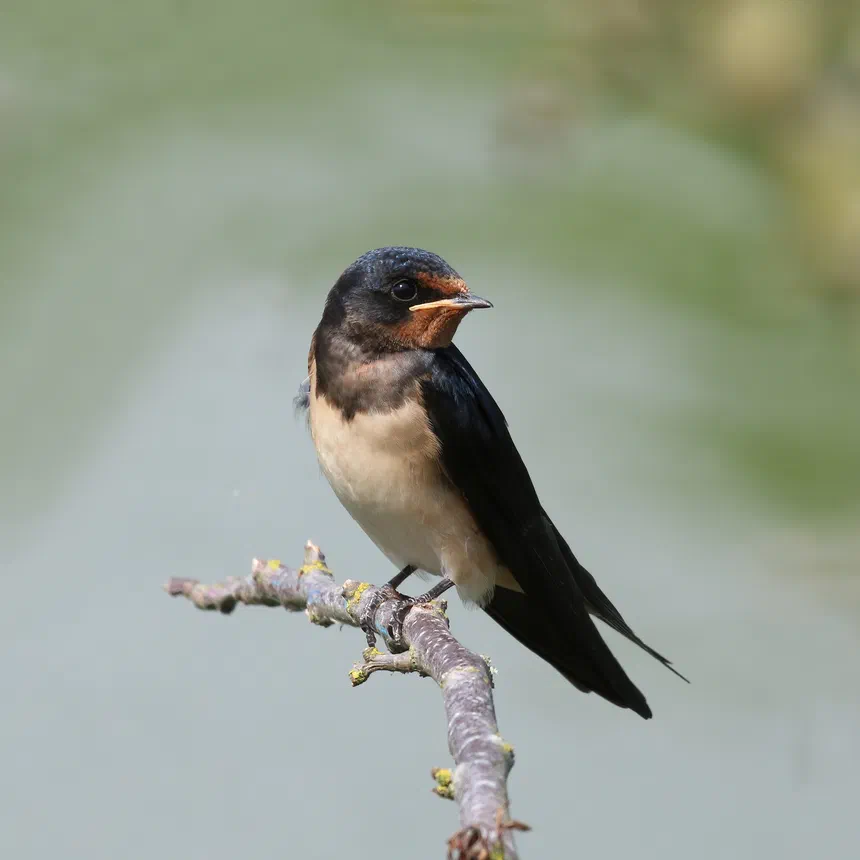
Image: Charles J. Sharp — CC BY-SA 4.0 · source
What Is a Barn Swallow?
The barn swallow (Hirundo rustica) is a small, fast-flying songbird in the swallow family, Hirundinidae. It is among the most widespread and familiar swallows in the world, easily recognized by its long, deeply forked tail and its habit of nesting on human-made structures. Few birds are so closely tied to farms, barns, and open landscapes across so much of the globe.
Appearance and Identification
Barn swallows are slender, streamlined birds built for agile flight. The upperparts are a glossy steel-blue, while the throat and forehead are a warm chestnut or rusty red. The underparts range from creamy white to a pale cinnamon-buff, depending on the population. The most distinctive feature is the long, deeply forked tail, whose outer feathers form trailing “streamers,” typically longer in males. In flight, small white spots are visible near the tips of the tail feathers. Males tend to be slightly more richly colored than females, and juveniles are duller with shorter tail streamers.
Habitat and Range
This is one of the most cosmopolitan of all land birds, breeding across North America, Europe, Asia, and parts of North Africa. It favors open habitats such as farmland, pastures, meadows, and marshes, often near water where flying insects are abundant. Barn swallows have a strong association with people and readily nest in barns, sheds, culverts, bridges, and porches. Populations in the Northern Hemisphere are highly migratory, wintering in Central and South America, sub-Saharan Africa, southern Asia, and Australia.
Diet
Barn swallows are almost exclusively insectivorous, catching their prey on the wing. Their diet is dominated by flying insects such as flies, beetles, wasps, bees, moths, and winged ants. They hunt with swift, graceful, low passes over fields, water, and pastures, often following livestock or farm machinery that flush insects into the air. During cold spells when flying insects are scarce, they may occasionally take berries or seeds, but aerial foraging remains their primary strategy.
Behavior
These birds are active and social, frequently seen swooping in loose flocks over open ground. They are strong, acrobatic fliers capable of sudden turns and dives as they pursue insects. Barn swallows drink and even bathe in flight, skimming low across the surface of ponds and rivers. Outside the breeding season they often gather in large communal roosts, sometimes numbering in the thousands, particularly in reed beds. Their cheerful, twittering song and sharp alarm calls are a familiar sound around rural buildings.
Life Cycle and Reproduction
Barn swallows build distinctive cup-shaped nests from mud pellets mixed with grass, lined with feathers, usually attached to a beam, wall, or ledge under cover. Pairs are often socially monogamous within a season, though extra-pair matings are common. A typical clutch contains around 3 to 6 eggs, which the female incubates for roughly two weeks. Both parents feed the nestlings, which fledge after about three weeks. In warmer regions, a pair may raise two broods in a single season. Young from an earlier brood sometimes help feed later chicks.
Conservation Status
The barn swallow is listed as Least Concern by the IUCN, reflecting its enormous global range and large overall population. Its close ties to human structures have allowed it to thrive alongside agriculture. Nonetheless, some regional populations have declined, likely due to changes in farming practices, loss of nesting sites through building modernization, pesticide use reducing insect prey, and climate-related shifts in migration timing. Maintaining traditional farm buildings and healthy insect populations benefits the species.
Frequently Asked Questions
Why do barn swallows have forked tails? The long, forked tail improves maneuverability, letting the birds make tight turns while chasing insects. Longer tail streamers in males also play a role in attracting mates.
Do barn swallows really nest inside barns? Yes. They readily build mud nests on beams and ledges inside barns and other structures, which is how they earned their name. This close association with people has helped them spread widely.
Where do barn swallows go in winter? Northern breeding birds are long-distance migrants, traveling to warmer regions such as Central and South America, sub-Saharan Africa, and southern Asia to find abundant flying insects.
References
The conservation status and key facts in this profile are supported by these sources:
- Animal Diversity Web — Hirundo rustica (Barn Swallow) (accessed 2026-07-29)
- GBIF — Hirundo rustica (Barn Swallow) (accessed 2026-07-29)
Found an error, source problem, or image concern? Report this page.