Birds Guide
Barn Owl
What Is a Barn Owl? The barn owl (Tyto alba) is a pale, long-winged nocturnal bird of prey known for its distinctive white, heart-shaped facial disc. It is one of the most widely distributed of all land birds, found on …
At a glance
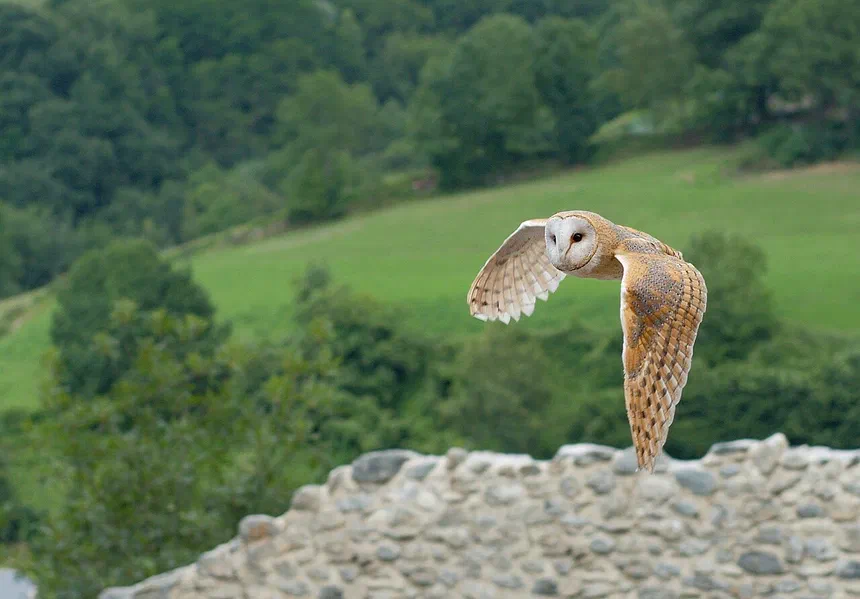
Image: Luc Viatour — CC BY-SA 3.0 · source
What Is a Barn Owl?
The barn owl (Tyto alba) is a pale, long-winged nocturnal bird of prey known for its distinctive white, heart-shaped facial disc. It is one of the most widely distributed of all land birds, found on every continent except Antarctica. Named for its habit of roosting and nesting in barns and other quiet structures, it plays a valuable role in controlling rodent populations.
Appearance and Identification
The barn owl is a medium-sized owl with a slender build and rounded head that lacks the ear tufts seen in many other owl species. Its upperparts are a soft golden-buff color speckled with gray, while the face, chest, and belly are usually pale to pure white. The heart-shaped facial disc frames dark eyes and helps funnel sound to the ears. In flight the owl appears ghostly, with long, broad wings and a slow, buoyant wingbeat that is nearly silent thanks to the comb-like fringes on its flight feathers. Females tend to be slightly larger and more heavily speckled than males, and populations from different regions vary in size and coloration.
Habitat and Range
Barn owls favor open and semi-open landscapes where they can hunt low over the ground. Typical habitats include grasslands, agricultural fields, marshes, savannas, forest clearings, and the edges of human settlements. They are cavity nesters that readily use tree hollows, cliff ledges, church towers, silos, and, as their name suggests, barns and other outbuildings. Their global range spans much of the Americas, Europe, Africa, southern Asia, and Australia, and numerous regional subspecies have been described. They are generally absent from very cold northern latitudes and the harshest deserts.
Diet
The barn owl is a specialized carnivore that feeds chiefly on small mammals. Voles, mice, rats, and shrews make up the bulk of its diet, though it also takes the occasional small bird, bat, frog, or large insect. Hunting mostly at night, the owl relies on exceptionally acute hearing to locate prey in darkness or under vegetation, then drops silently to seize it with its talons. A single owl may consume several small rodents each night, and a breeding pair with a nest full of young can catch large numbers over a season, making the species a natural ally to farmers.
Behavior
Barn owls are primarily nocturnal, becoming active around dusk and hunting through the night, though they may occasionally be seen at dawn or dusk. They are usually solitary or found in pairs and do not hoot like many owls; instead they produce an eerie, drawn-out screech along with hisses and bill-snapping sounds. Their asymmetrically placed ear openings allow them to pinpoint the exact location of prey by sound alone. Most barn owls are non-migratory and remain near their nesting sites year-round, defending a loose home range rather than a strict territory.
Life Cycle and Reproduction
Barn owls can breed at a young age and may raise one or two broods per year when food is plentiful. The female typically lays a clutch of around 4 to 7 white eggs, occasionally more, in a sheltered cavity with little or no added nesting material. She incubates the eggs for roughly a month while the male brings food. The chicks hatch at intervals, so a single nest often contains young of noticeably different sizes. Nestlings fledge at around 8 to 10 weeks of age and become independent soon after. Although wild barn owls often live only a few years, individuals in favorable conditions can survive considerably longer.
Conservation Status
Globally, the barn owl is listed as Least Concern by the IUCN because of its enormous range and large overall population. Even so, local populations can decline sharply due to loss of grassland and hedgerow habitat, intensive farming, rodenticide poisoning, and collisions with vehicles. Provision of nest boxes and the protection of open hunting habitat have helped stabilize or restore numbers in many areas, and the species is widely valued for the natural pest control it provides.
Frequently Asked Questions
Are barn owls dangerous to people? No. Barn owls are shy and pose no threat to humans. They are beneficial neighbors that help keep rodent numbers in check.
Why are barn owls so quiet in flight? Special comb-like fringes and a soft, velvety surface on their feathers muffle the sound of air moving over the wings, allowing them to approach prey almost silently.
Do barn owls really live in barns? Often, yes. They readily nest and roost in barns, silos, and other quiet structures, which offer sheltered cavities similar to the tree hollows and cliff ledges they use in the wild.