Birds Guide
Bar-Headed Goose
What Is a Bar-Headed Goose? The bar-headed goose (Anser indicus) is a medium-sized migratory goose of Central and South Asia, best known as one of the highest-flying birds in the world. It takes its name from the pair of …
At a glance
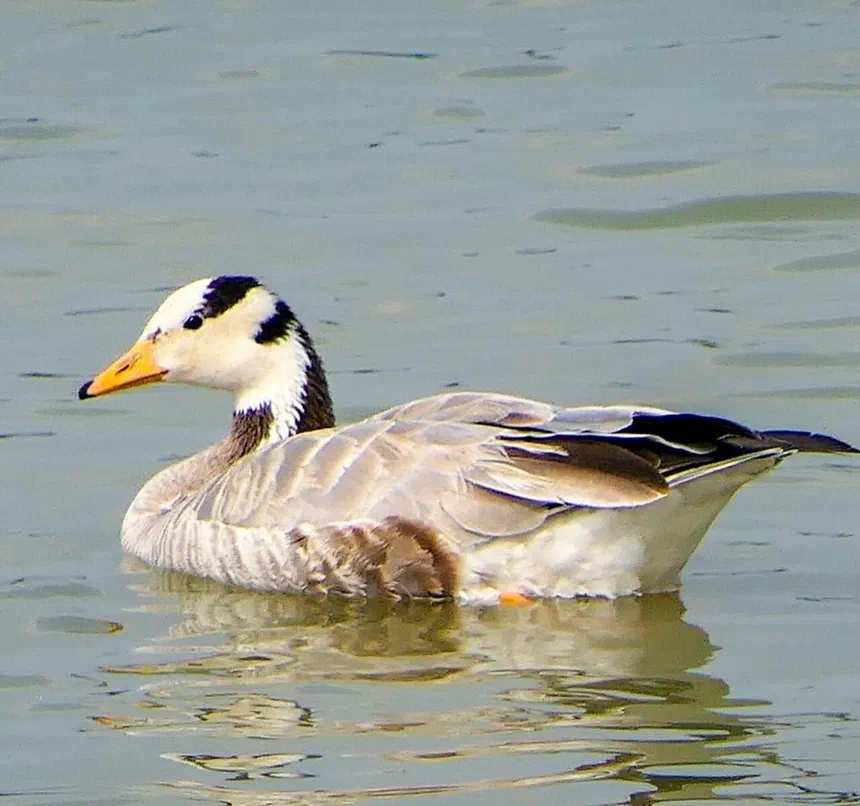
Image: Bijoyv — CC BY-SA 4.0 · source
What Is a Bar-Headed Goose?
The bar-headed goose (Anser indicus) is a medium-sized migratory goose of Central and South Asia, best known as one of the highest-flying birds in the world. It takes its name from the pair of dark brown bars that curve across the back of its otherwise white head. This species regularly crosses the Himalayas twice a year, an achievement that has made it a favorite subject of studies on how birds cope with thin, oxygen-poor air.
Appearance and Identification
The bar-headed goose is a fairly compact, pale grey goose that stands out from other geese thanks to its striking head pattern. Adults have a mostly white head and neck marked by two distinctive black or dark brown horizontal bars running across the crown and nape. The body is silvery grey above with fine, darker barring along the flanks, fading to whitish underparts. The bill and legs are a warm orange-yellow, and a pale stripe runs down each side of the neck. Both sexes look alike, though males average slightly larger. Adults typically measure about 28 to 30 inches from bill to tail, with a wingspan of roughly 55 to 63 inches and a weight commonly between 4 and 7 pounds. Juveniles are duller, lacking the crisp head bars until their first winter.
Habitat and Range
This goose breeds on high-altitude lakes, marshes, and river valleys across the plateaus of Central Asia, including parts of Mongolia, China, Kazakhstan, Kyrgyzstan, and the Tibetan Plateau. Breeding sites are often at elevations of 13,000 feet or higher. In autumn the birds migrate south to spend the winter in the lowlands of the Indian subcontinent, where they gather on lakes, reservoirs, floodplains, and farmland in India, Pakistan, Nepal, Bangladesh, and Myanmar. During migration they may fly directly over the Himalayan range, coping with extreme cold and low oxygen.
Diet
The bar-headed goose is essentially herbivorous. On its breeding grounds it grazes on grasses, sedges, and the shoots and roots of aquatic plants. On its wintering grounds it frequently feeds in agricultural areas, taking waste grain, barley, wheat, rice, and green crops, sometimes in large foraging flocks. Like many geese, it feeds by grazing on land as well as dabbling in shallow water, and it will drink and rest on open water between feeding bouts.
Behavior
Bar-headed geese are highly social and gregarious outside the breeding season, forming flocks that can number in the thousands at favored wintering lakes. They are strong, fast fliers and are famous for reaching remarkable altitudes during migration, with reliable records of birds flying at heights where the air holds only a fraction of the oxygen available at sea level. Physiological adaptations, including efficient lungs and hemoglobin that binds oxygen more readily, help them power through this thin air. Their calls are typical honking goose notes, softer and more nasal than those of many larger geese.
Life Cycle and Reproduction
Bar-headed geese usually nest in loose colonies near high-altitude water, often on the ground on islands or lake margins, and sometimes on cliffs or in old trees. Pairs are generally monogamous and may remain together across seasons. The female lays a clutch of roughly three to six eggs and incubates them for about four weeks while the male stands guard nearby. The downy goslings can walk, swim, and feed themselves soon after hatching, though they stay with their parents through their first migration. Young birds reach breeding age at around two to three years.
Conservation Status
The bar-headed goose is currently listed as Least Concern by the IUCN, reflecting a large range and a population that is stable or increasing in many areas. It benefits from its willingness to use farmland and reservoirs in winter. Localized threats include wetland drainage, disturbance at roosting sites, hunting in some regions, and occasional outbreaks of avian influenza, which have affected concentrated flocks in the past. Protection of key wetlands along its migration route remains important for its long-term security.
Frequently Asked Questions
How high can a bar-headed goose fly? These geese routinely cross the Himalayas and have been recorded flying at altitudes above 20,000 feet, making them among the highest-flying birds known.
What do the bars on its head mean? The two dark bars are simply the species’ natural head markings, useful for identification; they are not related to age or sex once the bird is mature.
Are bar-headed geese endangered? No. They are classified as Least Concern, though protecting the wetlands they depend on during migration and winter still matters for keeping their numbers healthy.
References
The conservation status and key facts in this profile are supported by these sources:
- GBIF — Anser indicus (Bar-headed Goose) (accessed 2026-07-29)
- Animal Diversity Web — Anser indicus (accessed 2026-07-29)
- ITIS — Anser indicus (accessed 2026-07-29)
Found an error, source problem, or image concern? Report this page.