Birds Guide
Baltimore Oriole
What Is a Baltimore Oriole? The Baltimore oriole (Icterus galbula) is a brightly colored songbird in the blackbird family, Icteridae, and a familiar summer visitor across eastern and central North America. Named for the …
At a glance
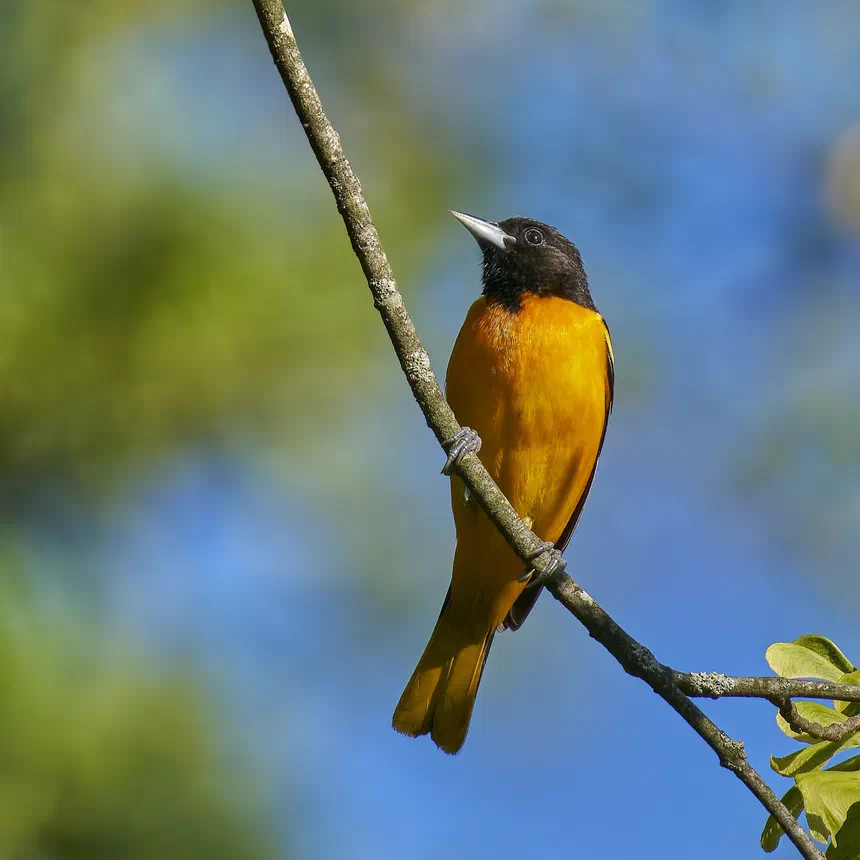
Image: Paul Danese — CC BY-SA 4.0 · source
What Is a Baltimore Oriole?
The Baltimore oriole (Icterus galbula) is a brightly colored songbird in the blackbird family, Icteridae, and a familiar summer visitor across eastern and central North America. Named for the orange and black colors of Lord Baltimore’s coat of arms, it is the official state bird of Maryland and a favorite of backyard birdwatchers.
Appearance and Identification
The Baltimore oriole is a slender, medium-sized songbird with a straight, sharply pointed bill. Adult males are unmistakable, with a solid black head, back, wings, and throat contrasting against a brilliant flame-orange breast, belly, rump, and shoulders. Their black wings show a single white bar and white feather edges. Females and immature birds are more subdued, ranging from yellowish-orange to golden below with grayish-brown upperparts and two white wing bars. Adults measure roughly 6.7 to 7.5 inches (17 to 19 cm) long with a wingspan of about 9 to 12 inches (23 to 30 cm). Males typically reach their full vivid plumage in their second year.
Habitat and Range
Baltimore orioles breed across much of eastern and central North America, from the southern reaches of Canada through the central and eastern United States. They favor open deciduous woodlands, forest edges, riverside groves, orchards, leafy suburbs, and parks, generally avoiding dense, unbroken forest. Rather than staying inside the woods, they prefer tall shade trees such as elms, cottonwoods, and maples near open ground. As long-distance migrants, most orioles leave in late summer and early fall to winter in Florida, the Caribbean, Mexico, and Central America, returning north the following spring.
Diet
The Baltimore oriole is an omnivore with a varied, seasonal diet. In spring and summer it feeds heavily on insects and other invertebrates, including caterpillars, beetles, grasshoppers, and spiders, which provide vital protein for growing young. The species is especially fond of ripe and even overripe fruit, seeking out berries, cherries, mulberries, and similar soft fruits. Orioles also drink nectar and are well known for visiting flowers and feeders stocked with orange halves, grape jelly, or sugar water. When feeding on fruit, they often use a behavior called “gaping,” stabbing the closed bill into the food and then opening it to create a juice-filled well they can lap up.
Behavior
Baltimore orioles are agile, active birds that forage high in the canopy, often hanging upside down to reach insects and fruit at the tips of branches. Males are known for their rich, flute-like whistling song, a series of clear, variable notes delivered from prominent perches, while both sexes give sharp chatter calls when alarmed. Though generally solitary or in pairs during the breeding season, they become more social on their wintering grounds. Their bright colors make them conspicuous, yet they can be surprisingly hard to spot as they move among sunlit leaves.
Life Cycle and Reproduction
Baltimore orioles are seasonally monogamous, forming pairs after males return to the breeding grounds and display to females. The female is a skilled weaver, constructing a distinctive hanging, pouch-like nest woven from plant fibers, grasses, and other materials, typically suspended from the drooping outer branches of a tall tree. She lays about three to seven pale, blotched eggs and incubates them for roughly two weeks. The nestlings are fed by both parents and fledge about two weeks after hatching. Pairs usually raise a single brood each year. In the wild, many orioles live several years, with some individuals recorded living beyond a decade.
Conservation Status
The Baltimore oriole is listed as Least Concern by the IUCN, reflecting its wide range and large overall population. Nonetheless, some surveys have noted long-term declines in parts of its range, linked to loss of habitat on both breeding and wintering grounds, the historical decline of American elms, and pesticide use that reduces insect prey. The species benefits from mature shade trees, native fruiting plants, and reduced pesticide use, and it readily visits well-stocked backyard feeders.
Frequently Asked Questions
How can I attract Baltimore orioles to my yard? Orioles are drawn to orange halves, grape jelly, and nectar feeders, as well as native fruiting shrubs and trees. Setting out these foods in spring, when the birds first arrive, gives you the best chance of a visit.
Why is it called a Baltimore oriole? The bird’s orange and black plumage matches the colors on the coat of arms of Lord Baltimore, the English noble family associated with the founding of Maryland, which later named the species after them.
Are Baltimore orioles related to Old World orioles? No. Despite the shared name, Baltimore orioles belong to the New World blackbird family, Icteridae, and are not closely related to the true orioles of Europe, Asia, and Africa, which simply share a similar look and name.
References
The conservation status and key facts in this profile are supported by these sources:
- Animal Diversity Web — Icterus galbula (Baltimore oriole) (accessed 2026-07-29)
- GBIF — Icterus galbula (Linnaeus, 1758) (accessed 2026-07-29)
- ITIS — Icterus galbula (Baltimore Oriole), TSN 179083 (accessed 2026-07-29)
Found an error, source problem, or image concern? Report this page.