Birds Guide
Pied Avocet
What Is a Pied Avocet? The pied avocet (Recurvirostra avosetta) is a large, elegant wading bird known for its bold black-and-white plumage and slender, upturned bill. It belongs to the family Recurvirostridae, a small …
At a glance
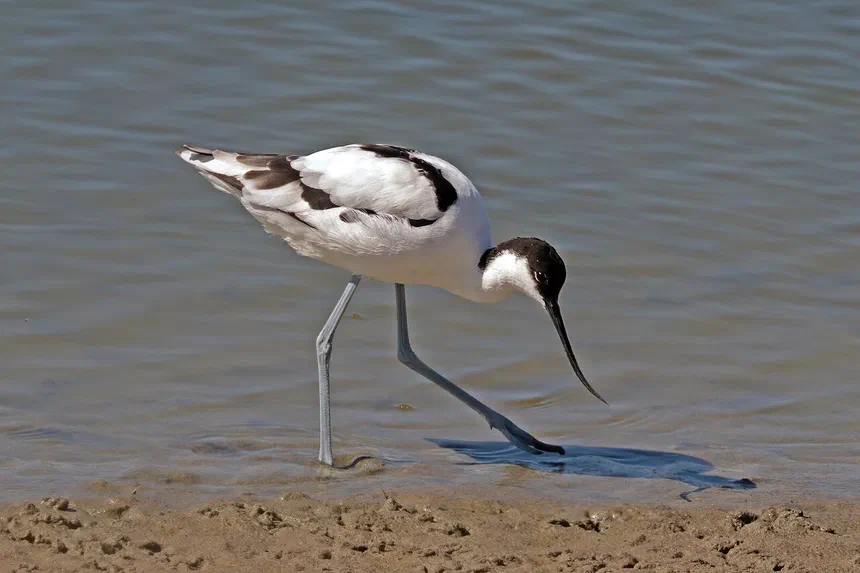
Image: Charles J. Sharp — CC BY-SA 4.0 · source
What Is a Pied Avocet?
The pied avocet (Recurvirostra avosetta) is a large, elegant wading bird known for its bold black-and-white plumage and slender, upturned bill. It belongs to the family Recurvirostridae, a small group of long-legged shorebirds, and is a familiar sight on the shallow wetlands and coastal lagoons of Europe, Africa, and Asia. Graceful and highly distinctive, it has become an emblem of wetland conservation.
Appearance and Identification
The pied avocet is unmistakable among shorebirds. Its plumage is crisp white marked with black on the crown, nape, and in bold patches across the wings and back. The most striking feature is the long, thin bill, which curves sharply upward, unlike almost any other bird. Long, bluish-grey legs allow it to wade through deeper water, and its feet are partially webbed, aiding both swimming and walking on soft mud. Adults typically measure around 16.5 to 17.5 inches (42 to 45 cm) in length, with a wingspan of roughly 30 to 31 inches (77 to 80 cm). Males and females look similar, though females often have a slightly shorter and more strongly curved bill. Juveniles resemble adults but show duller, greyish-brown tones where adults are black.
Habitat and Range
This species favors open, shallow wetlands with brackish or saline water, including coastal lagoons, estuaries, salt pans, mudflats, and shallow inland lakes. Such habitats offer the muddy, invertebrate-rich shallows on which the bird depends. Pied avocets breed across parts of temperate Europe and Central Asia and winter around the Mediterranean, in Africa, and in southern Asia. Some populations are migratory, moving south for the winter, while those in milder regions may remain year-round. Historically, wetland drainage caused sharp declines in some countries, but habitat restoration has helped populations recover in several areas.
Diet
The pied avocet is a carnivore that feeds mainly on small aquatic invertebrates such as crustaceans, insects, worms, and mollusks. It has a distinctive feeding method: sweeping its upturned bill from side to side through shallow water and soft mud, snapping up tiny prey it detects by touch. This scything motion is especially effective in murky water where visibility is poor. Avocets may also feed by pecking at prey they see and will sometimes swim in deeper water, upending like ducks to reach food below the surface.
Behavior
Pied avocets are social birds that often gather in flocks, particularly outside the breeding season and at roosting and feeding sites. They are notably bold in defense of their nests and young, and will loudly mob and dive at intruders, including much larger birds and mammals. During the breeding season they may perform distraction displays to lure predators away from eggs or chicks. Their calls are a clear, fluting “kluit” or “kloop,” often heard when a colony is disturbed.
Life Cycle and Reproduction
Pied avocets typically breed in loose colonies on open ground near water, often on islands or bare mudbanks that offer some protection from predators. The nest is usually a simple scrape on the ground, sometimes lined with a little vegetation. Females generally lay around three to four eggs, which both parents take turns incubating for roughly three to four weeks. The chicks are precocial, meaning they hatch well-developed, covered in down and able to leave the nest and feed themselves within a day or two, though the parents continue to guard and guide them. Young avocets fledge at around five to six weeks of age. In the wild, individuals may live for about 10 to 15 years.
Conservation Status
The pied avocet is currently listed as Least Concern by the IUCN, reflecting a large range and a generally stable or increasing overall population. It nonetheless remains sensitive to the loss and degradation of wetland habitats, disturbance at breeding colonies, and changes in water management. The species is protected under various national and international agreements, and its recovery in places like the United Kingdom, where it returned as a breeding bird in the 20th century, is often cited as a conservation success story.
Frequently Asked Questions
Why does the avocet have an upturned bill? The upward curve suits its side-to-side sweeping feeding style, letting the bird skim tiny invertebrates from shallow water and soft mud by touch.
Are pied avocets endangered? No. They are listed as Least Concern overall, though local populations still depend on healthy, well-managed wetlands.
Can avocets swim? Yes. Their partially webbed feet allow them to swim in deeper water and even upend like ducks to reach food beneath the surface.
References
The conservation status and key facts in this profile are supported by these sources:
- Animal Diversity Web — Recurvirostra avosetta (Pied Avocet) (accessed 2026-07-29)
- GBIF — Recurvirostra avosetta Linnaeus, 1758 (accessed 2026-07-29)
Found an error, source problem, or image concern? Report this page.