Birds Guide
Australian Pelican
What Is a Australian Pelican? The Australian pelican (Pelecanus conspicillatus) is a large waterbird native to Australia and neighboring regions. It is best known for its enormous bill and throat pouch, which is among …
At a glance
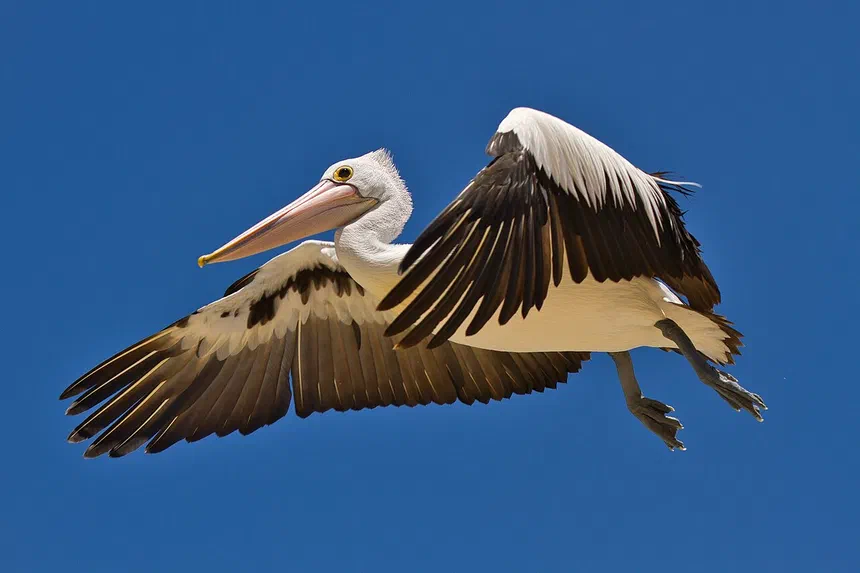
Image: Andrew Mercer (www.baldwhiteguy.co.nz) — CC BY-SA 4.0 · source
What Is a Australian Pelican?
The Australian pelican (Pelecanus conspicillatus) is a large waterbird native to Australia and neighboring regions. It is best known for its enormous bill and throat pouch, which is among the longest of any bird. This species is a familiar sight on lakes, rivers, and coastlines across much of the continent.
Appearance and Identification
The Australian pelican has predominantly white plumage contrasted by black feathers along the wings and tail, which are especially striking in flight. Its most distinctive feature is a long, pale pinkish bill measuring roughly 16-19 in (40-50 cm), beneath which hangs an expandable throat pouch. During courtship, the bill and pouch can flush with vivid pink, blue, and orange coloring. Adults typically measure about 5.2-6.2 ft (1.6-1.9 m) in length with a broad wingspan often exceeding 8 ft (2.5 m), allowing for efficient soaring flight. Males and females look similar, though males tend to be slightly larger with a longer bill.
Habitat and Range
This pelican is widely distributed across Australia and also occurs in New Guinea, parts of Indonesia, and occasionally as a vagrant on other Pacific islands. It favors large open expanses of water, including freshwater and saltwater lakes, rivers, estuaries, coastal lagoons, and wetlands. The species is highly nomadic and will travel great distances in response to rainfall and water availability. When inland lakes fill after heavy rains, pelicans may gather in the thousands, even in normally arid desert regions such as Lake Eyre.
Diet
The Australian pelican is a carnivore that feeds chiefly on fish. It also takes crustaceans, tadpoles, small turtles, and other aquatic animals, and will occasionally eat scraps or scavenge. Feeding often occurs cooperatively, with groups of pelicans herding fish into shallow water where they are easier to catch. The bird scoops prey and water into its expandable pouch, then drains the water before swallowing. The pouch can hold several quarts of water and functions much like a net.
Behavior
Australian pelicans are social birds that are frequently seen resting, feeding, and roosting in groups. They are strong fliers and use rising columns of warm air, or thermals, to soar for long periods with minimal effort, sometimes reaching considerable altitudes. On the water they float buoyantly and swim using their webbed feet. Though large and somewhat ungainly on land, they are graceful in the air and comfortable on the water. They are generally not aggressive toward people and often become accustomed to human presence in parks and along waterfronts.
Life Cycle and Reproduction
Breeding is closely tied to favorable conditions and can occur at almost any time of year when water and food are abundant. Pelicans nest in colonies, often on islands or secluded shorelines, where the female typically lays one to three eggs in a shallow scrape lined with vegetation and feathers. Both parents share incubation, which lasts around 32-35 days. Newly hatched chicks are naked and helpless, relying entirely on their parents for food, which is regurgitated from the pouch. Young pelicans gather in groups called creches as they grow and generally fledge after roughly three months.
Conservation Status
The Australian pelican is listed as Least Concern by the IUCN, reflecting its wide range and generally stable population. The species benefits from its ability to move across vast distances to exploit temporary water sources. Localized threats include habitat degradation, water management that alters natural flooding cycles, entanglement in fishing line, and disturbance at breeding colonies. Overall, however, the species remains common and widespread.
Frequently Asked Questions
How big is an Australian pelican’s bill? The bill is one of the longest of any bird, typically measuring about 16-19 in (40-50 cm), with an expandable throat pouch beneath it.
What does the throat pouch do? The pouch acts like a net to scoop up fish and water. The bird drains the water out of the sides of its bill before swallowing its catch.
Where can Australian pelicans be found? They occur across most of Australia, as well as New Guinea and nearby islands, wherever there are suitable lakes, rivers, estuaries, and coastal wetlands.
References
The conservation status and key facts in this profile are supported by these sources:
- Animal Diversity Web — Pelecanus conspicillatus (accessed 2026-07-29)
- ITIS — Pelecanus conspicillatus (TSN 174691) (accessed 2026-07-29)
Found an error, source problem, or image concern? Report this page.