Birds Guide
Australian Magpie
What Is a Australian Magpie? The Australian magpie (Gymnorhina tibicen) is a medium-sized black-and-white songbird native to Australia and parts of southern New Guinea. Despite its name, it is not closely related to the …
At a glance
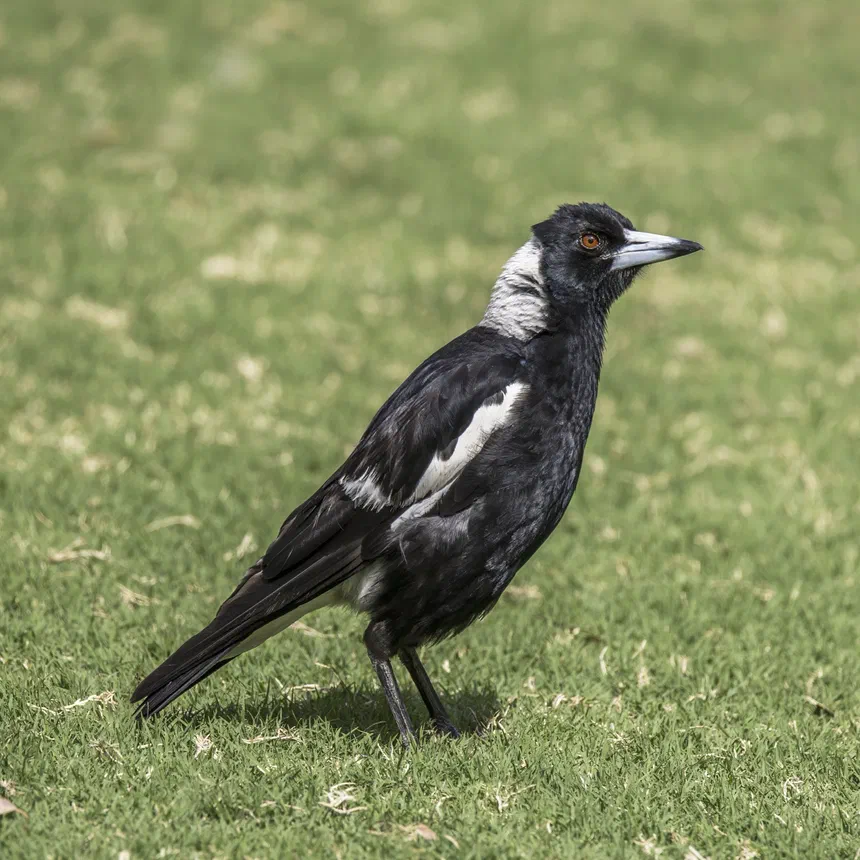
Image: Charles J. Sharp — CC BY-SA 4.0 · source
What Is a Australian Magpie?
The Australian magpie (Gymnorhina tibicen) is a medium-sized black-and-white songbird native to Australia and parts of southern New Guinea. Despite its name, it is not closely related to the European magpies of the crow family; instead it belongs to the family Artamidae, alongside the butcherbirds and currawongs. It is one of the continent’s most familiar and widely studied birds, known for its rich, caroling song and its confident presence in towns and gardens.
Appearance and Identification
Adults have striking black-and-white plumage, though the exact pattern varies among the several recognized subspecies. All have a glossy black head, underparts, and wings offset by white or grayish-white markings across the nape, shoulders, and rump. The stout, wedge-shaped bill is pale bluish-white with a darker tip, and the eyes are a deep reddish-brown. Males typically show crisp white patches on the back of the neck, while females often have a grayer, more mottled nape. Juveniles are duller and grayer overall. Body length ranges from roughly 14 to 17 inches (37 to 43 cm), with long legs suited to walking and foraging on the ground.
Habitat and Range
The species occurs across most of mainland Australia, in Tasmania, and in a small area of southern New Guinea. It has also been introduced to New Zealand. Australian magpies favor open country with scattered trees, including grassland, savanna woodland, farmland, playing fields, golf courses, and suburban parks and gardens. They generally avoid dense forest and true desert. The combination of open ground for foraging and tall trees for roosting and nesting makes human-modified landscapes especially attractive, and the birds have adapted readily to life alongside people.
Diet
Australian magpies are ground-foraging omnivores. The bulk of their diet consists of invertebrates such as beetles, larvae, worms, spiders, and grasshoppers, which they locate by walking across open ground and probing the soil, sometimes detecting prey by sound. They also take seeds, grain, small lizards, frogs, and the occasional nestling or small mammal. In settled areas they will accept scraps and food offered by people. Their varied, opportunistic diet is one reason they thrive in so many environments.
Behavior
These birds are highly social and often live year-round in territorial groups that cooperatively defend a patch of ground. They are notably intelligent, with a reputation for problem-solving and for recognizing individual human faces. Their song is a complex, melodious warble or carol, frequently delivered by several birds together, and it ranks among the most distinctive sounds of the Australian bush. During the spring breeding season, some individuals, usually males, become territorial and may swoop at people or animals that pass close to a nest, a behavior that is temporary and tied to protecting their young.
Life Cycle and Reproduction
Breeding generally takes place from late winter into spring, though timing varies with region. The female builds a bowl-shaped nest of sticks lined with softer material, usually high in a tree, and lays a clutch of about two to five eggs. She alone incubates them for roughly three weeks. The chicks are fed by the parents, and in group-living populations older offspring may help provision the young. Fledglings depend on adults for several weeks after leaving the nest. Australian magpies are relatively long-lived, with many wild birds reaching 15 to 25 years of age.
Conservation Status
The Australian magpie is listed as Least Concern by the IUCN. It is abundant and widespread, and its populations are considered stable. The species has benefited from the spread of open, grassy habitats created by agriculture and urban development, and it faces no significant range-wide threats. Localized management sometimes occurs where swooping birds come into conflict with people during the breeding season, but this has no bearing on the overall health of the population.
Frequently Asked Questions
Are Australian magpies related to European magpies? No. Despite the shared name and similar coloring, the Australian magpie belongs to the family Artamidae, while European magpies are members of the crow family, Corvidae. The resemblance is a case of convergent appearance rather than close kinship.
Why do magpies swoop at people? Swooping is a seasonal, defensive behavior shown by some birds, usually males, guarding a nest during the spring breeding season. It is aimed at perceived threats near the nest and stops once the chicks have fledged.
Can Australian magpies recognize individual people? Studies suggest they can. These birds are highly intelligent and appear able to distinguish and remember individual human faces, which may influence how they respond to particular people in their territory.
References
The conservation status and key facts in this profile are supported by these sources:
- Animal Diversity Web — Gymnorhina tibicen (accessed 2026-07-29)
- GBIF — Gymnorhina tibicen (Latham, 1802) (accessed 2026-07-29)
Found an error, source problem, or image concern? Report this page.