Birds Guide
Atlantic Puffin
What Is a Atlantic Puffin? The Atlantic puffin (Fratercula arctica) is a small, stocky seabird of the auk family that spends most of its life on the open ocean and comes ashore only to breed. It is instantly recognizable …
At a glance
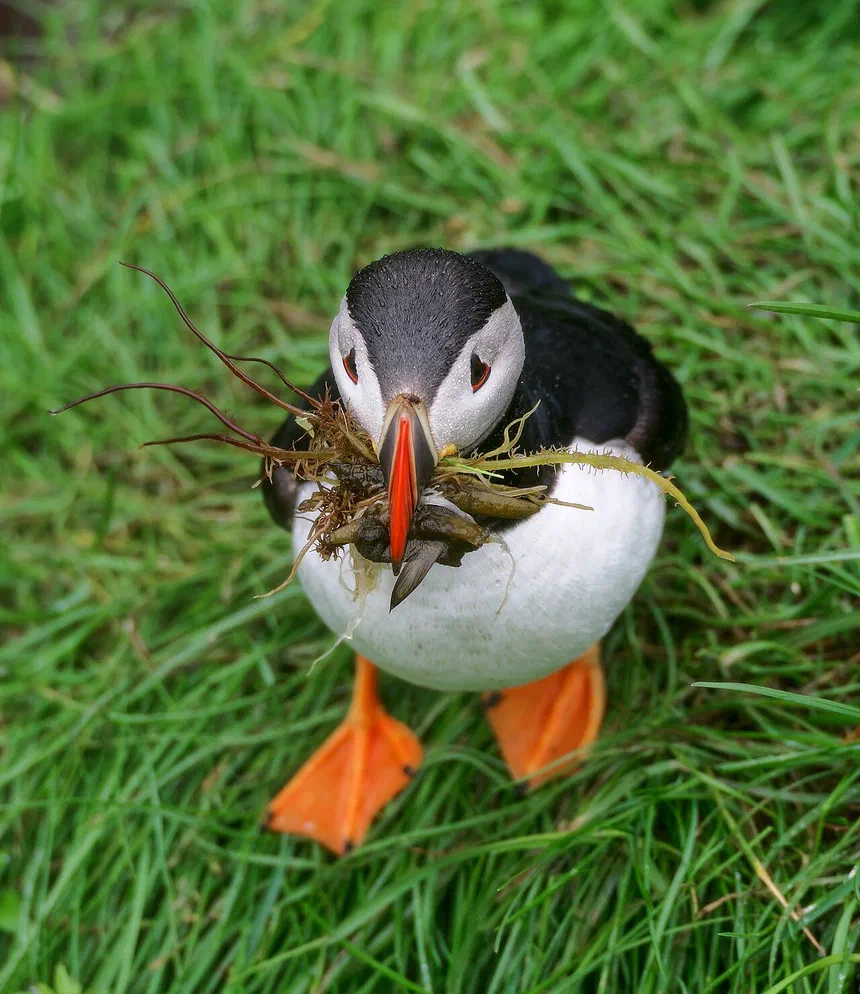
What Is a Atlantic Puffin?
The Atlantic puffin (Fratercula arctica) is a small, stocky seabird of the auk family that spends most of its life on the open ocean and comes ashore only to breed. It is instantly recognizable by its clownlike face and brightly colored triangular bill, which have earned it nicknames such as “sea parrot.” A superb swimmer and diver, it is far more at home underwater than in the air.
Appearance and Identification
Atlantic puffins have a compact body with black upperparts, a black collar, and clean white underparts. The face is pale grey to white, set off by dark eyes rimmed with red and small fleshy ornaments. During the breeding season the large, laterally flattened bill becomes vividly banded in red, orange, and blue-grey, and the legs and webbed feet turn bright orange. After breeding, the outer bill plates are shed, leaving a smaller, duller bill, and the face darkens. Males and females look alike, though males average slightly larger. Adults stand only about 8 inches (20 cm) tall, making them smaller than many people expect.
Habitat and Range
The species is found across the cold, productive waters of the North Atlantic and into the Arctic. Breeding colonies occur along coasts and on offshore islands from northeastern North America (including Newfoundland and Maine) across Greenland and Iceland to the British Isles, Scandinavia, and the Barents Sea. Iceland hosts a large share of the world population. Puffins nest on grassy slopes and clifftops where soft soil allows them to dig burrows. Outside the breeding season they disperse widely across the open ocean, often far from land.
Diet
Atlantic puffins are carnivores that feed almost entirely on small fish, especially sand eels, along with herring, sprat, and capelin. They also take some crustaceans and other marine invertebrates. Puffins hunt by pursuit diving, using their wings to “fly” underwater and their feet to steer, typically reaching depths of tens of feet. A hallmark of the species is its ability to hold many small fish crosswise in its bill at once, thanks to backward-facing spines on the tongue and palate, allowing it to carry a full load back to its chick.
Behavior
Puffins are highly social during the breeding season, gathering in dense, noisy colonies. In the air they beat their small wings rapidly, up to several hundred times per minute, producing a fast, whirring flight. On land they walk upright with a waddling gait. They are generally quiet at sea but produce low, growling calls from within their burrows. When not breeding, puffins are solitary or loosely scattered, riding the swells and diving for food across the open Atlantic.
Life Cycle and Reproduction
Atlantic puffins are long-lived and slow to mature, usually first breeding at around four to five years of age. They form strong, often lifelong pair bonds and return to the same colony and burrow year after year. The pair digs or reuses a burrow in soft ground, where the female lays a single egg. Both parents share incubation over roughly six weeks and then feed the chick, known as a puffling, in the burrow. After about five to seven weeks the young puffin leaves at night and heads out to sea alone, remaining at sea for several years before returning to breed.
Conservation Status
The Atlantic puffin is currently listed as Vulnerable on the IUCN Red List. Although the global population remains large, numbers have declined in parts of the range, particularly in Iceland and Norway. Key threats include shortages of prey fish linked to overfishing and warming seas, predation and disturbance at colonies by introduced mammals, marine pollution, and entanglement in fishing gear. Protecting breeding islands and maintaining healthy forage-fish stocks are central to the bird’s long-term survival.
Frequently Asked Questions
Why is the puffin’s bill so colorful? The bright bill is a breeding ornament used in courtship and territorial display. Its vivid plates are shed after the breeding season, leaving a smaller, plainer bill.
How do puffins catch and carry so many fish at once? They dive and swim after fish underwater, and backward-pointing spines inside the bill let them grip several small fish crosswise while continuing to hunt.
Are Atlantic puffins endangered? They are not classed as endangered but are listed as Vulnerable, meaning populations face real pressures from food shortages, climate change, and threats at their breeding colonies.
References
The conservation status and key facts in this profile are supported by these sources:
- Animal Diversity Web — Fratercula arctica (accessed 2026-07-29)
- GBIF — Fratercula arctica (Linnaeus, 1758) (accessed 2026-07-29)
- ITIS — Fratercula arctica (TSN 177025) (accessed 2026-07-29)
Found an error, source problem, or image concern? Report this page.